Rational Emotive Behavior Therapy Over Time
ISBN: 978-1-4338-0813-5Streaming options
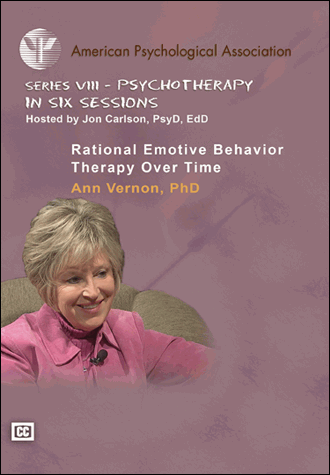
In Rational Emotive Behavior Therapy Over Time, Ann Vernon demonstrates this influential approach, which seeks to help people change self-defeating thoughts so they can feel and behave in more effective ways.
Rational emotive behavior therapy (REBT), developed by Albert Ellis in the 1950s, was the first of the main cognitive–behavioral therapies. REBT centers on the theory that people naturally cope with the stressors of life by adjusting their cognitive, emotional, and behavioral reactions. It posits that people have a tendency toward irrational thinking—creating absolute beliefs for themselves such as "I must always be liked" and "I can't stand it when others don't treat me exactly as I think I must be treated."
Such absolutist thinking is classified as irrational, as these demands are impossible to fulfill, and they in turn create habitually negative thoughts, feelings, and behaviors. REBT therapists focus on disputing irrational thoughts by showing how they increase a client's level of disturbance. Therapists then provide ways for the client to reduce disturbance through functional, logical, and empirical disputes and by teaching methods that clients use to help themselves become less irrational and more effective in how they think, feel, and act.
In this series of six sessions, Dr. Vernon works with a woman in her 20s who is struggling with anxiety related to leaving home, anger at her stepfather, and her parents' divorce many years ago. Consistent with REBT's present-focus, Dr. Vernon helps her client to recognize that she cannot change the past and, instead, helps her to deal more effectively with her present anger and anxiety. Dr. Vernon uses functional, logical, empirical, and philosophical disputes, as well as weekly homework assignments, to help her client decrease her anger and lessen the intensity of her anxiety.
Rational emotive behavior therapy (REBT) postulates that a person's perceptions of events, rather than the events themselves, create unhappiness and disturbance. In general, people have a tendency to think irrationally about how their lives should be and how the people around them should behave. For example, a common thought is "I must always do my job perfectly, and if I don't, I am a total failure." This type of thought, referred to as "absolutist thinking," is obviously not realistic, as no one can be perfect.
Furthermore, this type of thinking equates self-worth with performance, which is irrational. Irrational thinking leads to unnecessary disturbances in thoughts, feelings, and behaviors, as people try to live up to unrealistic expectations for themselves, others, and the world. In REBT, the therapist teaches the client to dispute their irrational beliefs in order to increase more moderate and less disturbing feelings and behave in a less self-defeating manner.
This theory is based on a self-help philosophy, in that the therapist takes an active role in teaching clients the A-B-C model of disturbance, helping them see how the activating event (A) does not result in emotional and behavioral disturbance (C) because if that were the case, then everyone whose parent dies, for example, would feel the same degree of grief.
In reality, the REBT therapist helps the client see that the grief reaction would vary in intensity based on what the client was thinking; if he or she were thinking that it was the end of the world that the parent died, the feeling would be much more intense than if the client realized that death is part of the human life cycle and life does go on, even if this is a difficult event.
As the therapist helps the client identify irrational, absolutistic beliefs and replace them with more rational ones through the disputational process, the client eventually is able to think more sensibly, feel less intense negative emotions, and behave in more self-enhancing ways. The therapist also employs a variety of cognitive, emotive, and behavioral interventions throughout the sessions and assigns homework assignments that help the client continue to learn the theory by practicing it between sessions.
Ann Vernon, PhD, is professor emerita, the University of Northern Iowa in Cedar Falls, where she served as professor and coordinator of the school and mental health counseling for many years.
Dr. Vernon is the vice president of the Albert Ellis Board of Trustees and a member of the International Training Standards and Review Committee that establishes standards for rational emotive behavior therapy (REBT) training centers throughout the world.
She has written many books, chapters, and journal articles on applications of REBT, including her latest book, What Works When with Children and Adolescents: A Handbook of Individual Counseling Techniques, which contains more than 100 creative approaches to employ for various internalizing and externalizing problems. In fact, Dr. Vernon is best known for her pioneering work focusing on REBT with children and adolescents and is considered a leading expert in this field.
She regularly presents workshops throughout the United States, Canada, South America, Europe, and Australia on REBT as well as on other topics. She has held numerous professional leadership positions and has been the recipient of many awards, including recently being selected as an American Counseling Association (ACA) Fellow.
How to use the Theories of Psychotherapy Series® in combination with APA Videos
- Dryden, W. (2002). (Ed.). Idiosyncratic rational emotive behavior therapy. Ross-on-Wye, England: PCCS Books.
- Dryden, W., DiGiuseppe, R., & Neenan, M. (2003). A primer on rational emotive behavior therapy (2nd ed.). Champaign, IL: Research Press.
- Dryden, W., & Branch, R. (2008). The fundamentals of rational emotive behavior therapy (2nd ed.). West Susses, England: Wiley.
- Ellis, A. (2001). Overcoming destructive beliefs, feelings, and behaviors. New York, NY: Prometheus Books.
- Ellis, A. (2002). Overcoming resistance: A rational emotive behavior therapy integrated approach (2nd ed.). New York, NY: Birch Lane Press.
- Ellis, A. (2004). Rational emotive behavior therapy: It works for me—it can work for you. New York, NY: Prometheus Books.
- Ellis, A., & MacClaren, C. (1998). Rational emotive behavior therapy: A therapist's guide. Atascadero, CA: Impact Publishers.
- Neenan, M., & Dryden, W. (1999). Rational emotive behaviour therapy: Advances in theory and practice London, England: Whurr.
APA Videos
- Cognitive–Behavioral Therapy for Clients With Anxiety and Panic
Bunmi O. Olatunji - Cognitive–Behavioral Therapy for Clients With Multiple Problems
Gayle Y. Iwamasa - Cognitive–Behavioral Therapy for Perfectionism Over Time
Martin M. Antony - Cognitive–Behavioral Therapy With Donald Meichenbaum
Donald Meichenbaum - Cognitive Therapy
Judith S. Beck - Cognitive Therapy for Panic Disorder
David M. Clark - Rational Emotive Behavior Therapy
Debbie Joffe Ellis - Treating Clients With Generalized Anxiety Disorder
Michelle G. Craske - Working With Anger
Lorne Korman
APA Book
- Behavioral Interventions in Cognitive Behavior Therapy: Practical Guidance for Putting Theory Into Action, Second Edition
Richard F. Farmer and Alexander L. Chapman
- Rational Emotive Behavior Therapy
Rational emotive behavior therapy (REBT) was created in the 1950s by the legendary Albert Ellis. This book describes the theory, history, therapy process, primary change mechanisms, and the empirical basis for the effectiveness of REBT.