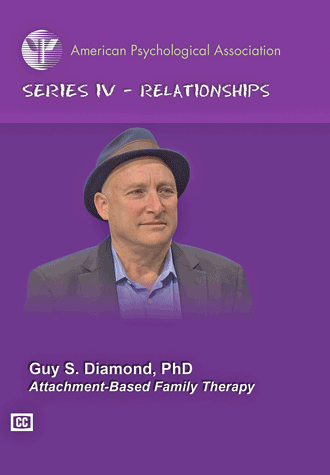
Attachment-Based Family Therapy
ISBN: 978-1-4338-1771-7Attachment-based family therapy (ABFT) aims to repair interpersonal ruptures and rebuild emotionally protective, secure relationships between family members. With its unique emphasis on the adolescent's developmental need for attachment and autonomy, ABFT aims to facilitate corrective attachment experiences within the therapy session.
Although the model is trauma-focused and process-oriented, it provides a clear structure for this reparative process.
In this video, Dr. Guy S. Diamond discusses the core ABFT principles and clinical strategies, the theoretical basis of the approach, and the evidence base that supports it.
In the demonstration, Dr. Diamond works closely with a mother, a father, and their teenage daughter as they cope with the daughter's struggle with depression and her suicide attempt. Dr. Diamond listens attentively to all family members and then encourages the parents to focus on rebuilding an emotionally protective family structure for their daughter.
This DVD features clients portrayed by actors on the basis of a composite of several cases.
Attachment-based family therapy (ABFT) is the only manualized, empirically supported, family therapy model specifically designed to target family and individual processes associated with adolescent suicide and depression. ABFT emerges from interpersonal theories suggesting adolescent depression and suicide can be precipitated, exacerbated, or buffered against by the quality of interpersonal family relationships.
Aware of and sensitive to issues of cultural diversity and their impact on family functioning, it is a trust-based and emotion-focused psychotherapy model providing specific goals and strategies that aims to repair interpersonal ruptures and rebuild an emotionally protective, secure-based parent–child relationship.
ABFT grows out of the structural family therapy tradition, but is informed by more contemporary systemic approaches such as multidimensional family therapy and emotionally-focused therapy. Attachment theory provides the overarching framework to understand and guide the clinical process.
Without ignoring biological factors, ABFT therapists presume that family conflict, detachment, harsh criticism, or more insidious family traumas (e.g., abandonment, neglect, abuse) can cause, maintain, and/or exacerbate depression in adolescents. The impact of these family processes is compounded when parents fail to comfort, support, and help their adolescent identify, discuss, and work through these disturbing experiences. Consequently, adolescents are denied the curative developmental context of secure attachment.
ABFT aims to repair this attachment rupture and reestablish the parents' good care giving and the adolescents' desire for emotional protection. Therapists are taught to rapidly focus on core family conflicts, relational failure, vulnerable emotions, and the instinctual desire for giving and receiving attachment security.
Dr. Guy Diamond is the director of The Center for Family Intervention Science at Drexel University's College of Nursing and Health Professions and the director of the PhD program in the couple and family therapy program.
During his 20 years of research at the University of Pennsylvania, his center has focused on developing, testing and disseminating mental health intervention and service models for adolescents and their families. The Center has had continuous funding for 15 years with numerous federal, state and foundation grants. The primary work has focused on the development of attachment-based family therapy (ABFT) for depressed and suicidal youth.
With the support of the National Institute of Mental Health, Centers for Disease Control and Prevention, and foundation funding, this model has now proven effective in four different studies with suicidal and depressed youth, youth with a history of trauma, gay and lesbian youth, and low income minority populations. The model has shown promise as an after care or hospital diversion program as well.
Dr. Diamond's work has also focused on integration of mental health into primary care and on the development and dissemination of the web-based behavioral health screening tool with the associated systems change activities that would support this model. He is now using the screening tool and ABFT to create a more integrated continuum of care of these high risk youth.
- Diamond, G.S., Diamond, G.M., & Levy, S.A. (2013) Attachment Based Family Therapy for Depressed Adolescents. Washington D.C: American Psychological Association
- Diamond, G.M., Diamond, G.S., & Hogue, A. (2007). Attachment-based family therapy: Adherence and differentiation. Journal of Marital and Family Therapy, 33 (2), 177–191.
- Diamond, G.M., Diamond, G.S., Levy, S., Closs, C., Ladipo, T., & Siqueland, L. (2012). Attachment-based family therapy for suicidal lesbian, gay, and bisexual adolescents: A treatment development study and open trial with preliminary findings. Psychotherapy, 49 (1), 62–71.
- Diamond, G.S. (2005). Attachment-based family therapy: A case study. In J. Lebow (Ed.). Handbook of Clinical Family Therapy (17–41). John Wiley & Sons: New York.
- Diamond, G.S., Creed, T.A., Gillham, J., Gallop, R., & Hamilton, J.L. (2012). Sexual trauma history does not moderate treatment outcome in attachment-based family therapy (ABFT) for adolescents with suicide ideation. Journal of Family Psychology, 26 (4), 595.
- Diamond, G.S., Reis, B., Diamond, G.M., Siqueland, L., & Isaacs, L. (2002). Attachment-based family therapy for depressed adolescents: A treatment development study. Journal of the American Academy of Child and Adolescent Psychiatry, 41 (10), 1190–1196.
- Diamond, G.S., Siqueland, L., Diamond, G.M. (2003). Attachment-based family therapy: A program of treatment development. Clinical Child and Family Psychology, 6, 107–127.
- Diamond, G.S., Wintersteen, M.B., Brown, G.K., Diamond, G.M., Gallop, R., Shelef, K., & Levy, S. (2010). Attachment-based family therapy for adolescents with suicidal ideation: a randomized controlled trial. Journal of the American Academy of Child & Adolescent Psychiatry, 49 (2), 122–131.
APA Videos
- Accelerated Experiential Dynamic Psychotherapy (AEDP) With a Male Client
Diana Fosha - Brief Dynamic Therapy Over Time
Hanna Levenson - Emotionally Focused Couple Therapy for Clients Dealing With Infidelity
Sue Johnson - Emotion-Focused Therapy for Trauma
Sandra C. Pavio - Functional Family Therapy
James F. Alexander
APA Books
- Attachment in Group Psychotherapy
Cheri L. Marmarosh, Rayna D. Markin, and Eric B. Spiegel - Attachment-Based Family Therapy for Depressed Adolescents
Guy S. Diamond, Gary M. Diamond, and Suzanne A. Levy - Attachment-Based Psychotherapy: Helping Patients Develop Adaptive Capacities
Peter C. Costello