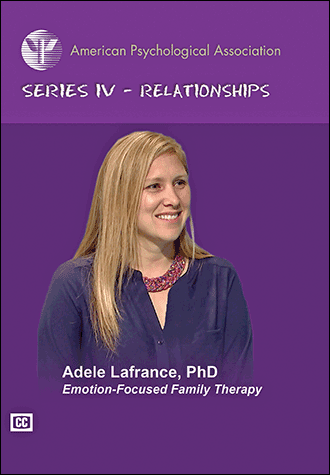
Emotion-Focused Family Therapy
ISBN: 978-1-4338-3111-9Available formats
Streaming options
Emotion-focused family therapy is a treatment model developed to empower parents to take on an active role in supporting their child's mental health, regardless of their age, level of motivation, or involvement in therapy themselves.
Throughout treatment, the clinician and parent work together to identify and process emotion states, or emotion blocks, that can lead to problematic patterns of parenting. Specifically, research has shown that parental fear and self-blame can lead to a decrease in parents' confidence in their abilities and an increase in enabling or accommodating their child's symptoms.
When such blocks surface, this approach always supports the parent — without judgment — to transform the emotional states interfering with optimal caregiving and also foster a reconnection to healthy parenting instincts.
In this video program, Dr. Adele Lafrance demonstrates a targeted approach to working through blocks with a mother whose fears interfere with her ability to support her son struggling with mental health issues.
A new development in the field of psychotherapy involves a central role for parents in the treatment of their child's mental health issues. Parental involvement can occur in the more traditional context of family therapy, parents can receive support parallel to their loved one's treatment or they can engage in the therapy as primary agents of change. In other words, the parents receive the treatment to support their child's healing in the home setting.
This shift in treatment delivery gives hope to the many families struggling to support their loved ones who, despite their suffering, refuse to or are unable to access mental health services.
The clinician's role is then to support caregivers in four domains:
- Becoming their child's recovery coach, that is, assisting their loved one — regardless of age — in the interruption of symptoms and maladaptive behaviors
- Becoming their child's emotion coach, that is, supporting their loved one to approach and process emotional pain, making symptoms unnecessary to cope
- Helping to let go of the weight of old family injuries and associated pain via relationship repair
- Identifying, understanding and transforming "emotion blocks" in caregivers that lead to therapy-interfering attitudes or behaviors
Dr. Adele Lafrance, CPsych, is an associate professor in the psychology department at Laurentian University in Canada.
She is a clinical psychologist and codeveloper of emotion-focused family therapy.
She maintains a practice of supervision and training for clinicians and organizations across North America and Europe and has supported the research of this model with different age groups and clinical populations.
She is most well-known for her work in eating disorders and child and adolescent mental health.
- Carr, A. (2009). The effectiveness of family therapy and systemic interventions for adult-focused problems. Journal of Family Therapy, 31, 46–74.
- Crane, R. (2008). The cost-effectiveness of family therapy: A summary and progress report. Journal of Family Therapy, 30, 399–410.
- Greenberg, L. S. (2004). Emotion-focused therapy. Clinical Psychology & Psychotherapy, 11(1), 3–16.
APA Videos
- Adoption-Specific Therapy in Practice
Jill Waterman - Attachment-Based Family Therapy
Guy S. Diamond - Functional Family Therapy
James F. Alexander - Functional Family Therapy for High-Risk Adolescents
James F. Alexander - Parenting Young Children
Edward R. Christopherson - Working With Emotion in Emotion-Focused Therapy
Leslie S. Greenberg
APA Books
- Attachment-Based Family Therapy for Depressed Adolescents
Guy S. Diamond, Gary M. Diamond, and Suzanne A. Levy - Family Therapy
William J. Doherty and Susan H. McDaniel - Intervening in Children's Lives: An Ecological, Family-Centered Approach to Mental Health Care
Thomas J. Dishion and Elizabeth A. Stormshak - Primary Care Psychology
Edited by Robert G. Frank, Susan H. McDaniel, James H. Bray, and Margaret Heldring - Stepfamily Therapy: A 10-Step Clinical Approach
Scott Browning and Elise Artelt