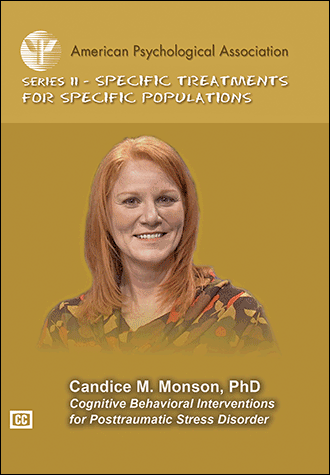
Cognitive Behavioral Interventions for Posttraumatic Stress Disorder
ISBN: 978-1-4338-2018-2Available formats
Streaming options
Cognitive theories of posttraumatic stress disorder, or PTSD, assert that traumatized individuals make problematic appraisals about their experiences that potentially impede recovery from trauma. Individuals with PTSD develop over-generalized and negative conclusions based on traumatic events in areas such as safety, trust, and intimacy.
Unlike anxiety-based or emotional-processing theories of PTSD, which are the foundation of exposure-based interventions, cognitive theories hold that PTSD is not a disorder of anxiety, but is instead characterized by emotional and physiological dysregulation that can be remedied with cognitive interventions.
In this video, Dr. Candice M. Monson employs cognitive behavioral therapy interventions with a woman who is suffering from PTSD after the tragic loss of her son.
Dr. Candice M. Monson employs several key cognitive and behavioral interventions that are used to correct the problematic appraisals that traumatized individuals make, and instead promote beliefs to encourage recovery after traumatic events. These interventions include the use of Socratic dialogue, cognitive worksheets, and related behavioral experiments.
Moreover, there are characteristic classes of cognitions that need to be addressed to facilitate recovery. These cognition classes include concerns about facing trauma-related cognitions, appraisals about the traumatic events, here-and-now thoughts emanating from the trauma, and thoughts about one's ability to cope with future aversive or traumatic events.
Candice M. Monson, PhD, is Professor of Psychology and Director of Clinical Training at Ryerson University in Toronto, Ontario, Canada.
Dr. Monson is one of the foremost experts on traumatic stress and the use of individual and conjoint cognitive therapies to treat PTSD. She has published extensively on the development, evaluation, and dissemination of PTSD treatments more generally. She is a Fellow of both APA and the Canadian Psychological Association.
She coauthored Cognitive Processing Therapy: Veteran/Military Version and is the original developer of Cognitive Behavioral Conjoint Therapy for PTSD. She also coauthored the APA book, Treating PTSD With Cognitive Behavioral Therapies: Interventions That Work.
Dr. Monson is well-known for her efforts in training clinicians in evidence-based assessments and interventions for PTSD.
- Monson, C. M. & Shnaider, P. (2013). Treating PTSD with Cognitive Behavioral Therapies: Interventions That Work. Washington, DC: American Psychological Association.
- Monson, C. M., & Fredman, S. J. (2012). Cognitive Behavioral Conjoint Therapy for Posttraumatic Stress Disorder: Harnessing the Healing Power of Relationships. New York, NY: Guilford.
- Resick, P. A., Monson, C. M., & Chard, K. M. (2007, revised in 2008). Cognitive Processing Therapy: Veteran/Military Version. Washington, DC: Department of Veterans' Affairs.
APA Videos
- Cognitive Behavioral Therapy for Social Anxiety
Amy Wenzel - EDMR for Trauma: Eye Movement Desensitization and Reprocessing
Francine Shapiro - Emotion-Focused Therapy for Trauma
Sandra C. Paivio - Mindfulness for Anxiety
Ronald D. Siegel - Working With Men Survivors of Trauma and Abuse
Laura S. Brown - Working With Women Survivors of Trauma and Abuse
Laura S. Brown
APA Books
- A Practical Guide to PTSD Treatment: Pharmacological and Psychotherapeutic Approaches
Edited by Nancy C. Bernardy, and Matthew J. Friedman - Spiritually Oriented Psychotherapy for Trauma
Edited by Donald F. Walker, Christine A. Courtois, and Jamie D. Aten - Treating PTSD With Cognitive Behavioral Therapies: Interventions That Work
Candice M. Monson and Philippe Shnaider - Treatment of Late-Life Depression, Anxiety, Trauma, and Substance Abuse
Edited by Patricia A. Areán