The Human and Relational Core of Psychotherapy
ISBN: 978-1-4338-2724-2Available formats
Streaming options
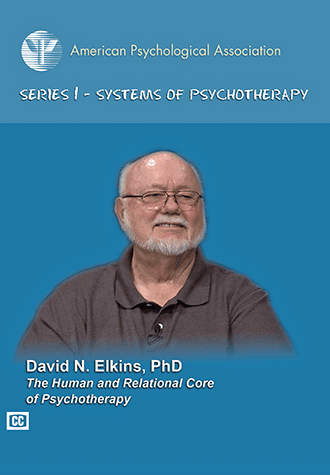
The Human and Relational Core of Psychotherapy is a demonstration and discussion of Dr. David N. Elkins's approach to helping clients overcome unresolved issues.
In this approach, the therapeutic work focuses on employing the human factors of psychotherapy to facilitate change. Such human elements include fostering a firm therapeutic alliance and deemphasizing modalities and techniques that are commonly used in traditional paradigms of psychotherapy.
In this video, Dr. Elkins works with a young woman who is coming into therapy to address her feelings surrounding the loss of her mother.
This video features a client portrayed by an actor on the basis of actual case material.
The old paradigm of psychotherapy, also known as the medical model, placed modalities and techniques at the center and relegated common factors to the margins. However, extensive evidence shows that common factors, and particularly human factors, are the primary agents of change in psychotherapy, dwarfing the effects of modalities and techniques.
In line with this evidence, Elkins places common factors at the center and moves modalities and techniques to the margins. In his book The Human Elements of Psychotherapy: A Nonmedical Model of Emotional Healing (APA, 2016), Elkins summarized evidence from numerous disciplines to show that humans evolved to give and receive emotional healing through social means and that psychotherapy is an expression of this evolutionarily derived ability. This is why the human elements of psychotherapy, including the client, therapist, and relationship, are such potent agents of change.
Dr. Elkins suggests that psychotherapists focus less on modalities and techniques and more on supporting and activating these powerful agents.
David N. Elkins is a licensed psychologist and a professor emeritus of psychology in the Graduate School of Education and Psychology at Pepperdine University where he trained clinical psychologists for 30 years.
As a clinician, Dr. Elkins has worked in hospital, community mental health, and private practice settings.
He is a fellow of APA and has served twice as president of APA Division 32 (Society for Humanistic Psychology).
Dr. Elkins is a contributor to the current debate in clinical psychology regarding the determinants of effectiveness in psychotherapy. His most recent book is titled The Human Elements of Psychotherapy: A Nonmedical Model of Emotional Healing (APA, 2016).
- Bohart, A., & Tallman, K. (2010). Clients: The neglected common factor in psychotherapy. In B. L. Duncan, S. D. Miller, B. E. Wampold, & M. A. Hubble (Eds.), The heart and soul of change: Delivering what works in therapy (2nd ed.). (pp. 299–322). Washington, DC: American Psychological Association.
- Duncan, B. L. (2014). On becoming a better therapist: Evidence based practice one client at a time (2nd ed.). Washington, DC: American Psychological Association.
- Duncan, B. L., Miller, S. D., Wampold, B. E., & Hubble, M. A. (Eds.). (2010). The heart and soul of change: Delivering what works in therapy (2nd ed.). Washington, DC: American Psychological Association.
- Elkins, D. N. (2007). Empirically supported treatments: The deconstruction of a myth. Journal of Humanistic Psychology, 47(4), 474–500.
- Elkins, D. N. (2009). Humanistic psychology: A clinical manifesto: A critique of clinical psychology and the need for progressive alternatives. Colorado Springs, CO: University of the Rockies Press.
- Elkins, D. N. (2009). The medical model in psychotherapy: Its limitation and failures. Journal of Humanistic Psychology, 49(3), 267–291.
- Elkins, D. N. (2016). The human elements of psychotherapy: A nonmedical model of emotional healing. Washington, DC: American Psychological Association.
- Lambert, M. J., & Barley, D. E. (2002). Research summary on the therapeutic relationship and psychotherapy outcome. In J. C. Norcross & M. R. Goldfried (Eds.), Psychotherapy relationships that work (pp. 17–32). Oxford, UK: Oxford University Press.
- Norcross, J. C. (Ed.). (2002). Psychotherapy relationships that work. Oxford, UK: Oxford University Press.
- Wampold, B. E. (2001). The great psychotherapy debate: Model, methods, and findings. Mahwah, NJ: Erlbaum.
- Wampold, B. E. (2010). The research evidence for the common factors models: A historically situated perspective. In B. L. Duncan, S. D. Miller, B. E. Wampold, & M. A. Hubble (Eds.), The heart and soul of change: Delivering what works in therapy (2nd ed.). (pp. 49–82). Washington, DC: American Psychological Association.
APA Videos
- Client-Centered Therapy
Nathaniel J. Raskin - Client-Directed Outcome-Focused Psychotherapy
Scott D. Miller - Integrative Therapy
John C. Norcross - Mindfulness-Based Cognitive Therapy for Depression
Zindel V. Segal - Multimodal Therapy
Arnold A. Lazarus - Qualities and Actions of Effective Therapists
Bruce E. Wampold - Using Client Feedback in Therapy
Barry L. Duncan
APA Books
- The Basics of Psychotherapy: An Introduction to Theory and Practice
Bruce E. Wampold - Behavior Therapy
Martin M. Antony and Lizabeth Roemer - On Becoming a Better Therapist, Second Edition: Evidence-Based Practice One Client at a Time
Barry L. Duncan