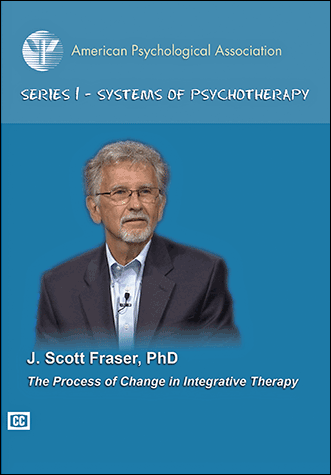
The Process of Change in Integrative Therapy
ISBN: 978-1-4338-2731-0Available formats
Streaming options
There are many different, yet equally effective, evidence-supported therapies for most psychological problems today. Yet, if different, how can they be equally effective? How can therapists integrate them in practice?
In this video, J. Scott Fraser discusses the process paradigm, which proposes that all problems are vicious cycles, shaped by context, that effective treatments intercept and reverse. This approach targets pattern shifts in clients' vicious cycles and provides a model for matching effective treatment approaches for the client and therapist.
In this video, J. Scott Fraser demonstrates the approach with a client and discusses the therapy session with highlights that illustrate how this approach translates theory into practical integration of psychotherapies that work.
Who can deny the good intentions of public behavioral health funding agencies, government agencies overseeing mental healthcare, third-party payers, or universities when it comes to funding and training to deliver evidence-supported psychotherapy (EST)? Each of these parties has an investment in knowing about and endorsing the delivery of only the best-proven practices for consumers. Who among us would want our family physician to choose an unproven treatment over one shown to have evidence of effectiveness?
Yet, there are more than 50 ESTs, and the list is growing. How is a practitioner to learn them all, much less be good at them? Moreover, there are multiple ESTs, representing different orientations for most psychological diagnoses. How can this be so?
The medical model would never predict so many different approaches to be equally effective. Furthermore, not all ESTs are compatible with therapists' training or clients' worldviews. The challenges go on! Even current models of psychotherapy integration have met challenges when trying to integrate all psychotherapies that work.
The Contextual Process of Change approach takes these challenges head on. All effective treatments facilitate therapeutic change, yet none addresses it the same way. A new paradigm is required to address the issues of change common to all ESTs and by so doing, integrate them.
The book, Second-Order Change in Psychotherapy: The Golden Thread That Unifies Effective Treatments (Fraser & Solovey, 2007) introduced this perspective on change. The forthcoming book, Integrating Psychotherapies That Work: Following the Process of Change (2017) further solidifies this view.
The Contextual Process of Change view integrates psychotherapies that work by shifting the ground on which they are all based. This view flows from the process of change paradigm, replacing the current rational–empirical medical model.
It asserts that all client difficulties are vicious cycles resulting in solution-generated problem patterns. All effective treatments interdict and reverse those vicious cycles and support new virtuous cycle patterns. It does this through honoring cultural and other contextual factors that shape the problem cycle; applying an appropriate therapeutic rationale that fits with clients and therapists; and implementing a process to create a second-order change and problem resolution.
The model advocates that therapists identify the contextual factors that shape and channel the problem; identify the vicious problem cycle; target a second-order change; and implement a therapeutic rationale to cement a working alliance for problem resolution.
The Contextual Process of Change approach offers therapists flexibility to use a range of effective approaches to psychotherapy, including that which best fits their own training and expertise. It also allows flexibility in psychotherapy rationale to best fit with clients' worldviews, contexts, and strengths. Moreover, it does this while focusing on change processes shared by all effective approaches.
Shifting to the process of change paradigm allows today's therapists to use current best practices for client problems while truly integrating well-grounded flexibility into their work. The approach seamlessly translates high theory into step-by-step practical guidelines for practitioners integrating psychotherapies that work.
J. Scott Fraser is a clinical psychologist with a career path of nearly 40 years of clinical practice, supervision, training, and academic teaching.
Receiving his doctorate in clinical psychology in 1976, he served as clinical director of a hospital-based crisis and brief therapy center for 14 years. He served for 24 years as director of internship training, associate dean/director of clinical training, and as professor of clinical psychology at the School of Professional Psychology at the Wright State University in Dayton, Ohio.
A recipient of the school's teaching award, he recently retired as Professor Emeritus within the university. He is a Diplomat in Family Therapy and an approved supervisor in the founders' track of the American Association for Marital and Family Therapy (AAMFT).
A protégé of Paul Watzlawick and John Weakland of the Mental Research Institute's Brief Therapy Center in Palo Alto, California, Dr. Fraser has written, supervised, and taught systems approaches to crisis intervention and brief therapy, family therapy, and psychotherapy integration throughout his career.
A strong presenter and clear writer, the audio recordings of Dr. Fraser's panel presentations with John Weakland and Steve de Shazer, and later with Insoo Kim Berg and Richard Fisch were noted as best sellers from their respective conferences of the AAMFT.
His classic article comparing the bases of structural and strategic therapy was republished as one of the most influential articles in family therapy in 1982. His article comparing strategic and solution focused therapies was reprinted and translated into German in 1997.
Dr. Fraser has presented and trained therapists in the United States, Europe, and Asia over the course of his long career.
- Fraser, J. S. & Solovey, A. D. (In press). Integrating psychotherapies that work: Following the process of change. Washington, DC: American Psychological Association.
- Fraser, J. S., & Solovey, A. D. (2007). Second-order change in psychotherapy: The golden thread that unifies effective therapies. Washington, DC: American Psychological Association.
- Fraser, J. S., Grove, D., Lee, M. Y., Greene, G. J. & Solovey, A. (2014). Integrative families and systems treatment (I-FAST): A strengths-based common factors approach. New York: Oxford University Press.
APA Videos
- Integrative Behavioral Couple Therapy
Andrew Christensen - Integrative Behavioral Couple Therapy With Gay Men
Christopher R. Martell - Integrative Psychotherapy Supervision
John C. Norcross - Integrative Relational Psychotherapy
Paul L. Wachtel - Integrative Therapy
John C. Norcross - Working With Issues in Divorce
Jay Lebow
APA Books
- A Casebook of Psychotherapy Integration
George Stricker and Jerry Gold - Clinical Dilemmas in Psychotherapy: A Transtheoretical Approach to Psychotherapy Integration
Douglas Scaturo - Inside the Session: What Really Happens in Psychotherapy
Paul L. Wachtel - Psychotherapy Case Formulation
Tracy D. Eells - Psychotherapy Integration
George Stricker - Supervision Essentials for Integrative Psychotherapy
John C. Norcross and Leah M. Popple