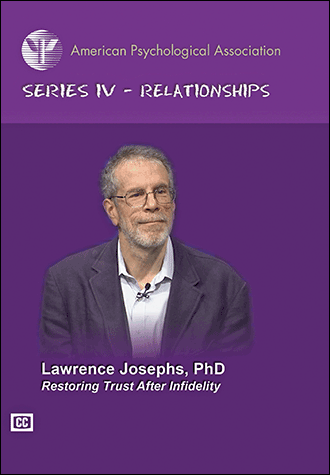
Restoring Trust After Infidelity
ISBN: 978-1-4338-2730-3Available formats
Streaming options
Infidelity in any relationship creates devastating feelings of loss and betrayal, and can potentially result in insecure attachment bonds and subsequent separation or divorce. Couples seeking therapeutic intervention want to recover and repair the rupture, but often times are not sure how to push past what seems like an impasse — the betrayed partner suffers from hurt and anger, while the unfaithful partner suffers from shame and guilt.
In Restoring Trust After Infidelity, Dr. Lawrence Josephs demonstrates his integrative mentalization-based approach for helping couples manage conflicts and emotional dysregulation.
In the therapy demonstration, Dr. Josephs works with a couple engaged to be married who have suffered from issues stemming from infidelity. Applying his approach, Dr. Josephs helps the couple to effectively manage negative interaction patterns and begin to restore trust and develop more secure attachment bonds.
Dr. Lawrence Josephs' approach integrates mentalization-based treatment with integrative behavioral approaches to couples therapy. In traumatic states of mind reflective functioning diminishes, dichotomous thinking increases, and couples communicate in defensive ways that hide their underlying vulnerabilities while tending to antagonize each other. As a consequence there is increasing marital conflict and emotional flooding.
Reflective functioning is restored by facilitating awareness of the impact of self-protective ways of relating on a partner's mental states that protect the self by attacking the partner. Partners need help learning to tolerate feeling unfairly criticized and shamed by a hurt and angry partner hiding attachment insecurity without responding defensively in ways that exacerbate rather than diffuse conflict. Mindful acceptance of the unflattering characterizations of hurt and angry partners (i.e., that the unfaithful partner is a "liar" and a "cheat" or that the betrayed partner is "paranoid" and "crazy") helps to restore a meeting of minds between partners whose secure attachment with each other has been damaged by infidelity.
Lawrence Josephs, PhD, is a professor at the Derner Institute of Advanced Psychological Studies of Adelphi University. He is on the editorial board of the International Journal of Psychoanalysis and a regular book reviewer for Psychoanalytic Psychology. He has published articles in Archives of Sexual Behavior, Journal of Sex and Marital Therapy, Self and Identity, Psychoanalytic Dialogues, Journal of the American Psychoanalytic Association, and Contemporary Psychoanalysis as well as International Journal of Psychoanalysis and Psychoanalytic Psychology.
Dr. Josephs published two books: Character Organization and the Structure of the Self (Columbia University Press) and Balancing Empathy and Interpretation (Jason Aronson), and has a book in press with APA.
He is in private practice in individual and couples therapy in New York City.
- Josephs, L. (2006). The impulse to infidelity and the Oedipal splitting. The International Journal of Psychoanalysis, 87(2), 423–437. doi: 1 0.1516/5A5VWLPB-4HJ3-329J
- Josephs, L. (2015). The challenge of mentalizing sexual betrayal. In J. M. Thompson & R. Tuch (Eds.), Stories we tell ourselves: Mentalizing tales of dating and marriage. London, UK: Routledge.
- Josephs, L. (in press) The dynamics of infidelity: Relationship science and clinical practice. Washington, DC: American Psychological Association.
- Josephs, L., & McCleod, B. (2014) A theory of mind-focused approach to anger management. Psychoanalytic Psychology, 31(1), 68–83 doi: 10.1037/a0034175
- Josephs, L., & Shimberg, J. (2010). The dynamics of sexual infidelity: Personality as a reproductive strategy. Psychoanalytic Psychology, 27(3), 273–295. doi: 10.1037/a0020455
APA Videos
- Attachment-Based Family Therapy
Guy S. Diamond - Couple Power Therapy
Peter L. Sheras and Phyllis R. Koch-Sheras - Emotionally Focused Couple Therapy for Clients Dealing With Infidelity
Sue Johnson - Integrative Behavioral Couple Therapy With Gay Men
Christopher R. Martell - Integrative Family Therapy
Jay Lebow - Working With Issues in Divorce
Jay Lebow
APA Books
- Attachment-Based Psychotherapy: Helping Patients Develop Adaptive Capacities
Peter C. Costello - Couple and Family Therapy: An Integrative Map of the Territory
Jay Lebow - Couple Power Therapy: Building Commitment, Cooperation, Communication, and Community in Relationships
Peter L. Sheras and Phyllis R. Koch-Sheras - Emotion-Focused Couples Therapy: The Dynamics of Emotion, Love, and Power
Leslie S. Greenberg and Rhonda N. Goldman - The Marriage Checkup Practitioner's Guide: Promoting Lifelong Relationship Health
James V. Cordova