Emotion-Centered Problem-Solving Therapy
Available formats
Streaming options
Emotion-centered problem-solving therapy is a transdiagnostic approach that teaches individuals, via an experiential learning framework, a series of skills geared to foster their flexibility and resilience when coping with major life stressors.
Emotion-centered problem-solving therapy is the updated version of problem-solving therapy, which has more than 30 years of demonstrated efficacy regarding multiple clinical disorders, particularly depression. This newer version provides additional tools to help people better understand and regulate negative emotionality in order to more successfully problem-solve stressful life problems.
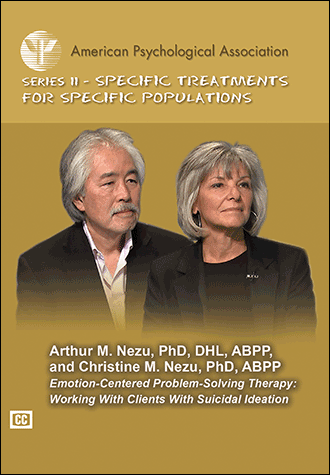
In this video program, Dr. Arthur M. Nezu works with a client who is dealing with substantial life setbacks with the goal of enhancing his ability to both learn and apply the problem-solving skills. Dr. Christine Maguth Nezu discusses various teaching moments identified within this clinical demonstration that illustrate the four major toolkits that embody emotion-centered problem-solving therapy.
Emotion-Centered Problem-Solving Therapy (EC-PST) is a major extension and reformulation of Problem-Solving Therapy (PST), which is an evidence-based, transdiagnostic approach that has been researched and developed over the past four decades.
Originally outlined by D'Zurilla and Goldfried (1971), the theory and practice of PST has been significantly revised over this time to assimilate emerging scientific findings in psychopathology, cognitive science, and affective neuroscience. Because the therapy protocol has changed significantly from its earlier roots, we now use the term "emotion-centered problem-solving therapy" to highlight these changes, and to incorporate an increasing focus on the role of emotions in learning to solve stressful life problems.
Based on a biopsychosocial, diathesis-stress model of psychopathology, EC-PST involves training people to cope effectively with life stressors hypothesized to engender negative health and mental health outcomes. Contrary to the viewpoint of PST as a series of techniques focused solely on changing a problematic situation, contemporary and emotion-focused PST is a comprehensive system of psychotherapy that increases patients' awareness of their inner experience, teaches specific skills regarding emotional understanding and regulation, and fosters the intentional practice of newly learned problem-solving skills in order to create an experiential learning process.
The experiential component of EC-PST is essential, in that, suggestive of studies that document the plasticity of the brain, this intervention is designed to "train patients' brains" to react and attempt to manage challenging life stressors.
The overarching goal of PST is to foster the adoption and effective implementation of adaptive problem-solving attitudes (i.e., optimism, enhanced self-efficacy) and behaviors (i.e., adaptive emotional regulation, planful problem solving). According to this model, several major obstacles can potentially exist for a given individual when attempting to successfully resolve real-life stressful problems.
Arthur M. Nezu, PhD, ABPP, is currently Distinguished University Professor of Psychology, Medicine, and Community Health and Prevention at Drexel University in Philadelphia.
He is one of the codevelopers of a cognitive–behavioral approach to teaching social problem-solving skills and has conducted multiple randomized clinical trials testing its efficacy across a variety of populations. These populations include clinically depressed adults, depressed geriatric patients, adults with mental retardation and concomitant psychopathology, distressed cancer patients and their spousal caregivers, individuals in weight-loss programs, breast cancer patients, and adult sexual offenders.
Dr. Nezu has contributed to more than 175 professional and scientific publications, including the books Solving Life's Problems: A 5-Step Guide to Enhanced Well-Being, Helping Cancer Patients Cope: A Problem-Solving Approach, and Problem-Solving Therapy: A Positive Approach to Clinical Intervention. He also codeveloped the self-report measure Social Problem-Solving Inventory–Revised.
Dr. Nezu is on numerous editorial boards of scientific and professional journals and a member of the Interventions Research Review Committee of the National Institute of Mental Health.
An award-winning psychologist, he was previously president of the Association for Advancement of Behavior Therapy, the Behavioral Psychology Specialty Council, the World Congress of Behavioral and Cognitive Therapies, and the American Board of Cognitive and Behavioral Psychology. He is a fellow of APA, the Association for Psychological Science, the Society for Behavior Medicine, the Academy of Cognitive Therapy, and the Academy of Cognitive and Behavioral Psychology.
Dr. Nezu was awarded the diplomate in Cognitive and Behavioral Psychology from the American Board of Professional Psychology and currently serves as a trustee of that board.
He has been in private practice for more than 25 years and is currently conducting outcome studies to evaluate the efficacy of problem-solving therapy to treat depression among adults with heart disease.
Christine Maguth Nezu, PhD, ABPP, is currently Professor of Psychology and Medicine at Drexel University in Philadelphia. She has also served as Program Consultant to the US Department of Veterans Affairs, the US Department of Defense, and the US Air Force. She previously served as director of the APA-accredited Internship/Residency in Clinical Psychology, as well as the Cognitive–Behavioral Postdoctoral Fellowship Program, at the Medical College of Pennsylvania/Hahnemann University.
She is the coauthor or editor of more than 100 scholarly publications, including 15 books. Her publications cover a wide range of topics in mental health and behavioral medicine, many of which have been translated into a variety of foreign languages.
Dr. Maguth Nezu is currently the president-elect of the American Board of Professional Psychology, on the board of directors for the American Board of Cognitive and Behavioral Psychology, and on the board of directors for the American Academy of Cognitive and Behavioral Psychology.
She is the recipient of numerous grant awards supporting her research and program development, particularly in the area of clinical interventions. She serves as an accreditation site visitor for APA for clinical training programs and is on the editorial boards of several leading psychology and health journals.
Dr. Maguth Nezu has conducted workshops on clinical interventions and case formulation both nationally and internationally. She is currently the North American representative to the World Congress of Cognitive and Behavioral Therapies. She holds a diplomate in Cognitive and Behavioral Psychology from the American Board of Professional Psychology and has been active in private practice for more than 20 years.
Her current areas of interest include the treatment of depression in medical patients, the integration of cognitive and behavioral therapies with patients' spiritual beliefs and practices, interventions directed toward stress, coping, and health, and cognitive behavior therapy and problem-solving therapy for individuals with personality disorders.
- D'Zurilla, T. J., & Nezu, A. M. (2007). Problem-solving therapy: A positive approach to clinical intervention (3rd ed.). New York: Springer Publishing Co.
- D'Zurilla, T. J., Nezu, A. M., & Maydeu-Olivares, A. (2002). Social Problem-Solving Inventory–Revised (SPSI–R): Technical manual. North Tonawanda, NY: Multi-Health Systems.
- Nezu, A. M. (2004). Problem solving and behavior therapy revisited. Behavior Therapy, 35, 1–33.
- Nezu, A. M., & Nezu, C. M. (in press). Problem-solving therapy. In S. Richards & M. G. Perri (Eds.), Relapse prevention for depression. Washington, DC: American Psychological Association.
- Nezu, A. M., Nezu, C. M., & Clark, M. (in press). Problem solving as a risk factor for depression. In K. S. Dobson & D. Dozois (Eds.), Risk factors for depression. New York: Elsevier Science.
- Nezu, A. M., Nezu, C. M., & D'Zurilla, T. J. (2007). Solving life's problems: A 5-step guide to enhanced well-being. New York: Springer Publishing Co.
- Nezu, A. M., Nezu, C. M., & Perri, M. G. (2006). Problem solving to promote treatment adherence. In W. T. O'Donohue & E. Livens (Eds.), Promoting treatment adherence: A practical handbook for health care providers (pp. 135–148). New York: Sage Publications.
- Nezu, A. M., Nezu, C. M., Friedman, S. H., Faddis, S., & Houts, P. S. (1998). Helping cancer patients cope: A problem-solving approach. Washington, DC: American Psychological Association.
- Nezu, C. M., D'Zurilla, T. J., & Nezu, A. M. (2005). Problem-solving therapy: Theory, practice, and application to sex offenders. In M. McMurran & J. McGuire (Eds.), Social problem solving and offenders: Evidence, evaluation and evolution (pp. 103–123). Chichester, UK: Wiley.
- Nezu, C. M., Palmatier, A., & Nezu, A. M. (2004). Social problem-solving training for caregivers. In E. C. Chang, T. J. D'Zurilla, & L. J. Sanna (Eds.), Social problem solving: Theory, research, and training (pp. 223–238). Washington, DC: American Psychological Association.
APA Videos
- Comparing Models of Emotion in Therapy
Leslie S. Greenberg, Norka T. Malberg, and Michael A. Tompkins - Depression
Michael D. Yapko - Depression With Older Adults
Peter A. Lichtenberg - Emotion-Focused Therapy for Depression
Leslie S. Greenberg - Emotion-Focused Therapy Over Time
Leslie S. Greenberg - Mindfulness-Based Cognitive Therapy for Depression
Zindel V. Segal - Narrative Processes in Emotion-Focused Therapy for Trauma
Lynne Angus and Sandra C. Paivio - Problem-Solving Therapy
Arthur M. Nezu and Christine Maguth Nezu
APA Books
- Behavioral Interventions in Cognitive Behavior Therapy: Practical Guidance for Putting Theory Into Action, Second Edition
Richard F. Farmer, and Alexander L. Chapman - Essential Components of Cognitive–Behavior Therapy for Depression
Jacqueline B. Persons, Joan Davidson, and Michael A. Tompkins - Experiences of Depression: Theoretical, Clinical, and Research Perspectives
Sidney J. Blatt - Preventing Youth Substance Abuse: Science-Based Programs for Children and Adolescents
Patrick Tolan, PhD, José Szapocznik, and Soledad Sambrano