skip to main content

As COVID-19 cases increase, so does trauma among health providers

Research from countries where COVID-19 cases spiked months ago shows that U.S. front-line health-care providers are likely to experience more collective trauma and PTSD. Psychologists are working to address the crisis on several fronts.

APA Style leaf logo Cite This Article in APA Style
Abrams, Z. (2020, June 1). As COVID-19 cases increase, so does trauma among health providers. https://www.apa.org/topics/covid-19/trauma-health-providers

As COVID-19 cases increase, so does trauma among health providers

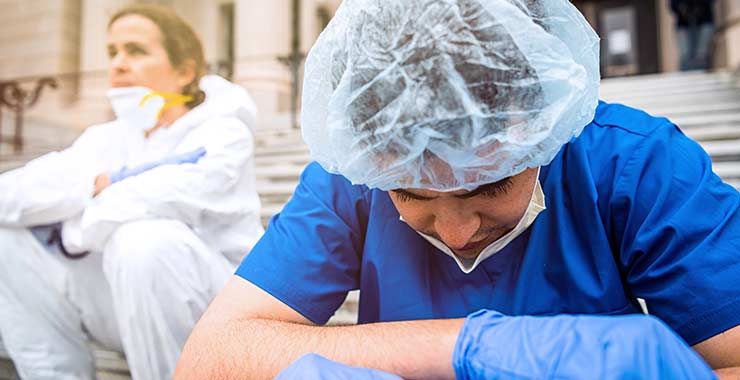
For months, front-line health-care providers have faced war-like circumstances—prolonged suffering, more deaths than usual, and in many cases, a lack of adequate resources to respond. Psychologists counseling those workers have observed depression, panic, paranoia, and suicidality. They are also seeing cases of acute stress disorder and early indicators of posttraumatic stress disorder (PTSD), although some caution it’s too early to render a PTSD diagnosis.

“We’re dealing with an omnipresent, continuing threat,” says Laura S. Brown, PhD, a clinical psychologist based in Seattle who helped create APA’s clinical practice guideline on PTSD. “This isn’t posttraumatic yet because the trauma piece is still ongoing.”

Research conducted in countries where COVID-19 cases spiked months ago shows high rates of psychological suffering that may indicate where the United States is headed. In China, more than 70% of health-care providers studied reported distress (Lai J., et al., JAMA Network Open, Vol. 3., No. 3, 2020opens in new window), while nearly half of those surveyed in Italyopens in new window reported PTSD symptoms.

With that trajectory in mind, psychologists are rallying to provide support, including trauma-informed care, to front-line physicians, nurses and other hospital staff, as well as paramedics.

“We know that getting involved early is key for minimizing the long-term effects of trauma,” says Karla Vermeulen, PhD, deputy director at the Disaster Mental Health Institute at the State University of New York at New Paltz. “Those early interventions can usually restore a sense of stability and safety and help people return more quickly to their pre-disaster functioning, but it's unclear if they'll have the same effect during this protracted response when it's hard for anyone to feel safe, especially those on the front lines.”

Signs of trauma

Psychologists treating front-line medical workers have observed a range of symptoms typical of those exposed to trauma. Susan McDaniel, PhD, former APA president, leads a team of psychologists embedded in departments across the University of Rochester Medical Center (URMC) in New York. They’ve seen everything from providers unable to function because of extreme distress to those who show no emotion when recounting a traumatic experience.

Brown has seen symptoms of anxiety and hyperarousal, including sleep disturbances, irritability, and nightmares. She also reports that health-care workers are showing signs of depression, including withdrawing from social connections and feeling numb, hopeless, or unable to find pleasure in activities they normally enjoy.

“This is what the body does when it’s continuously exposed to danger and crisis,” Brown says.

Several months into the pandemic, medical providers are also showing signs of burnout, including poor judgment, short tempers, and errors at work, says clinical psychologist Lauren DeCaporale-Ryan, PhD, an assistant professor at URMC.

Given what the health-care workers she supports have faced—including the death of patients, colleagues, and friends, and online harassment following a COVID-19 outbreak in the nursing unit—DeCaporale-Ryan says such reactions aren’t surprising.

And front-line medical workers are still juggling other challenges, including equipment and testing shortages and concerns about contracting the virus.

“There’s a tremendous amount of fear and worry related to their own health and wellbeing,” McDaniel says. “But even more upsetting for many is the fear of bringing it home to their loved ones.”

As a result, some providers choose to self-isolate when they return home, for instance by sleeping in a guest room or basement—or find alternative lodging, such as a hotel near their workplace—to avoid exposing family members to the virus, which can cut them off from supports key to managing ongoing distress. Some providers face the added fear of losing their income; more than 250 hospitals have already furloughed workers due to lost revenue since the pandemic began (Becker’s Hospital Reviewopens in new window, April 2020).

“Right now, people are facing a series of stressors and problems,” says DeCaporale-Ryan. “It's not just the trauma of COVID itself—it's the trauma that COVID has wrought in all aspects of their lives.”

Enhancing support

Psychologists are finding inventive ways to support medical workers to curtail downstream effects of prolonged distress and trauma, including PTSD and suicidality. For one, they’re offering free treatment for health-care workers through partnerships with the EMDR Humanitarian Assistance Programs’ Trauma Recovery Networkopens in new window, the U.S. Department of Defense,opens in new window and other groups.

Within their own institutions, psychologists have also worked quickly to establish or enhance mental health supports for clinicians, residents, program managers, and other hospital staff. At URMC, McDaniel and DeCaporale-Ryan launched weekly virtual check-in sessions for personnel in eight of the center’s departments with psychologists embedded. The sessions include sharing experiences among colleagues, discussions about burnout, resources for wellness and resilience—such as mindfulness exercises or strategies for healthy sleep—and practical solutions for day-to-day challenges, such as maintaining physical distance from family members at home.

“When we started seeing the data from China related to anxiety, distress, and the possibility of PTSD, we realized our workers needed a confidential forum for support,” DeCaporale-Ryan says.

URMC also increased the frequency of self-reflection circles offered to medical residents, launched a series of light-hearted departmental newsletters, established an institution-wide support phone line, and created a buddy system for daily check-ins between junior and senior faculty members and in some residency programs.

At the Emory University School of Medicine, Nadine Kaslow, PhD, ABPP, director of postdoctoral residency training in health service psychology, helped launch a similar series of support groups—Caring Communities for COVID Caregivers—which are delivered to all intensive care units and hospital floors treating COVID-19 patients. The groups use a peer support framework to help medical workers share coping strategies.

“A big focus of our support groups is on helping our health-care professionals find purpose during this challenging time,” says Kaslow, also a former APA president.

Like URMC, Emory University Medical Center embeds psychologists within hospital departments, which Kaslow says is key to their success. Psychologists who work closely with health-care workers in a given unit, such as emergency medicine or pediatrics, earn trust and credibility that’s essential for rolling out a rapid response during a crisis. And among physicians, discussing distress or seeking help is often still taboo—partly because receiving mental health care can lead to increased scrutiny from state licensing boardsopens in new window—so an established relationship with a psychologist can be important for destigmatizing care.

Kaslow and her colleagues also run support groups for medical workers who have tested positive for COVID-19 and for those who are grieving. In addition, they have partnered with the World Health Organization to offer virtual counseling to front-line medical providers in Africa and other regions with a shortage of mental health-care providers.

On top of the work being done within individual medical centers, psychologists have also developed frameworks that can be instituted systemwide. Melissa Brymer, PhD, PsyD, director of terrorism and disaster programs at the UCLA-Duke National Center for Child Traumatic Stressopens in new window, is building a three-tiered mental health support system for health-care workers that is rolling out at the University of California, Los Angeles.

The model’s basic level of care includes a phone and text line that offers medical workers emotional support, wellness tips and help solving logistical issues such as booking lodging. Its second-tier dispatches mental health providers to conduct one-on-one counseling sessions and peer support groups based on the needs identified by each hospital department. Finally, psychiatric or traditional therapy services are available for those who require them.

“Just like in any type of disaster or emergency, we know that some health-care workers will end up needing more formalized treatments,” Brymer says.


Treating a collective trauma

If the United States follows the course of China and Italy, psychologists will continue to see increases in PTSD and other mental health problems among front-line workers. But some say an individual trauma approach can’t repair all the damage wrought by COVID-19—and may miss opportunities to help.

“I worry about simply labeling these cases as PTSD, because what we’re experiencing here is a collective trauma,” says Kaslow. “If we treat this the way psychologists have in the past—as individual patients with trauma—then we’ve missed the boat.”

That collective problem calls for a collective solution, she says, which involves listening to the stories of health-care workers, acknowledging that the United States wasn’t prepared for the pandemic and taking steps to better manage COVID-19 moving forward.

“This is not just about getting rid of symptoms, it’s about helping people make meaning out of what happened,” Kaslow says.

Recommended Reading

Related

You may also like