

Foreword
As an association, APA seeks to foster an accessible, equitable, and inclusive psychology that promotes human rights, fairness, and dignity for all. We have intentionally centered our disability inclusion efforts in individual well-being, empowerment, and systemic change for the disability community.
Grounded in principles of our Equity, Diversity, and Inclusion (EDI) Framework, APA’s Accessibility and Inclusion Maturity Model (AIMM) offers a systematic, science-based approach to advancing disability awareness and equity across the association with the primary goal of supporting the implementation of best practices around disability inclusion and accessibility. This approach will then position APA to serve as an exemplar for the field of psychology and broader society.
Implementation is successful when organizations like APA promote transformative cultural change and long-term, sustainable success. APA is striving for these important outcomes by continuously seeking opportunities for growth and evaluating our progress. Throughout this work, we are prioritizing engagement with the breadth and diversity of multiple people and communities, particularly those with disabilities, because using lived experience to inform our work is critical. In fact, the creation of the AIMM itself drew on the professional, and in many cases personal, perspectives of people with disabilities and their allies across the field of psychology.
Thank you to everyone who has offered their input and expertise to this document and to those working in partnership with APA to cultivate growth across the association, the field, and broader society.
Arthur C. Evans Jr., PhD
Chief Executive Officer
Executive Vice President
Maysa Akbar, PhD, ABPP
Chief Diversity Officer
Chief of Psychology in the Public Interest
Background
In 2021, APA) released the Equity, Diversity, and Inclusion (EDI) Framework (2021) to guide the Association’s future planning on equity, diversity, and inclusion. The EDI Framework, which reflects a comprehensive review from staff, elected and appointed leaders, and experts across the Association’s membership, indicates that equity, diversity, and inclusion are vital to the progress of APA, the field of psychology, and society (APA, 2021). The EDI Framework is a foundational document that allows for the expansion of APA’s vision for an accessible, equitable, and inclusive psychology. A primary tenant of the framework is to promote human rights, fairness, and dignity for all. The framework also provides a roadmap for the next phases of EDI strategic planning, including the development of the Accessibility and Inclusion Maturity Model (AIMM).
Disability inclusion is vital to the health and success of both individuals and organizations. Millions of Americans with disabilities continue to experience subtle or blatant discrimination in areas like employment, housing, and health care (APA, 2023b). Attitudinal barriers can be the most significant hindrance to people with disabilities2 achieving their full potential, which deprives people, organizations, and society of a valuable set of skills and resources (APA, 2019a). More specifically, disabled psychologists have a notable history of working against barriers, especially related to clinical training and supervision (Lund et al., 2020).
Even with a lack of current research measuring the prevalence of disability among psychologists and trainees, earlier surveys from the 21st century have found that between 6–8% of psychology trainees report experiencing a disability (Lund et al., 2014). In addition to attitudinal barriers, psychology trainees with disabilities experience physical, programmatic, and systemic barriers, including barriers to supervision and access to accommodations (Lund et al., 2020). Addressing these barriers can mold supervisors into better advocates for disability inclusion while simultaneously supporting the growth and development of disabled psychologists in the field (Lund et al., 2020).
In alignment with the EDI Framework, the AIMM strives to dismantle barriers and advance disability inclusion within the Association while influencing the other spheres of the EDI Framework such as the field of psychology and society.
Brief history of disability inclusion at APA
The needs of people with disabilities were first addressed with the creation of Division 22: Rehabilitation Psychology in 1958 and Division 33: Intellectual and Developmental Disabilities/Autism Spectrum Disorder in 1978. However, the needs of psychologists with disabilities themselves were not addressed until the mid to late 1970s when a group of disabled psychologists began convening at several annual APA conventions. The discussions and efforts of this informal group focused on issues of accessibility and advocacy. Their work prompted the development of a task force that would recommend the formation of what is now known as the Committee on Disability Issues in Psychology (CDIP).
Since its first meeting in 1985, CDIP has played a critical role in the creation of policies, programs, and resources dedicated to the inclusion of people with disabilities and the mitigation of ableism3. For example, a key initiative of CDIP was the development of APA’s Disability Mentoring Program (DMP). For more than 20 years the DMP has helped retain people with disabilities in psychology’s academic programs and careers by supporting graduate psychology students, psychologists entering the field, and practicing psychologists with disabilities.
In 2019, the Association adopted the Resolution on Support of Universal Design and Accessibility in Education, Training and Practice. This resolution further affirms APA’s support of the full participation and inclusion of people with diverse needs and abilities while advocating for a move toward infusing universal design principles throughout APA’s actions, programs, and policies (APA, 2019a). Prompted by the adoption of the resolution, APA determined the need for a more formal assessment of the current state of disability inclusion, across the Association.
In 2021, APA deployed an Association-wide disability inclusion survey and held focus groups consisting of members and staff. In 2022 and 2023, additional input and feedback was collected from individual APA members with disabilities, various member groups, disability experts and advocates, leadership, staff representatives from each directorate and office, and the inaugural Staff Disability Inclusion Advisory Group, which includes staff with disabilities as well as allies and staff who are disability inclusion and accessibility experts.
While APA has made significant strides in the past four decades, the result of this environmental scan suggested that gaps remain, and opportunities exist for a more coordinated strategy to further advance disability inclusion, leading to the development of the AIMM.
Guiding principles
The following core values inform and infuse the AIMM, some of which have been adapted from the APA/APASI Strategic Plan (PDF: 81 KB)opens in new window (APA, 2024) and others developed in collaboration with members and staff. The AIMM has also been informed by other values reflected in rehabilitation psychology, disability science, clinical psychology, counseling psychology, and industrial and organizational psychology. Many of these values are core to the work of APA.
- Champion equity, diversity, and inclusion. APA will continue to do this by centering the voices of APA’s disabled constituents in work surrounding the development, implementation, and evaluation of the AIMM.
- Build on a foundation of science. Ensure that the best available psychological science informs the AIMM.
- Commit to recognizing the wide range of disabilities and the varying impacts they have on individuals’ lives. While acknowledging the unfortunate reality that oftentimes a hierarchy of disabilities exits, usually perpetuated by internalized ableism, APA is dedicated to not reinforcing this hierarchy. Addressing the needs of people with all types of disabilities, both apparent and nonapparent, remains a priority.
- Consider the impact of intersectionality and intersectional identities. APA recognizes that intersectionality focuses on how systems of oppression, such as ableism, racism, sexism, and classism, intersect to produce and sustain complex inequities. We acknowledge that people have multiple social and cultural identities in addition to their disability identity, and these intersecting identities may compound vulnerabilities. However, intersecting identities also bring rich strengths and flourishing to individuals, which APA recognizes as a component of intersectionality.
- Respect and promote human rights. Disability rights are human rights.
- The AIMM embodies universal design and inclusive design. APA strives to dismantle attitudinal barriers by collaborating with disabled people to foster inclusive and fully accessible environments for all.
About the AIMM
Maturity models
Maturity models are structured frameworks that are used to assess and measure the current state of an organization’s practices and processes. By identifying areas for improvement and setting goals, maturity models are aspirational, helping organizations both create a baseline to understand where they are and determine where they would like to be (Puvar & Call, 2021). Such models also aid organizations in establishing a roadmap for cultural change. Each stage represents a developmental progression toward a higher degree of effectiveness and maturity. Organizations can use maturity models to track their progress and take incremental steps toward change and continuous improvement.
A psychosocial model grounded in psychological science
The APA AIMM is firmly grounded in psychological science. While older disability models reflect stereotypes and biases that contribute to the marginalization of people with disabilities, the field of rehabilitation psychology has historically prioritized advocacy (Andrews et al., 2023). Specifically, the main ideals of this field include advocating alongside disabled people, honoring human dignity, and valuing equity, inclusion, and opportunity (Tackett, 2023). Additionally, rehabilitation psychology asserts that all people are entitled to the development of their abilities, support of their current assets, a sense of belonging, and necessary alterations to their environment that eliminate interpersonal and structural barriers (APA, 2019a; Wright, 1972). Furthermore, managing and coping with disability is a continuous, dynamic process that requires an individualized approach and ongoing evaluation to be effective (Dunn et al., 2016; Wright, 1972). The AIMM is intended to remain iterative and evolve with the Association as the needs of disabled constituents develop and change over time.
The AIMM is designed to be a psychosocial model that encourages an organizational culture that embodies inclusivity. This model borrows from many key aspects of biopsychosocial models, consistent with the EDI framework, and applies them to workplace settings, including its person-centered, individualized approach to disability and neurodiversity4, as well as its focus on alleviating barriers to create a supporting environment for all, not just some individuals (Whelpley et al., 2023). The psychological (mental) domain involves motivation and stress, individuals’ personal attitudes or beliefs about their disability, and how they affect work performance (Whelpley et al., 2023).
The social domain acknowledges an individual’s sense of identity related to their social environments and interactions with others (Whelpley et al., 2023). An employee’s perception of themselves may be influenced by other’s attitudes and behaviors, also leading to a change in social dynamics (Whelpley et al., 2023). Understanding the social impact of either inclusive or discriminatory environments may help organizations develop better practices to combat stigma (Whelpley et al., 2023; Doyle, 2020). The AIMM considers both psychological and social aspects of disability throughout every phase including strategic development, implementation, evaluation, and improvement.
Universal design and inclusive design
Universal design is an approach that aims to create systems that are inclusive and accessible, promoting independence and equal opportunities for everyone (Perrson et al., 2015). It stems from the field of architecture and environmental design, but this design approach may also apply to technology, communication, and various other aspects of daily life. Inclusive design, on the other hand, emphasizes the importance of ongoing dialogue and collaboration with people from various backgrounds to guarantee that their perspectives are continuously incorporated and reflected in the design (Perrson et al., 2015). Additionally, including people with the lived experience and a deep understanding of intersecting identities will further support more equitable and inclusive practices that respect the complex identities of all individuals.
Universal design and inclusive design are methods that promote equal access, inclusivity, and participation for all people. They often complement each other and in practice, elements from both approaches are used to ensure that products and experiences are as equitable, user-friendly, and accessible as possible. These design approaches may have the most obvious benefits for people with disabilities; however, other traditionally underrepresented groups may also benefit, such as older adults and people with diverse cultural and linguistic backgrounds.
Further infusing universal design and inclusive design into the fabric of APA is at the core of AIMM, as well as ensuring that APA is consistently evaluating our progress and incorporating feedback from our partners and experts with the lived experience of disability. This will help to ensure that APA is working toward eliminating barriers, embracing differences, and creating an environment where people with all types of disabilities feel they belong.
Structure of the AIMM
Figure 1 depicts the APA AIMM that is influenced by the work of several researchers (see Addendum B). Among the maturity models that contributed to the development of the AIMM, the Employer Assistance and Resource Network on Disability Inclusion (EARN; 2022) was one of the most relevant. To develop the EARN maturity model, researchers examined general EDI practices (see Puvar & Call, 2021) and suggested strategies that companies can implement to align disability inclusion initiatives with existing EDI practices. The EARN maturity model includes three levels of general EDI practices: emerging (developing strategy and foundational elements; advancing (executing clearly defined strategies and engaging employees); and leading (integrating EDI across all business processes). The model then suggests disability-based strategies that align with these practices and can be grouped into topics such as infrastructure, diversity, inclusion, integration, accountability, and equity.
The rationale behind this framework is that incorporating disability as an aspect of diversity into broader EDI practices, including those that are already in place, may efficiently advance disability inclusion, equity, and accessibility. Informed by APA’s core values and research in relevant psychology topics (e.g., rehabilitation psychology, industrial/organizational psychology), APA adapted the EARN’s rationale to include an initial level of EDI practices, in which there is minimal knowledge or use of disability-inclusive best practices, and different dimensions in which the strategies may be implemented (infrastructure, accessibility, knowledge, engagement, and external-facing).
Figure 1.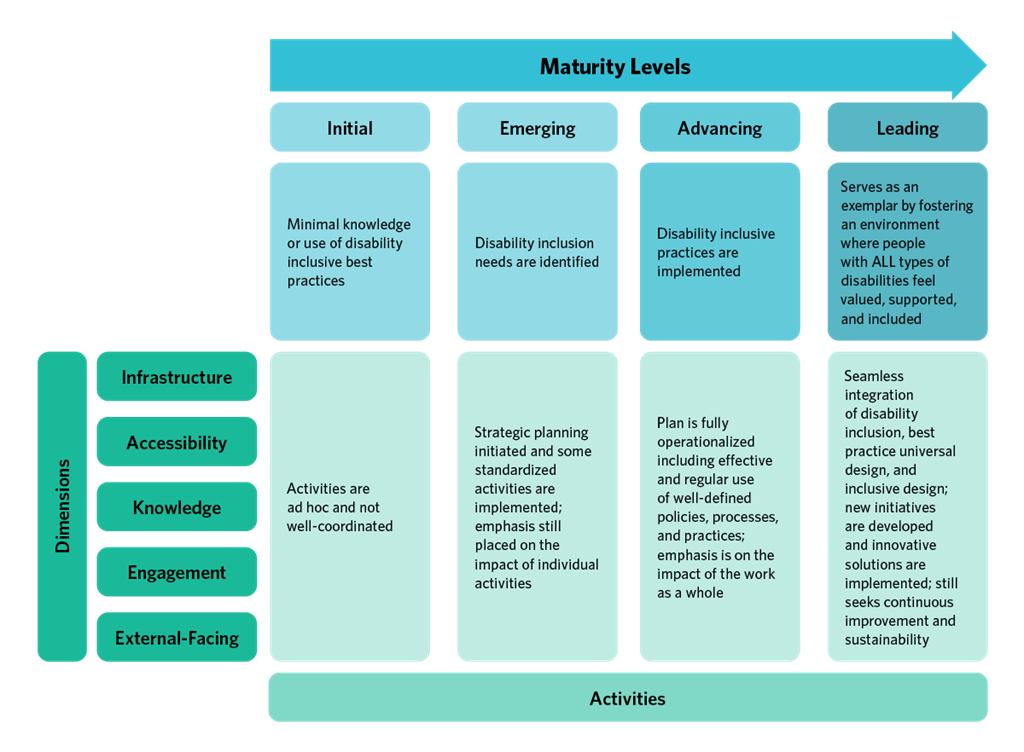
The APA Accessibility and Inclusion Maturity Model (AIMM). This model displays the four maturity levels (Initial, Emerging, Advancing, and Leading) across the top beginning with the initial level on the left side and evolving to the leading level at the other end. Along the left side, the dimensions (Infrastructure, Accessibility, Knowledge, Engagement, and External-Facing) are listed from top to bottom. The middle of the model contains high-level descriptions of the activities that will support advancement within the maturity model.
Dimensions
Dimensions are the areas by which APA will measure its maturity regarding advancing disability inclusion and equity. The following are the dimensions of the AIMM:
- Infrastructure: policies, procedures, and data collection/utilization as it relates to the inclusion of disabled psychologists, members and nonmembers, as well as staff in the Association.
- Accessibility: the infusion of universal design and inclusive design into digital (virtual), built (physical spaces), and hybrid environments. This also includes the usability and accessibility of internal and external communications, content, and materials.
- Knowledge: education, training, and guiding resources/tools for staff, psychologists, and the broader public to help build cultural humility around disability and develop an understanding of accessibility best practices.
- Engagement: raising awareness of APA’s disability inclusion initiative, soliciting the best policy proposals from experts in the field, and centering the voices of constituents with apparent and nonapparent disabilities. This includes gaining insight from psychologists and staff who identify as disabled and/or neurodivergent into our current disability inclusion initiatives and garnering input about future efforts.
- External-facing: programs, initiatives, and advocacy that use psychological science and knowledge to improve the lives of people with disabilities in psychology and society.
Activities
Activities are actions taken within each dimension to advance to the next maturity level. Examples of activities may include providing training opportunities for developing accessibility-related skills, fostering leadership development for members and staff with disabilities, and facilitating opportunities for disabled people at APA to connect with one another.
Maturity levels
Maturity levels are defined levels used to measure maturity across dimensions. Each level builds upon one another.
- Initial: little to no knowledge of the needs of people with disabilities; minimal knowledge of disability inclusion and accessibility best practices and protocols; if activities are in place, they are usually ad hoc and not well-coordinated.
- Emerging: disability inclusion and accessibility needs are recognized; planning initiated; some standardized activity implemented; emphasis placed on the impact of individual activities.
- Advancing: plan is fully implemented including consistent use of well-defined policies, procedures, and practices; emphasis is on the impact of the work as a whole and a coordinated approach is utilized.
- Leading: there is a seamless integration of disability inclusion and accessibility best practices, universal design, and inclusive design; quality data is collected and informs decisions about future activities; a culture of continuous improvement and sustainability; new initiatives are developed and innovative solutions are implemented.
Essentially, the AIMM integrates the dimensions, activities, and maturity levels into a comprehensive approach that empowers continuous improvement. With the maturity levels offering a clear trajectory, the dimensions serve as key areas for focusing the work and the activities facilitate progress. Together, these components synergize to drive meaningful change, fostering an environment where inclusivity is not just a goal but a lived reality.
Roadmap for implementation
The roadmap for implementing the AIMM and advancing disability inclusion includes four phases which are outlined in Figure 2. As detailed in earlier sections, phase one was “assessment and prioritization,” which involved development of the AIMM and prioritization of opportunities for growth. Figure 3 depicts the current strategic priorities across each dimension that APA has identified as crucial for advancing to the next maturity level.
The priorities were based on:
- maturity level criteria
- feedback and input from APA (e.g., elected and appointed leaders, divisions, staff representatives, the executive leadership team, etc.)
- universal design and inclusive design approaches
- feedback and input from expert consultants
- ongoing/current work best positioned for scaling
- the 2019 APA Resolution on Support of Universal Design and Accessibility in Education, Training, and Practice.
Figure 2.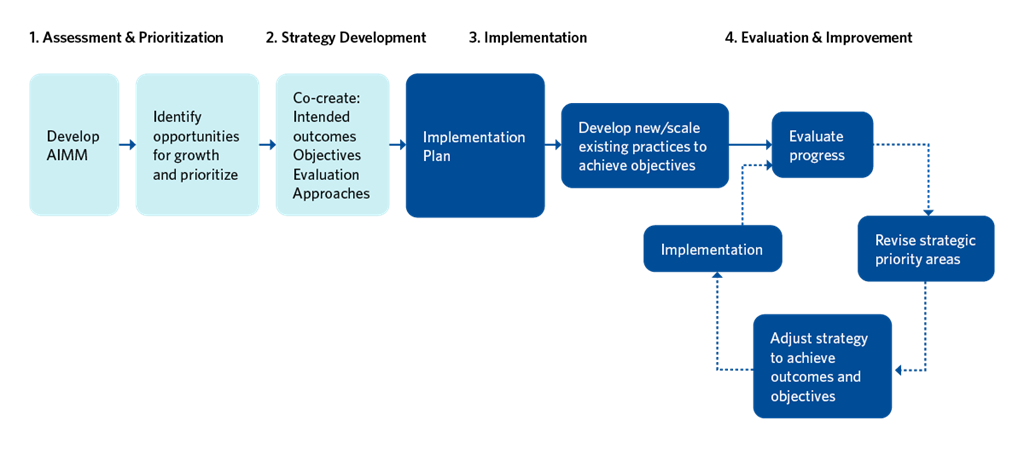
Overview of development, implementation, and evaluation process for the Accessibility and Inclusion Model. This image displays the four phases for advancing disability inclusion: 1) assessment and prioritization that involves development of the AIMM and prioritization of opportunities for growth, 2) strategy development that involves co-creating intended outcomes, objectives, and approaches, 3) implementation that includes the development of an implementation plan along with creating new or scaling existing practices to achieve objectives, and 4) evaluation and improvement that constitute the iterative process of evaluating progress, prioritizing new opportunities for growth, and implementing new and updated practices.
View a full-size version with detailed description of Figure 2
Figure 3.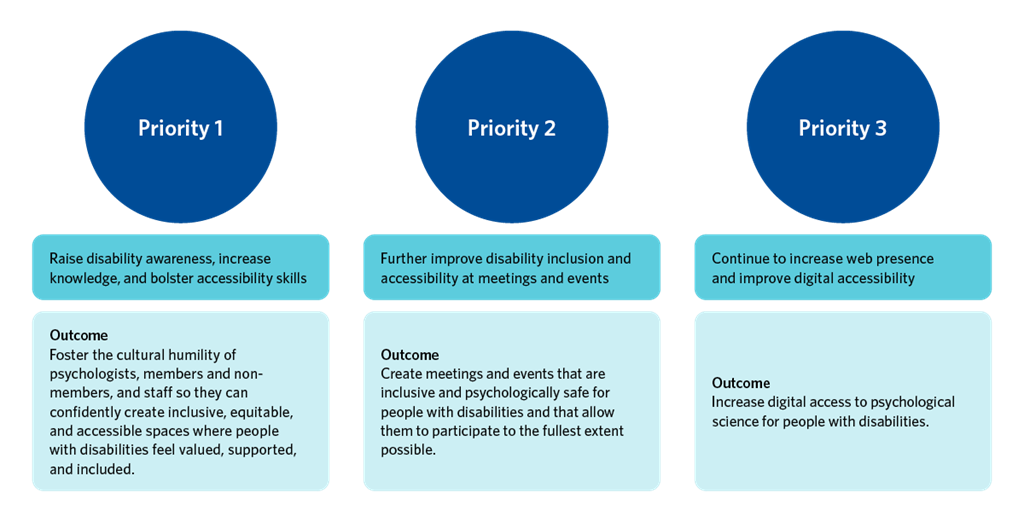
The current three strategic priority areas for advancing to the next maturity level at APA include: 1) Raise disability awareness, increase knowledge, and bolster accessibility skills, 2) further improve disability inclusion and accessibility at meetings and events, and 3) continue to increase web presence and improve digital accessibility. Corresponding outcomes are listed under each priority area.
View a full-size version with detailed description of Figure 3
After identifying the strategic priorities for the AIMM in partnership with members and staff, APA moved into the “strategy development” phase. We first identified potential functional owners, such as APA member groups and staff, with work that was already closely aligned with the priority areas. These were also people who had indicated a particular interest in further advancing disability inclusion. Initial conversations with the potential functional owners helped to determine feasibility and necessary resources for conducting new or existing work related to the priority areas. Once the functional owners agreed to complete the work, we co-created corresponding outcomes, or the intended impact of the work under each priority, and objectives. These time-bound objectives included indicators, or measurable variables, as well as the activities and outputs, or direct products that will result from the activities.
During the “implementation” phase, the functional owners were responsible for developing and implementing work plans to achieve the objectives. This mainly involved creating new projects or scaling existing practices. In addition to leading the development of the AIMM and serving as advisors during the implementation phase, the EDI Office continued to:
- assess the current state of disability inclusion and accessibility, identify barriers, and co-create solutions with members and staff across the Association
- identify successes and determine how APA can replicate those practices in the Association and in the field
- track disability inclusion activities across APA
- identify and offer suggestions for potential partnerships for increasing impact
- promote accountability for the Association’s and the field’s efforts toward disability inclusion and accessibility
Toward the end of year, APA will enter the “evaluation and improvement” phase, in which the Association will measure APA’s progress with advancing disability awareness and equity. This will be an iterative and collaborative process likely to occur on an annual basis. The AIMM is not a linear model. Regression and/or stagnation will be a risk if we do not continue to review our progress frequently and address barriers. While the dimensions of the AIMM will remain constant, new strategic priorities will be identified as APA progresses to the next level in the maturity model. Thus, outcomes and objectives will be re-evaluated and updated, as needed. Data and input collected from members and staff will continue to inform strategic planning in the coming years and help APA implement the AIMM as our ongoing strategy for advancing disability inclusion.
Conclusion
The implementation of the AIMM by APA represents a transformative approach for advancing disability inclusion, equity, and accessibility across the Association, the field of psychology, and society. Through the meticulous identification of strategic priorities and the steadfast commitment to developing corresponding outcomes and objectives, APA has laid out a clear path for progress.
Actively partnering with members and staff, including those who have the lived experience of disability, infuses every step with a sense of purpose and accountability ensuring that progress is not just a goal but a shared commitment. With the iterative nature of the model, APA welcomes change as an opportunity for growth. Consistently refining and adapting strategies to meet evolving needs ensures sustained progress over time.
APA embraces the AIMM as a guiding framework ensuring that every step forward is intentional and impactful. By emphasizing collaboration, ongoing evaluation, and data-driven decision-making, APA is charting a course towards a more inclusive and equitable future.
References
American Psychological Association. (2019a). Resolution on support of universal design and accessibility in education, training, and practice. https://www.apa.org/about/policy/resolution-support-universal-design-accessibility-education.pdfopens in new window.
American Psychological Association. (2021). Equity, diversity, and inclusion framework. American Psychological Association. https://www.apa.org/about/apa/equity-diversity-inclusion/framework.pdfopens in new window.
American Psychological Association. (2022a). Bias-free language. https://apastyle.apa.org/style-grammar-guidelines/bias-free-language.
American Psychological Association. (2022b). Guidelines for Assessment and Intervention with Persons with Disabilities. https://www.apa.org/about/policy/guidelines-assessment-intervention-disabilities.pdfopens in new window.
American Psychological Association. (2023a). 2023 Work in America Survey: Workplaces as engines of psychological health and well-being. https://www.apa.org/pubs/reports/work-in-america/2023-workplace-health-well-being.
American Psychological Association. (2023b). Inclusive language guide (2nd ed.). https://www.apa.org/about/apa/equity-diversity-inclusion/language-guidelines.
American Psychological Association. (2024). APA/APASI Strategic Plan. https://www.apa.org/about/apa/strategic-plan/apa-apasi-strategic-plan-2024.pdfopens in new window.
Andrews, E. E., Pilarski, C. R., Ayers, K., & Dunn, D. S. (2023). Advocacy: The seventh foundational principle and core competency of Rehabilitation Psychology. Rehabilitation Psychology, 68(2), 103–111. https://doi.org/10.1037/rep0000492.
Baumer, N., & Frueh, J. (2021, November 23). What is neurodiversity? Harvard Health Blog. https://www.health.harvard.edu/blog/what-is-neurodiversity-202111232645.
Bogart, K. R., & Dunn, D. S. (2019). Ableism special issue introduction. Journal of Social Issues, 75(3), 650–664. https://doi.org/10.1111/josi.12354.
Doyle, N. (2020). Neurodiversity at work: A biopsychosocial model and the impact on working adults. British Medical Bulletin, 135(1), 108–125. https://doi.org/10.1093/bmb/ldaa021.
Dunn, D. S., & Andrews, E. E. (2015). Person-first and identity-first language: Developing psychologists’ cultural competence using disability language. American Psychologist, 70(3), 255–264. https://doi.org/10.1037/a0038636.
Dunn, D. S., Ehde, D. M., & Wegener, S. T. (2016). The foundational principles as psychological lodestars: Theoretical inspiration and empirical direction in rehabilitation psychology. Rehabilitation Psychology, 61(1), 1–6. https://doi.org/10.1037/rep0000082.
Employer Assistance and Resource Network on Disability Inclusion (EARN). (2022). Including disability in diversity, equity & inclusion priorities: Building a maturity model.
Lund, E. M., Andrews, E. E., & Holt, J. M. (2014). How we treat our own: Characteristics and experiences of psychology trainees with disabilities. Rehabilitation Psychology, 54, 367–375. https://doi.org/10.1037/a0037502.
Lund, E. M., Wilbur, R. C., & Kuemmel, A. M. (2020). Beyond legal obligation: The role and necessity of the supervisor-advocate in creating a socially just, disability-affirmative training environment. Training and Education in Professional Psychology, 14(2), 92–99. https://doi.org/10.1037/tep0000277.
Persson, H., Åhman, H., Yngling, A .A., & Gulliksen, J. (2015). Universal design, inclusive design, accessible design, design for all: different concepts—one goal? On the concept of accessibility—historical, methodological and philosophical aspects. Universal Access in the Information Society, 14, 505–526. https://doi.org/10.1007/s10209-014-0358-z.
Puvar, D., & Call, E. (2021, June). The evolution of DEI. CAHRS ILR. https://est05.esalestrack.com/eSalesTrack/Content/Content.ashx?file=bba0fbda-9669-455e-bca0-8f6581000223.pdfopens in new window.
Tackett, M. J. (2023, August 4). Rehabilitation psychology’s contribution to shaping the role of equity in global health care [Conference presentation]. APA 2023 Convention, Washington, DC, United States.
Whelpley, C. E., Holladay-Sandidge, H. D., Woznyj, H. M., & Banks, G. C. (2023). The biopsychosocial model and neurodiversity: A person-centered approach. Industrial and Organizational Psychology, 16(1), 25–30. https://doi.org/10.1017/iop.2022.95.
Wright, B. A. (1972). Value-laden beliefs and principles for rehabilitation psychology. Rehabilitation Psychology, 19(1), 38–45. https://doi.org/10.1037/h0090869.
Acknowledgements
We extend our deepest gratitude to the APA members with disabilities and disability inclusion advocates, experts, governance leaders, students, and staff who have provided invaluable input and feedback during the development of the AIMM, including members from the following APA groups1:
- APA Board for the Advancement of Psychology in the Public Interest
- APA Ad Hoc Committee on Health Equity
- APA Committee on Aging
- APA Committee on Children, Youth, and Families
- APA Committee on Disability Issues in Psychology
- APA Committee on Ethnicity, Race, and Cultural Affairs
- APA Committee on Sexual Orientation and Gender Diversity
- APA Committee on Socioeconomic Status
- APA Committee on Women and Psychology
- APA Division 22: Rehabilitation Psychology
- APA Division 33: Intellectual and Developmental Disabilities/Autism Spectrum Disorder
- APA Staff Disability Inclusion Advisory Group
Prioritizing the further advancement of disability inclusion would not be possible without support from APA’s Board of Directors and the adoption of disability-related policies such as the Resolution on Support of Universal Design and Accessibility in Education, Training and Practice (2019a), and the Guidelines for Assessment and Intervention with Persons with Disabilitiesopens in new window (PDF: 715 KB)opens in new window (2022b) by the APA Council of Representatives.
This document was issued by APA on August 8, 2024.
Thank you to key staff in the Office of the Chief Diversity Officer.
Triven Parker, MPH
Deputy Chief Diversity Officer
Nichole Sorhaindo, MPH
Senior. Director, EDI Planning and Integration
Nadia Dawood, MS
Director, Diversity and Impact
Meggin van der Hilst, AuD
Director, Disability Inclusion and Accessibility
Krystal Augustin, MS
EDI Consultant
Jennifer Albert
EDI Intern
Addendum A. Recognition of contributors
APA Board of Directors
Kathleen S. Brown, PhD
APA Board for the Advancement of Psychology in the Public Interest
Arthur Blume, PhD
Sharon Adusei, PhD
Ayli Carrero Pinedo, PhD
Norma Fernandez, PhD
Jessica Jackson, PhD
Barbara Kamholz, PhD
Brian Keum, PhD
Kelly McConnell, PhD*
Kim McLear, PhD
Jessica Murakami-Brundage, PhD
APA Ad Hoc Committee on Health Equity
Maria Espinola, PsyD
Kisha B. Holden, PhD, MSCR
Kristina Hood, PhD
Ezer Kang, PhD
Norman Kim, PhD
Romee McAdams
Ida Salusky, PhD
Eboni C. Winford, PhD, MPH*
APA Committee on Aging
Rebecca S. Allen, PhD, ABPP
Lisa Lind, PhD, ABPP
Christopher Nguyen, PhD, ABPP*
Cecilia Poon, PhD, ABPP
Ann Steffen, PhD, ABPP
Susan Krauss Whitbourne, PhD, ABPP
APA Committee on Children, Youth, and Families
Laurie Cardona, PsyD*
Eileen Chaves, PhD
Laura Dilly, PhD, ABPP, NCSP
Wendy S. Grolnick, PhD
Sue Hobbs, PhD
Gary Howell, PsyD
APA Committee on Disability Issues in Psychology
KJ Conner, PhD
H’Sien Hayward, PhD*
Nazanin Heydarian, PhD
Emily M. Lund, PhD, CRC5
Cara Miller, PhD
Andrea Witwer, PhD
APA Committee on Ethnicity, Race, and Cultural Affairs
Judith A. Arroyo, PhD
Amoneeta Beckstein, PhD
Wing Yi Chan, PhD
Skyler Jackson, PhD*
Rose Weakhee, PhD
David Zelaya, PhD
APA Committee on Sexual Orientation and Gender Diversity
Kat Arenella, PhD
Taymy Josefa Caso, PhD*
Roberto Carlos González Fócil, PhD
Erin M Liebich, PsyD
G. Nic Rider, PhD, LP
APA Committee on Socioeconomic Status
Jeremy Coleman, PhD*
Deborah Fish Ragin, PhD
Rachel Renbarger, PhD
Joshua E. Turchan, PhD
Carmen R. Valdez, PhD
Melanie M. Wilcox, PhD
APA Committee on Women and Psychology
Michelle Koch, EdS, PPC
Jioni A. Lewis, PhD
Nicole M. Lozano, PhD
Aysha Najjab, PhD
Meghna Patel, PhD, ABPP*
APA Division 22: Rehabilitation Psychology
Kara Ayers, PhD
Susanne M. Bruyère, PhD, CRC
Kim Gorgens, PhD
Meredith Jan Tackett, PhD, ABPP (RP)
Kristen Jackson, PhD
Rebecca Wilbur, PsyD
APA Division 33: Intellectual and Developmental Disabilities/Autism Spectrum Disorder
Jason Baker, PhD
Rachel Fenning Baker, PhD
Cameron L. Neece, PhD
Karrie A. Shogren, PhD
Julie Lounds Taylor, PhD
APA Staff Disability Inclusion Advisory Group
Elizabeth Alger, MS
Efua Andoh
Emily Ayubi
Rebecca Cannie
Peter Cardamone
Samantha Denneny
Sean Gerety
Kris Guin
Angela Shuback, MA
* denotes current Chair of Board or Committee
Addendum B. Maturity models that informed the AIMM
The AIMM owes its foundation to the tireless efforts and extensive research conducted by numerous advocates over the years. Their dedication and commitment have laid the groundwork for this model, empowering us to build upon their insights and advance the field further. We are profoundly grateful for their pioneering work, which has paved the way for our contributions.
The following documents and maturity models informed the development of the AIMM:
Anderson, K., Esquenazi, A., Hall, J. P., Havercamp, S. M., Moore, C. L., Zazove, P., Iezzoni, L. I., Swenor, B. K., LeFauve, C. E., Shin, J. H., & Lang, N. (2022). Advisory committee to the director working group on diversity subgroup on individuals with disabilities report. National Institutes of Health. https://cpresource.org/sites/www/files/2023-09/Disabilities%20Subgroup.pdfopens in new window.
Business Disability Forum. (2022). Accessibility Maturity Model (AMM) scorecard. https://businessdisabilityforum.org.uk/knowledge-hub/resources/tech-taskforce-accessibility-maturity-model/.
Byrne-Haber, S., Fazio, D., LaPierre, C., & Sajka, J. (2023). W3C Accessibility Maturity Model. World Wide Web Consortium. https://www.w3.org/TR/maturity-model/.
Carnegie Mellon University. (2010). Improving processes for developing better products and services. U.S. Department of Defense. https://resources.sei.cmu.edu/asset_files/TechnicalReport/2010_005_001_15287.pdf.
Employer Assistance and Resource Network on Disability Inclusion (EARN). (2022). Including disability in diversity, equity & inclusion priorities: Building a maturity model. https://production-askearn.org.s3.amazonaws.com/EARN_Including_Disability_in_DEI_Priorities_Building_a_Maturity_Model_6e4565b214.pdf.
Puvar, D., & Call, E. (2021, June). The evolution of DEI. School of Industrial and Labor Relations. https://est05.esalestrack.com//eSalesTrack/Content/Content.ashx?file=bba0fbda-9669-455e-bca0-8f6581000223.pdfopens in new window.
Triangle Diversity, Equity, and Inclusivity Alliance. (2020). The Deloitte diversity and inclusion model. https://www.triangledei.org/blog/the-deloitte-diversity-and-inclusion-model.
Washington, E. (2022, November-December). The five stages of DEI maturity. Harvard Business Review. https://hbr.org/2022/11/the-five-stages-of-dei-maturity
Footnotes
1 Please refer to Addendum A for the names of the individual contributors from each group.
2 Person-first language (e.g., people with disabilities) is intentionally used interchangeably with identity-first language (e.g., disabled people) throughout this document. For more information on person-first and identity-first language, please refer to the disability section of the APA Bias-Free Language guidelines in conjunction with the APA Inclusive Language Guide (APA, 2023b).
3 Ableism can be defined as stereotyping, prejudicial attitudes, discriminatory behavior, and social oppression toward people with disabilities, inhibiting their rights and well-being (APA 2021, Bogart & Dunn, 2019). It is rooted in cultural factors and microaggressions and perpetuates a deficit-based view that devalues individuals based on their physical, cognitive, or emotional capabilities (APA, 2023b). Discrimination related to neurodiversity is a form of ableism that manifests through biases and expectations concerning cognitive abilities, neurodivergence, or mental health (APA, 2023b). As described by Dunn and Andrews (2015), the social model presents disability as a neutral characteristic resulting from external, social barriers that prevent accessibility and participation.
4 As defined in the APA Inclusive Language Guide (2023b), “Neurodiversity refers to the diversity of minds and brains that exist among all people.” While the term encompasses everyone, it is often associated with neurological and developmental conditions such as autism, attention-deficit/hyperactivity disorder (ADHD), and learning disabilities (Baumer & Frueh, 2021). With that said, neurodiversity is not limited to only disabilities or neurodivergence but also includes neurotypicality (APA, 2023b).
5 Dr. Lund also served as a representative of the Division 22 Disability Identity Committee during the review of this document.