 John D. Hogan
SAGE Publishing
Copyright 2020
ISBN 978-1-5063-7825-1
261 Pages
$30.00
Connor Cunningham, Glen Rock High School
Senior at Glen Rock High School, New Jersey
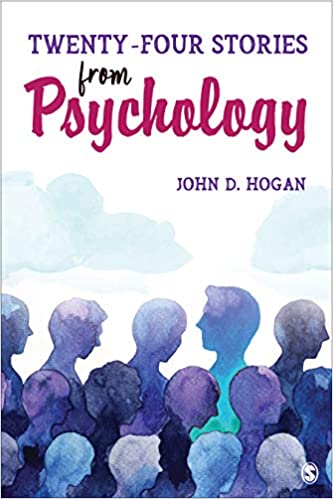
Twenty-Four Stories from Psychology features some of the most important research in the history of psychology. This collection of true accounts has been selected by Professor John Hogan of St. John’s University. Hogan strives to go beyond the typical textbook by exploring interesting topics in further detail, which leaves the reader wanting more. Hogan selected stories that he found to be incompletely reported, underrepresented or neglected, and the extra information he supplies gives a different perspective on the topic. Hogan included biographical information on the researcher to help the reader understand the historical context of the study. The book is divided into three parts: Prescientific Psychology, The Early Years, and Entering the Modern Era. It begins by telling the story of the “witches” of Salem, continues on through Pavlov and Freud, and finishes with Milgram and the account of the Kitty Genovese case.
Hogan describes criticisms, limitations, or controversies of each story which enables the reader to gain a greater appreciation of the research. He includes several stories in which experimental ethics have been questioned. One such story details the contributions of psychologist Cyril Burt, who has been excluded from traditional texts because of accusations of fraud. Others tell of groundbreaking work that had the effect of changing existing social norms, for example, Evelyn Hooker’s endeavors to challenge views regarding homosexuality. He also writes about Kenneth and Mamie Clark and their doll-test research that helped overturn school segregation.
Each story begins with information about a subject’s early life and career, which helps the reader understand their background and what it took for them to accomplish their goals. For example, the story of Mary Whiton Calkins details her struggle early in her career to find opportunities in a field that largely consisted of men. This helps the reader fully appreciate her achievement of attending graduate school and becoming the first female president of the APA. After the main discussion of the study or experiment, a consideration of its effects takes place. For instance, the story of Little Albert includes information about what may have become of him after Watson’s research was completed. At the conclusion of each chapter, Hogan provides a number of discussion questions to prompt critical thinking and reflection. Psychology teachers may find these to be particularly useful in attempting to evaluate a student’s comprehension of the text or to stimulate meaningful conversation.
Twenty-Four Stories from Psychology serves as an excellent supplement to a traditional textbook as the stories elaborate and illustrate key concepts that relate to specific topics covered in class. For example, the chapter about Phineas Gage would be a valuable reading when learning about the relationships between the frontal lobe of the brain and personality. Another example includes the story of Victor, the feral child found alone in the wild who could not be taught more than minimal language. After students learn about language acquisition and the critical period hypothesis, reading this story brings these concepts to life. Introduction to Psychology courses discuss many of the topics included in this book, but there are also several stories that are not typically found in a traditional psychology textbook. This is beneficial in that it works to broaden a student’s knowledge and perspective on the field of psychology. Students may also find that these stories pique their interest because they haven’t learned about them before or because they haven’t understood them from a psychological standpoint. Hogan himself wrote that his students were so intrigued by the story of the Salem witch trials that it had to be included in this book. In this way, Twenty-Four Stories from Psychology can help motivate students and enhance learning.
Here are five interesting fun facts I learned from this book to pique your interest:
- Freud saw a porcupine for the first time on his visit to Clark University in 1909 and he said it made his entire visit worthwhile.
- Rorschach initially proposed 15 inkblots, but the publisher reduced it to 10 due to expense.
- Pavlov was pickpocketed in New York City on his first visit to the U.S. in 1923.
- Alexander Graham Bell and his wife opened their own Montessori school in D.C.
- Richard Nixon was a participant in the Terman gifted intelligence study.