skip to main content

This page has been archived and is no longer being updated regularly.

Jeffrey Lockman, PhD

Developmental Psychologist
Jeffrey Lockman, PhD
“I study early development, from infants to young children, and I focus on what I call perception action skills.”

Tool Time

Jeffrey Lockman, PhD, studies how babies begin to use objects in a tool-like manner, which is a precursor to the motor skills needed to hammer and write, among other developmental milestones. He also works on understanding spatial cognition in children, focusing on how they integrate motor skills with thought processes.

“I became interested in babies because they present a very interesting challenge,” he says. “They clearly are capable of thinking but they can’t quite tell us through language what they are thinking or what their thought processes are.”

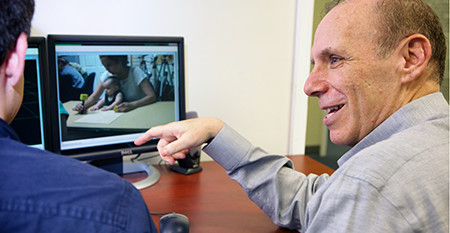
In his laboratory at Tulane University, Lockman and his graduate student research team watch what babies do with their hands, where they look and how they solve problems. “One of the things we look at, for example, is how babies bang objects,” he says. “That’s a very common behavior. One of the things we’ve tried to show is that this transitions into a very important form of tool use – hammering.”

This behavior sets the stage for more complex problem-solving skills, as well as the development of motor patterns that evolve into different forms of tool use.
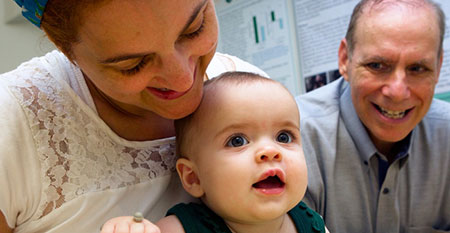
Developmental Psychology and Children

The Eyes Have It

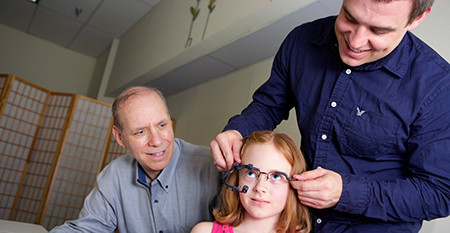
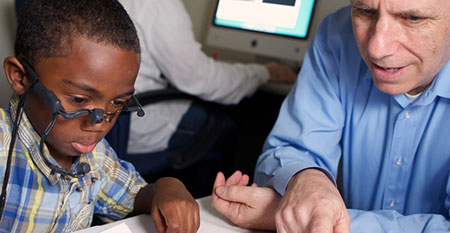
Working with older children, Lockman uses eye-tracking technology to understand the arc of their development, from object manipulation to learning how to write. The researchers attach an apparatus with two video cameras to the children’s heads. It videotapes what a child is trying to write or copy and what he or she is looking at. “We can look at how the child glances back and forth, and how the hand movements are related to the eye movements,” Lockman says. “It’s a very complex dance between what the child sees and what the child is writing.”

What the researchers learn from these observations is how the children’s movements become more automatic as the kids get older. Without using these scientific methods, Lockman says younger children’s behavior would appear to be random. But with systematic observation, “we really see that their behavior is very well-organized,” he says.

The upshot is that Lockman and his colleagues have learned that cognitive and motor skills building blocks are present in infancy, and continue to develop all the way through school and into adulthood. This research benefits parents, who want to know what their babies and children are capable of at certain ages. It also helps teachers figure out what types of play might be best for children at different development stages. And for health and medical professionals, understanding these milestones helps them see if a child is on track in development.

Dr. Lockman in Action

Dr. Lockman testing a young boy

Tracking Eye Movement

Dr. Lockman observes the relationship between hand and eye movement in young children.
Dr. Lockman observing a child

Tools Tell a Story

Hammering leads to more complex motor skills in babies.
Dr. Lockman with a student colleague

Student Colleagues

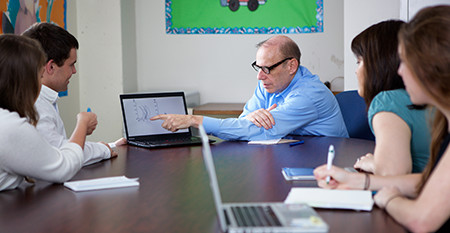
Dr. Lockman also learns from the students in his research lab.
Dr. Lockman preforming head-tracking study on child

Using Technology

Head-tracking cameras enable Dr. Lockman to see learning changes in older kids.
Dr. Lockman working with his students

Collaboration is Key

Dr. Lockman works with his students to analyze study results.

Babies are Teachers, Too

Lockman began college as a math and chemistry major, “but I took a psychology course, and it just sparked my interest, in part because of the idea that you could study behavior scientifically.” As he learned more about psychology, he felt it was a better fit than math or chemistry because he could be more creative.

Today, he says, one of the joys of being a developmental psychologist is getting to work in his lab with students at all levels, both undergraduate and graduate. “I feel that we are, together, engaged in a process of discovery and we are working toward a common goal,” he says. “I’m constantly learning new things, both from the students but also from the babies.”

“I like to say that it’s looking at infant behavior in a child-positive way. Just a simple example, a baby banging an object at a restaurant may be very annoying … but if you frame it in a way that, ‘well, this baby’s really trying to explore something; this child is really trying to learn how to control its arm movements,’ it makes you appreciate how motivated babies are to learn about the world.”

Developmental Psychology

Developmental psychologists focus on human growth and changes in development across the lifespan, including physical, cognitive, social, intellectual, perceptual, personality and emotional growth.

Learn more about the science of developmental psychology

Date created: 2015
The content I just read: