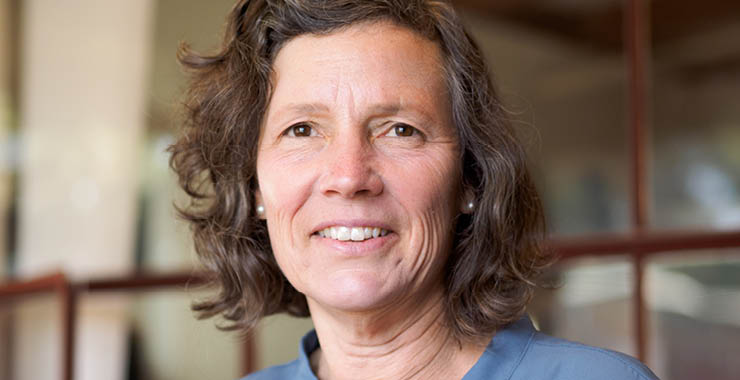
Jennifer Joy Freyd, PhD, professor emeritopens in new window at the University of Oregon (UO) in Eugene, has spent her career exploring what happens when powerful people and institutions abuse their charges. Some of her ideas have helped to change the public discussion around these topics.
“One of the hardest things for people to accept is that terrible violations can occur in situations where you would expect the most care and trust,” says Freyd, founder of the Center for Institutional Courage in Palo Alto, California. She is also the editor of the Journal of Trauma and Dissociationopens in new window, and has appointments to Stanford Universityopens in new window in Palo Alto, where she obtained her doctorate in psychology.
An expert on memory, Freyd began in the early 1990s to research sexual violence, developing her theory around what she calls “betrayal traumaopens in new window,” which can occur “when the people or institutions on which a person depends for survival significantly violate that person’s trust or well-being.”
Freyd says that when she was starting out, even some colleagues reacted with embarrassment or impatience to the attention she was paying to what they characterized, she says, as “an obscure little problem affecting a very small number of people.”
But other researchers, including psychologists like Mary Kossopens in new window, PhD, a professor at the University of Arizona, had already begun to illuminate the actual scope of sexual violence. In 1987, Koss published the first national study of sexual assaultopens in new window among college students that showed that 28% of college women reported being the victim of rape or attempted rape, and 8% of college men reported perpetrating sexual violence.
“It impacts so many people,” Freyd says.
According to the United States Centers for Disease Control and Prevention, nearly one of every seven American women is rapedopens in new window in her lifetime—90% of rape victims are women. One in four girls and one in 13 boys will experience sexual abuse in childhood, and most of their abusers will be a relative, family friend, or acquaintance.
Freyd’s 1996 book, Betrayal Traumaopens in new window: The Logic of Forgetting Childhood Abuse, explores coping mechanisms people employ going forward from this kind of transgression. One such coping strategy Freyd calls “betrayal blindness,” an “unawareness, not-knowing, forgettingopens in new window” of those painful events. In 2013, Freyd wrote a book with UO colleague Pamela Birrellopens in new window called, Blind to Betrayalopens in new window.
Betrayal blindness can range from complete forgetting to being somewhat aware of the betrayal. In the latter case, the betrayed individuals “don’t forget the facts, but they twist around the causality,” Freyd says.
Betrayal compounds the trauma
Betrayal adds to the toxicity of a trauma. “If you have a sexual assault by a stranger versus a parent, how do they compare?” she asks. Her research found that betrayal accounted for “a lot of problems” in terms of mental health, physical responses, and behavior. Abusers are not always men, and betrayal trauma does not exclusively affect women. However, Freyd says, “there is a pretty big gender effect. Betrayal is associated with being female.”
Freyd describes herself as a theoretician. One of her most influential ideas has been DARVO, an acronym for "deny, attack, reverse victim and offender," which Freyd coined to identify a manipulation she says abusers commonly deploy when victims attempt to hold them accountable. This strategy, Freyd has asserted, is to deny wrongdoing, attack the accuser's credibility, and assume the role of an innocent victim suffering under a false accusation.
“Concepts are the primary way that I’ve made intellectual contributions,” she says, but she has also proved out some of her concepts, often because, at crucial points, her graduate students have helped devise ways of pinning down the data.
In 2010, one such student, Carly Smith, took the point on creating a questionnaire for measuring “institutional betrayal,” which Freyd says occurs when families, employers, schools, religious organizations, or other entities fail to protect those in their care from sexual violence or other types of abuse committed within the context of an institution. Freyd’s team went on to study institutional betrayal, and the concept eventually came to resonate well beyond the mental health field, she says.
Broken trust is the key element. “We interact with some institutions in that same way [as with trusted individuals]. We depend on them. People have an emotional attachment to those institutions, and once you’ve got that, you can be betrayed.”
Since she began her research, Freyd says, “there's been a huge shift” in the public toward a willingness to believe people who claim to have been sexually assaulted or harassed. Contrary to popular opinion, though, she says, that shift didn't happen overnight.
“There was a growing awareness, over the course of thirty years, with lots of ups and downs,” she says.
The Boston Globe’s 2002 investigation of child sexual abuse by Roman Catholic priests was a real watershed in terms of public acceptance of survivors’ accounts of abuse. Since then, the military, religious groups, schools at all levels, employers, and athletic and social organizations have been found to be protecting abusive individuals who have committed sexual violence or other abuse.
Taking a stance of institutional courage
Freyd officially resigned from UO in March, though she still has a lab and graduate students there. Increasingly, she says, she will be looking at institutional courage, which she defines as a “commitment to seek the truth and engage in moral action, despite unpleasantness, risk, and short-term cost.”
Freyd says she founded the Center for Institutional Change to foster research to guide institutions toward better structures to support the people who rely on them. “We have documented that betrayal is really harmful. The question is what to do about it,” she says.
One step institutions can take toward a stance of institutional courage is gathering anonymous, scientifically sound data about the interpersonal experiences of their members, as well as the behavior of the institutions. Freyd says that the United States Armed Forcesopens in new window, for example, have been doing that for some time.
Another step is to support whistleblowers when they come forward with complaints or disclosures of bad behavior. Those individuals are doing the institution a great favor, and should be rewarded, not punished, Freyd says. “As soon as you start cherishing truth-telling, you change the culture dramatically,” she said during a recent panelopens in new window discussion on institutional courage.
“Activists are really important, but I think researchers have made a huge difference” in making justice and healing accessible to those who have endured betrayal and sexual violence, Freyd says. “There is science, and it gives credibility to survivors and their advocates.”