
The world's population of 7.3 billion is predicted to grow to 9.7 billion by 2050, according to the Global Harvest Initiative. To feed all those people, global agricultural productivity must increase by 1.75 percent annually.
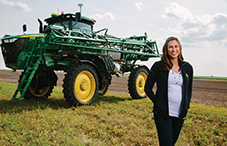
One person working to drive this increase is Margaux Ascherl, PhD, user experience leader at John Deere Intelligent Solutions Group in Urbandale, Iowa. John Deere recruited Ascherl in late 2012 while she was finishing her PhD in human factors psychology at Clemson University. Five years later, she now leads a team responsible for the design and testing of precision agriculture technology used in John Deere equipment.
Ascherl spoke to the Monitor about what it's like to apply psychology in an agricultural context and how her team is helping farmers embrace new technology to feed the world.
What does your job entail?
My team is dedicated to making a good farm even better, in particular through the powerful combination of precision ag equipment and technology—the precise placement and timing of inputs into the land, whether that be seed, moisture or crop nutrients. It's about more output and less input, which is better for the crops, the land and the farmers.
We work with the precision agriculture technology used in our machinery, like tractors, harvesters and planters. This covers everything that goes in the cab, from seats, controls and displays, as well as the technology outside of the cab that controls an array of factors from seed placement, weed and pest management to data collection. This increased technology has made the farmer's job more complex, so our group is responsible for creating the best user experience possible, so that farmers can focus on farming.
How did you find your job at John Deere?
I was working on my PhD in human factors psychology at Clemson University. About a year before I graduated, John Deere approached the school with a job opportunity. I learned about all the cool stuff that John Deere was doing in robotics and automation, and that captured my interest. A site visit the following summer sold me on the job.
How do you use your applied psychology training?
There are so many areas to apply our human factors knowledge—there's always a new and interesting challenge to tackle.
I started out as a senior engineer on a product team at the Moline Technology and Innovation Center, designing and testing interfaces and working through automation design issues. We'd look at industry literature and what we know on a particular topic, and apply it to a particular design. We took psychology principles and predicted how our customers would respond to design changes. We were often in the simulation lab, figuring out how to test something that wasn't quite ready for production. It's expensive to go to the field since our equipment is very large and our customer's time is valuable, so we come up with ways to work problems out in the lab first.
My next role was managing a team that looked at the entire experience across the cab. I did a lot of field research, riding along with customers and listening to their feedback on the things they liked and didn't like in the cab.
Now I manage a larger group that is working on the complex strategy of how we tie all these things together. As precision agriculture grows, automation is increasing, so the level of insights we're aiming to provide our customers through data is increasing as well.
Tell us about visiting customer farms. What do you learn from observing farmers in action?
It's fun to see how the products we've put into production are helping farmers, and how farmers are adapting to complex technology. We help them document their outcomes, and through this data they get insights into ways to increase yield and efficiencies that they wouldn't have thought of in the past.
It's also fascinating to observe just how much a farmer does in the cab. They say they're not doing much, but they're monitoring a lot of information. There are screens inside the cab to monitor as well as what's going on outside their window with the implements, such as a combine header, loader bucket or planter. There's also information coming in on their radio and smartphones, whether that be weather, crop prices or updates from other parts of their farm business. Farmers are so good at their job they don't always realize how much information they're processing to make the right decisions in the field every day.
What's it like working with huge farm machinery?
Seeing these machines up close for the first time is amazing for a human factors engineer. A combine is basically a factory on wheels, with the cockpit of a plane. It melds all the things that you study in human factors into one vehicle. There's the cockpit to consider, as well as the transportation and manufacturing aspects.
I'm from Merritt Island, Florida, so I grew up watching space shuttle launches on the coast. I understood how important human factors is in engineering for making things useful and easy to use. So I was fascinated to learn that many John Deere machines have almost as many lines of code as a space shuttle. The 8R tractor, for example, has over 4 million lines of code and 20 processors.
What do you enjoy most about your position at John Deere?
I'm constantly learning, and there's always a new problem to solve. I love that we can see our work go into production and observe firsthand how it changes farming. When farmers tell us how our products have improved their operations and made their lives easier, that makes me feel great about the work we do.
What would you say to applied psychology graduates who may not have considered the agriculture industry as a career path?
This is a great field if you enjoy searching for solutions. If you like the user-centered design process, you'll get to collaborate with fellow human factors experts as well as agronomists, industrial designers and people from all types of engineering fields. You also get to see the output of your work fairly quickly, which is very satisfying.
This really has been the career opportunity of a lifetime. There's no such thing as a typical day. I could be in the office, in meetings, in a workshop or heading out to a test farm. There's a pair of boots that always sit in my office. I'm never sure when I'm going to need them, but I'm always ready.
Does this career path sound interesting to you? Learn more about applied psychology careers, research and more by visiting the website of APA's Div. 21 (Applied Experimental and Engineering Psychology) at www.apa.org/about/division/div21 .