
For social psychologist Yorelis Acosta, life as a professor at the Universidad Central de Venezuela’s Centro de Estudios del Desarrollo in Caracas is increasingly hard. Hyperinflation and payroll deductions have reduced her university salary to nothing. Last year she juggled four jobs so she could eat, and she now collects food, clothing and money for colleagues who are even needier than she is. The assistant helping her in her research on the economic crisis’s impact on university professors had to quit because she kept breaking down after every interview.
Stories like Acosta’s have become common in Venezuela. Once Latin America’s wealthiest country, the oil-rich nation has fallen on hard times, with an already-struggling economy descending into crisis after Nicolás Maduro took over as president from Hugo Chávez in 2013. The years since have seen a worldwide collapse in oil prices, mismanagement of the economy and international sanctions against Maduro’s increasingly authoritarian regime. By printing more money in response to the crisis, the government has created hyperinflation, which the International Monetary Fund predicted would reach 1 million percent by the end of 2018. With its money worthless, the government can no longer afford to import food, medicine and other necessities.
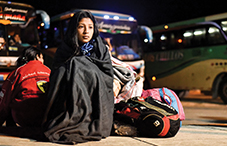
As a result, some Venezuelans are now starving. Those who can are fleeing. Since 2015, 1.9 million Venezuelans have left the country, according to the Office of the United Nations High Commissioner for Refugees, with 5,000 more joining their compatriots abroad each day.
Among those who remain, there’s a growing mental health crisis, says psychologist Juan Carlos Canga Linares, president of the Federación de Psicólogos de Venezuela, citing the frustration, stress, fear and despair brought on by insecurity, resource shortages and sociopolitical conflict.
“The frequency and intensity of these situations is exhausting Venezuelans’ psychological resources,” says Canga.
A mental health crisis
Although psychologists themselves are also affected, they are taking action.
Acosta, for example, has been creating “emotional maps” since 2015, conducting qualitative research with Venezuelans in Caracas and 10 other cities across the country about how they’re feeling. While an opposition victory in the National Assembly initially prompted hope and joy among the 2,534 Venezuelans Acosta and her team surveyed in 2015 (Comunicaciónopens in new window, Vol. 174, 2016), dashed expectations and no improvements in living conditions have meant a return to despair. Since then, Acosta’s follow-up research has found a predominance of negative emotions such as sadness, fear and anger.
At the same time, the public sector’s capacity to meet Venezuelans’ mental health needs is diminishing, says Canga. To help fill the gap between increasing need and decreasing services, the Federación de Psicólogos de Venezuela has launched a one-day-a-week hotline operated by volunteer psychologists, plus a program in which volunteer psychologists offer no-cost services in their private practices. The federation has also created an online directory of mental health centers offering free or low-cost care.
Educating the public about coping strategies is also key, says Canga. Psychologists are speaking out about stress and other mental health problems on radio and TV, and the federation is stepping up its presence on Twitteropens in new window and Instagramopens in new window. The federation has produced brochures offering advice for managing stress, handling anger and street violence, and discussing inflation and scarcity with children. It has also issued half a dozen pronouncements expressing concerns about the crisis’s impact on mental health, offering recommendations as well as psychologists’ expertise.
Special populations
The crisis has hit certain groups especially hard. For those with severe mental illness, the unavailability of psychiatric medications has meant relapses or financial difficulties for families forced to buy medication on the black market.
Children are also particularly vulnerable to the effects of the crisis. “Venezuela’s humanitarian emergency has had a profound impact on children and adolescents,” says psychologist Abel Saraiba, who coordinates a program called Growing Without Violence for a nonprofit group called Cecodap that promotes and defends the rights of children and adolescents in the country.
Anxiety and depression are increasingly common among Venezuela’s young people, and violence against children is rising along with parents’ frustration and anger over their inability to provide for their families. Many children whose parents have emigrated elsewhere are now being raised by grandparents, aunts and uncles or even minor-age siblings, and they often experience deep feelings of insecurity, sadness and anger, as well as feelings of abandonment. The effects of all these stressors could be long-lasting, warns Saraiba, noting that children may have trouble managing their emotions and parenting their own children once they’re adults.
Women and girls are having an especially hard time, in part because they tend to get short shrift when it comes to families’ food supplies, says psychologist Magdymar León Torrealba, who coordinates a nonprofit group called the Asociación Venezolana para una Educación Sexual Alternativa, or AVESA. Also, with contraceptives now largely unavailable, there has been an increase in unwanted pregnancies and the intense stress, anxiety and depression that can accompany them, says León, noting that there has been an uptick in abandoned fetuses and newborns.
“The fact that women don’t have the ability to control their reproduction interferes with their exercising of other rights,” she adds. Pregnancy, for example, often curtails the ability to go to school or get a job, she points out.
And because Venezuela has one of the region’s most restrictive abortion laws, terminating unwanted pregnancies brings the additional stressors of potential criminal prosecution and physical harm or even death. At the same time, women forced into maternity may develop substance use problems, anxiety, depression or panic disorders, or they may take out their frustrations on vulnerable family members, says León.
AVESA is now working with the nonprofit humanitarian organization Psicólogos sin Fronteras and another group to bring a gender-sensitive perspective to a program they’re developing to train social “promotores” to provide psychosocial support to low-income communities in Caracas. AVESA also hopes to expand the program to psychologists and groups León calls “human rights defenders.”
Victims of state violence—including mistreatment, torture, forced disappearances and public shootings by state security forces—are also a matter of major concern, says social psychologist Pedro E. Rodríguez, PhD, a professor and researcher in the Universidad del Valle’s Instituto de Psicología in Cali, Colombia, who decided to leave Venezuela after failing to find basic medicine to treat his young child’s fever. “The psychological effects of these events are simply brutal—not only for the victims but for the general population,” he says.
There has also been “a process of pathologization and stigmatization of the political enemy carried out by the national government,” Rodríguez says. “This enemy has several forms,” he explains. “While ‘enemy’ usually means a political adversary, it can also be an abstract notion, such as ‘the rich’; a country, such as the United States; or an idea, such as imperialism or capitalism.”
The impact of psychology
Venezuelan psychology is suffering along with the rest of society. The number of professors and students is dwindling, says Acosta, who has studied the plight of Venezuela’s professors (Revista de Investigación Psicológicaopens in new window, online first publication, 2018).
“Today, teachers are more concerned about covering their basic needs, which detracts from their academic work,” says Acosta. Research is also suffering, with diminished access to books, databases and international conferences. “We are gradually disappearing from the international scene,” she says. “The future does not look good.”
Many psychologists who have been forced to leave Venezuela are working to help their fellow Venezuelans from the outside. One is clinical psychologist and former Universidad Católica Andrés Bello professor Alejandra Sapene Chapellin, who left Venezuela two years ago in the face of hyperinflation, increasing limits on freedom of expression and the violence engulfing Caracas.
Sapene, now a researcher and professor at the Universidad Libre Seccional Cali in Valle del Cauca, Colombia, coordinates a virtual network called Madres Venezolanas por la Pazopens in new window that brings together various disciplines and organizations to ensure the well-being of children, adolescents and families; share strategies for weathering the current crisis; and promote democratic behavior and solidarity among Venezuelan families. Sapene also provides online psychotherapy to Venezuelans and serves as a board member of Cecodap.
Despite the problems, there is some hope, says Rodríguez, who calls on Venezuelans to be both realistic and optimistic about the future. “Venezuela reinvented itself in the 20th century, after a series of military dictatorships,” he says. “It will have to do it again in the 21st century—a process that will be hard and expensive and cause immense social and psychological wounds to the population, creating new challenges for the practice of psychology.”