The COVID-19 pandemic is disrupting psychological research around the world, forcing researchers to delay many laboratory studies. But as some research avenues temporarily shut down, others are opening. Psychologists and other behavioral scientists are studying the immediate and long-term effects the pandemic is having on mental health as well as using this unplanned “natural experiment” to explore difficult-to-study psychological and social phenomena such as quarantine and forced telework on a mass scale.
Since early March, the National Science Foundation (NSF) has funded several dozen pandemic-related research proposals through its Rapid Response Researchopens in new window grant program. The Agency for Healthcare Research and Qualityopens in new window and government agencies in half a dozen countries around the world have also released grants solicitations of their own. In addition, the National Institutes of Healthopens in new window (NIH) has solicited COVID-19-related supplements to existing grants. And some private entities, including the American Psychological Foundation, have also announced funding for COVID-19-related psychology research.
“Psychology and social science research are more important today than ever,” says Arthur Lupia, PhD, NSF assistant director and head of the agency’s directorate for social, behavioral and economic sciences. “It is critical to national resilience and it is essential in understanding and protecting the safety of health-care workers and first responders. This type of research empowers the nation to take the fight to COVID-19.”
Something to 'sink our teeth into'
The new research has come together quickly. During the initial days of the COVID-19 lab shutdowns, “we went through what can only be described as total paralysis,” Micah Allen, PhD, an associate professor of psychology at Aarhus University in Denmark, wrote in a long Twitter threadopens in new window. “I initially played videogames until my eyes bled…But then I needed—we needed—something to sink our teeth into.”
After brainstorming with his colleagues, Allen put together a self-report study to investigate whether people self-isolating at home during the pandemic shutdown would experience distress as a result of paying more attention to bodily signals from their lungs, heart, stomach and throat. The project gave him new motivation. “As soon as we had that collective goal, the change was clear,” Allen continued. “We were all energized, excited to work.”
Labs around the world have followed a similar trajectory—after shelter-in-place orders sent them home, research teams regrouped online to see what they could learn from the pandemic. So many new projects launched in such a short time that it was hard to keep up with them all. To help amass a list, on March 19, Cornell University professor of psychology J. Nathan Matias, PhD, tweeted out a call for psychologists and social scientists to add their COVID-19-related studies to a crowdsourced list of projectsopens in new window that he put together with Alex Leavitt, PhD, a computational social scientist at Facebook.
“At critical moments like this, it’s especially valuable to coordinate resources, ideas and data,” Matias says.
As of late April, descriptions of more than 260 projects have been added to the tracker, along with links to research and analysis plans. About half of these studies are in the data collection stage, while a couple dozen have already been uploaded to preprint servers such as PsyArXivopens in new window—which, as of late April, is hosting nearly 100 COVID-19-related reports. In addition, peer-reviewed journals, including Nature, Human Behaviour, Royal Society Open Science and the European Journal of Personality, as well as a number of APA journals including American Psychologist, have committed to accelerated review of COVID-19-related research in order to publish findings quicker.
Meanwhile, the Psychological Science Acceleratoropens in new window (PSA), a global network of researchers collaborating to conduct rigorous, large-scale psychology research, is fielding three studies focused on framing social distancing recommendations and regulating negative emotions. “Our hope is that results of these studies will contribute to our understanding of how people around the world are feeling and thinking in the midst of this pandemic,” says PSA Associate Director Heather Urry, PhD.
New research questions
Among the studies conducted so far, many have addressed one of the most difficult aspects of the outbreak—the physical distancing measures required to slow the spread of the pandemic. Researchers have been trying to understand why some people are willing to engage in this protective measure while others are not, and they have found evidence that many factors play a role: empathyopens in new window, whether a celebrity has endorsed the ideaopens in new window, knowledge of science and trust in medicineopens in new window, and whether public health messaging focuses on individual or collective benefitsopens in new window.
In that last study, for example, researchers led by David Rand, PhD, of the Massachusetts Institute of Technology, presented 2,176 Americans with basic information about the pandemic—including the number of confirmed cases, projections of the number of deaths and the fact that there is no vaccine—and messages about keeping safe that focused on benefits to individual health, community health or both. They found that messages that emphasized the benefits of preventative behaviors for other people’s health were more effective at increasing prevention intentions than messaging that focused on the benefits for individual health.
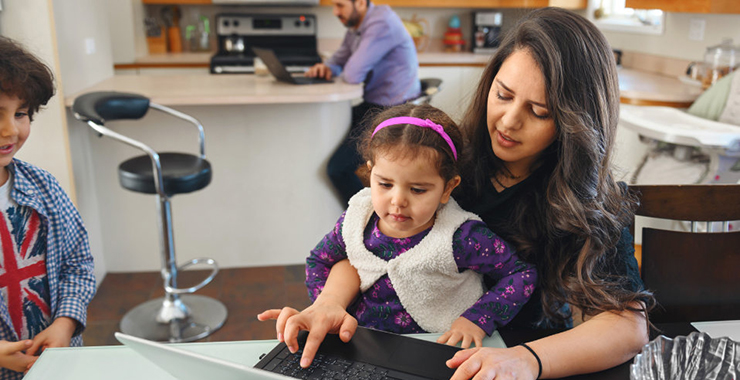
Another topic that has attracted considerable attention is mass forced telework. Kristen Shockley, PhD, an associate professor of psychology at the University of Georgia, for example, has received an NSF Rapid Response Research award to determine pre-COVID-19 factors that predict a more successful adjustment to telecommuting, including characteristics of the job, the organization and the employee. Shockley has also obtained internal funding from her university to investigate how couples with children are coping when both adults are working remotely full time. “What will give? How will spouses compromise during this time? Whose career productivity takes a hit? These are the questions we’re interested in,” she says.
Like Shockley’s telework studies and the physical distancing studies mentioned above, the vast majority of psychological studies about the pandemic are being done via online surveys, in-depth phone interviews and daily diaries. In addition, researchers are deploying creative research methods, including digital ethnography, online games, Google Trends analysis, observation of CCTV footage, and analysis of social media, news stories and governmental policies.
A good example of creatively using existing data to try to learn something new from the pandemic is a studyopens in new window, now posted on PsyArXiv, led by Shinobu Kitayama, PhD, a professor of psychology at the University of Michigan. Kitayama and his team hypothesized that relational mobility—a community-level tendency to engage with strangers and freely choose friends—might be associated with the faster spread of infectious viruses, including COVID-19. Using daily confirmed cases and deaths for 37 countries compiled by Johns Hopkins University, and relation mobility metrics for those countries publishedopens in new window in 2018, the researchers found a strong correlation between the rate of increase of confirmed cases and relational mobility. “Virus infection and propagation are biological at one level, but they are related to our behavior and our culture,” Kitayama says. “They are greatly influenced by social psychological dynamics.”
Mental health impacts
Another major question on many psychologists’ minds is the long-term mental health implications of the pandemic. One team of researchers at the University of British Columbia—led by health psychologists Nancy Sin, PhD, and Anita DeLongis, PhD—launched a studyopens in new window in March that will follow people over time to understand their fears and anxieties about the outbreak and identify psychological and social factors that promote better coping and adjustment during the crisis.
“Before the pandemic, I was doing a longitudinal study focused on daily stress and positive experiences, particularly related to aging. We recruited older adults from the community centers and had them do some intensive health assessments, wear health monitors and collect saliva across multiple days,” Sin says. “We obviously had to put that work on hold.”
With the team’s new online study, Sin hopes to still focus on older adults and their experiences. But she faces new barriers as well. “The truth, though, is that we can’t really get the same sort of sample online, especially of older adults, because many may not use mobile technology or have an internet connection,” says Sin, who notes that researchers also struggle with recruiting people from a wide range of ethnic backgrounds and socioeconomic statuses for online studies.
While these new studies take shape, researchers who had been leading large ongoing projects have had to decide either to hit the pause button, like Sin, or to shift their project’s focus to pandemic-related questions. One researcher who is doing the latter is Susan Tapert, PhD, a professor of psychiatry at the University of California, San Diego. She leads one of several projects that are part of the Adolescent Brain Cognitive Development (ABCD) study, a massive effort funded by the NIH in which 12,000 children and their families have been enrolled in 21 sites across the United States. Tapert and her group had been using brain imaging, neuropsychological testing, bioassays and other methods to identify predictors and consequences of substance use in children and adolescents. With COVID-19 making it impossible to collect their normal stream of data, Tapert and the directors of ABCD projects at the other sites have modified their ABCD research to include videoconferencing and phone interviews to explore how the pandemic may affect children’s development.
“We have kids in New York City who we know will be very heavily affected, and we have kids in less impacted cities, such as here in San Diego,” Tapert says. Her team plans to track such local differences and their impacts over time.
“The COVID-19 pandemic is touching on every part of our lives,” Matias says. “There are political psychology angles to explore, as well as public health behaviors, impacts on relationships and general questions about mental health and stress.”
There are so many ways researchers can contribute, he adds. “If we can do it in a careful, evidence-based way, then I think psychologists can be doing a lot of good right now.”