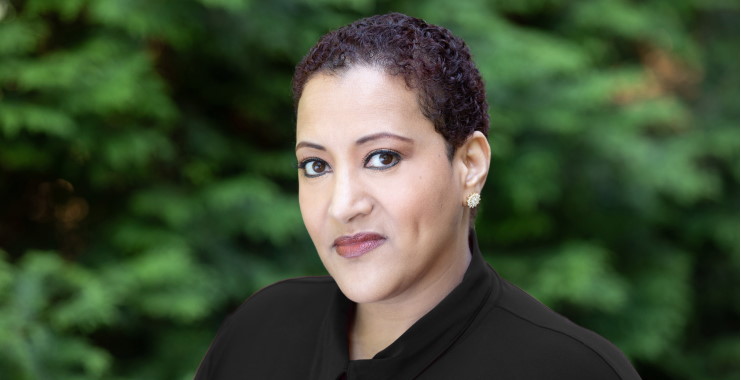
Remote work has been shown to boost productivity, according to years of research by organizational behaviorists. So when the COVID-19 pandemic triggered a massive global shift to working from home, Tsedal Neeley, PhD, a professor of business administration at the Harvard Business School, was not worried about slackers and lollygaggers bringing corporate productivity down.
Neeley, the author of Remote Work Revolution: Succeeding from Anywhere (Harper Business, 2021), is now concerned that many workers will struggle with edicts to return to offices. If companies pay attention to the findings of research—and the lessons of the pandemic—however, 2020 may be remembered as a year when work changed forever.
The Monitor talked to Neeley about what this shift might mean and where organizations and companies need to go from here.
For someone who studies remote work, the pandemic had to be quite an abrupt experience. Did anything surprise you about what happened when so many people suddenly became remote workers?
What surprised me was how quickly people adapted. When the global pandemic started to rage in March 2020, the sheer scale of people who migrated home to begin their remote work “grand experiment” was huge, crossing many industries, companies, and countries. Within a matter of days, people began to use digital tools that used to be complements in their repertoire as lifelines and became quite fluent in how to use them and how to interact remotely. The speed of the adaptation, when it was necessary, was mind-blowing.
Are the benefits of remote work limited to white-collar office workers, or can we see this trend somehow benefiting all workers?
There are disparities as to what work can be done remotely, no doubt about it. One of the things that people and organizations are trying to do is to look at job tasks very closely to determine how certain job functions or technologies can afford virtuality in ways we hadn’t thought about.
For example, imagine a counseling center where the work is tied to in-person meetings. Can you do counseling work remotely? Well, it was done very effectively during the pandemic using new telehealth technologies. But those are still white-collar jobs.
One of the things to consider in expanding the benefits of remote work for those whose work is tied to physical spaces is to offer people learning days remotely. They can develop themselves in a remote environment and also enjoy some of the flexibility it affords. We have seen many continuing-education courses and professional conferences go virtual. Otherwise, remote opportunities become an inclusion issue, a luxury, and a privilege that only some members of an organization can participate in. You want to figure out a way to spread the flexibility, which is the key aspect of remote work that people so value.
How will the increase in remote work affect different demographic groups? Might we see disparities for BIPOC or women, or perhaps advantages for groups who have been disadvantaged in the past?
Interestingly enough, there is very compelling data of marginalized groups who report that they’ve never felt more included in their organizations. They’ve never experienced fewer microaggressions. This is also the case for people who are physically differently abled, who are saying, “I can finally participate in professional endeavors in ways that I just couldn’t before.” My deepest worry today is what the return to work will look like for these members of organizations. For example, many Black professionals are experiencing a positive remote-work professional life, and they’re not excited about going back to work. Organizations have to work very hard to create cultures that are inclusive, that are safe, and that are an improved environment for different groups.
How can employers best create effective interactions between in-person and remote employees?
In-person and remote-employee interaction is where hybridity becomes complicated. All-or-nothing is always easier. But the hybrid format is also not new. Global organizations have been participating in hybrid formats for decades, so the leaders and managers need to have rules of engagement that ensure that everyone is able to participate fully, that people are sharing airtime, and that managers are not privileging those that they have near them—what people are calling “proximity bias”—when they think about their entire team.
The big question people have to answer is: Why are you instituting a hybrid schedule? If it’s only to do the same kind of things that people can do at home, minus the commute and minus the stresses, it’s not going to work. Collaboration, social connection, and innovation all have to be heavily woven into the in-person format.
How can companies ensure equity and fairness in who is offered flexible schedules?
The framework has to be established by top leaders and be the same across the company, because you don’t want one manager to offer lots of autonomy and flexibility while another manager requires rigid in-person schedules. Within that framework, individual managers and groups can have their own interpretation. Otherwise, you could very quickly build inequities within your organization without consciously approaching scheduling with equity in mind. The centralized framework can articulate the type of activities that are ideal for the office. It’s important for the hybrid schedule to be cocreated with those who have to live it out. There is no one-size-fits-all.
Finally, we have found that it’s important for companies to approach this in an experiment-learn-and-iterate mode, because surely many will learn lessons that will help them ensure that everyone can thrive.