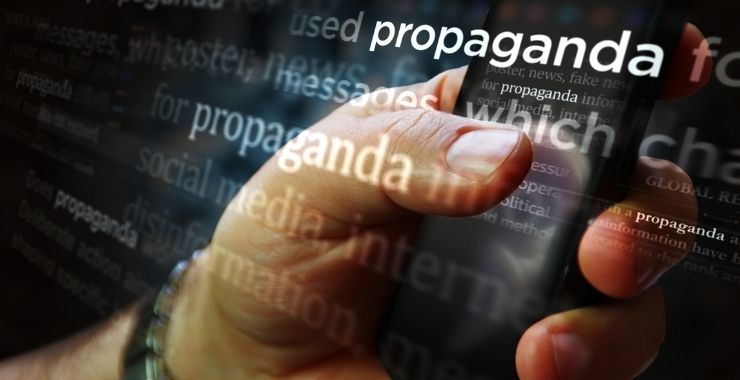
Disinformation in war is nothing new—in fact, it’s a key part of the playbook. Leaders commonly inflate or fabricate information about everything from military might to supposed atrocities to confuse opponents or boost morale at home. Even Ukraine has appeared to pushopens in new window some wartime narratives that may be false.
But with the rise of social media, propaganda can now be deployed on a much larger scale—and it has been used to garner support for genocide and other human rights violations, including those against the Uyghur population in China, the Rohingya in Myanmar, and Muslim populations in India. To describe the growing role of online media in political conflicts, Singer helped coin the term “LikeWar.”
“If you think of cyber war as the hacking of networks, LikeWar is its evil twin: the hacking of people on those networks, through our likes, shares, and sometimes lies,” said Singer, who is also a strategist and senior fellow at the nonpartisan public policy institute New America.
For years, Russia has been waging—and winning—a LikeWar against much of the world. The Kremlin has deployed tried-and-true psychological manipulation strategies via social and online media, including disparaging outgroups and rapid-fire lying, according to research by Jon Roozenbeek, PhD, a postdoctoral fellow in psychology at the University of Cambridge, who studies mis- and disinformation and media discourse in Ukraine.
Roozenbeek documented how the Kremlin stoked outgroup animosity toward Ukrainians and the Ukrainian government during the takeover of the Donetsk and Luhansk regions in eastern Ukraine, a tactic linked with high social media engagement (“Media and Identity in Wartime Donbas, 2014–2017opens in new window,” University of Cambridge, 2019; Rathje, S., et al., PNASopens in new window, Vol. 118, No. 26, 2021).
Another ploy Russian President Vladimir Putin has used to great success is conspiracy “gish gallop,” or rapid-fire lying, said Roozenbeek, for instance around the Malaysian Airlines disaster of 2014. The Kremlin’s constant stream of liesopens in new window—that it was a Ukrainian attack, that all the passengers were dead before takeoff, that the pilot intentionally crashed the plane—is used to sow confusion and disillusionment (Paul, C., & Matthews, M., RAND Corporationopens in new window (PDF, 177KB), 2016).
“It’s a firehose of falsehoods that don’t even hang together,” Lewandowsky said. “They’re just saying anything, literally anything, to reinforce people’s belief that you can never get to the truth.”
The Russian leader also uses specific leadership and aggressive tactics to help justify violence, said Tin Nguyen, a research associate at the National Counterterrorism, Innovation, Technology, and Education Center who is completing his doctoral degree in industrial-organizational psychology at Penn State University (Lovelace, J. B., et al., The Leadership Quarterlyopens in new window, Vol. 30, No. 1, 2019; James, L. R., et al., Organizational Research Methodsopens in new window, Vol. 8, No. 1, 2005). For example, Putin’s strategies include painting Ukraine and Western nations as evil and immoral and framing messages in terms of power dynamics. If Russia is merely a victim that other world powers are exploiting, the country has a justification for revenge.
Such claims may be easily dismissed by Westerners, but many Russian citizens have lacked access to reliable counterinformation due to the restrictions on independent and social media in the country, Nguyen said. They’ve also faced repeated exposure to these falsehoods for years, which psychologists have shown can increase the persuasiveness of disinformation (Pennycook, G., et al., Journal of Experimental Psychology: Generalopens in new window, Vol. 147, No. 12, 2018).
“It’s not just what’s being communicated now that matters—it’s what’s been communicated for the last decade or so that’s really influencing the way that [the Russian] people are thinking about this war,” Nguyen said.