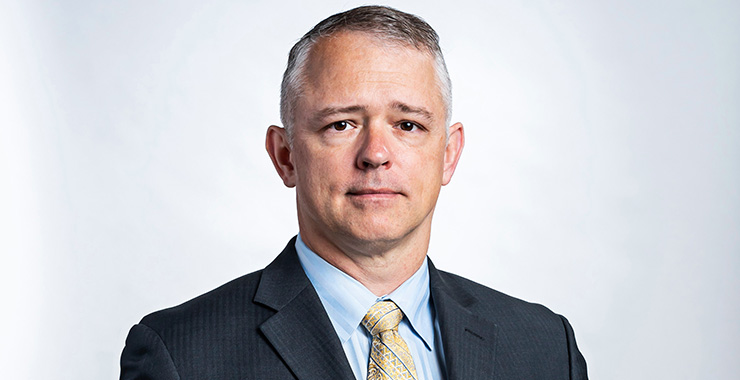
As the senior policy adviser for global Covid-19 response operations on the White House’s Covid Response Team, Colonel Matt Clark, PhD, has worked tirelessly over the past year to help coordinate the donation of more than half a billion Covid-19 vaccines from the United States to 115 countries.
In this role, Clark has been responsible for shipping and delivering Covid-19 vaccines from the U.S. government bilaterally through the Covid-19 Vaccines Global Access (covax) initiative and via the African Vaccine Acquisition Trust (AVAT). Covax is a worldwide effort to expand access to Covid-19 vaccines that is directed by the international vaccine alliance organization Gavi, the Coalition for Epidemic Preparedness Innovations (CEPI), and the World Health Organization (WHO), and is aided by Unicef. Previously, Clark served as the vaccine team program manager for Operation Warp Speed, the federal program initiated early in the pandemic that was responsible for developing, manufacturing, and distributing Covid-19 vaccines and therapeutics within the United States.
The Monitor spoke with Clark about leading a global vaccination distribution operation and how psychologists can continue to aid Covid-19 recovery efforts.
Take us through the logistics of the vaccine donation effort. What were you and your team responsible for?
Ultimately, the success of the donation program depends on multiple partners. My job is to make sure the operations run smoothly across all organizations. This involves coordination and collaboration between governmental, nongovernmental, intergovernmental, and commercial entities in a way that promotes trust and transparency while building teams, managing risk, and solving problems through teams of teams. My role is to keep partners moving with the urgency that the pandemic has required across various activities involving allocation, legal, readiness, regulatory, and shipping logistics processes, each of which is product specific.
One example of an activity is providing targeted input on regulatory matters. Success in shipping medical products globally requires alignment between the company, the distributor, supporting organizations, the government organization that contracted for the product, and the respective regulatory agencies. One of my roles has been to ensure coordination between all the parties was completed successfully so that the operation could effectively and quickly distribute vaccines for use globally.
More broadly, my teammates and I work the allocation, legal, readiness, regulatory, and shipping logistics processes for each product to press for predictable shipments of fresh vaccines with long shelf life through a process that maintains the product’s quality. To date, we have delivered more than 530 million doses in 10 months and have set the conditions for the rest.
Tell me about some of the challenges your team experienced. What skills did you draw on to work through the difficulties?
Part of the challenge with delivering vaccines globally is that we do not own all aspects of the Covid-19 vaccination program or processes locally. In the global effort, our role is to facilitate rather than own, operate, and monitor the entire process. The U.S. federal government, covax, and AVAT efforts are all structured to deliver vaccines through recipients’ national health systems with no strings attached, which includes national deployment and local vaccination plans. Unlike the domestic program, the global effort had to rely on local experts and contacts to optimize success in delivering the vaccines we donated.
The partnerships we fostered were the key to success. Whether it was working on procuring ultra-cold chain assets to help keep the vaccines cold as they are transported and stored and needles and syringes through Unicef or working on securing regulatory authorizations and approval via the WHO, we had to engage, challenge, and trust our partners to get the job done. Even when working with companies such as Pfizer, Moderna, and Johnson & Johnson, we had to challenge them and the entire logistics and operations system to do more on a faster timeline. The teams we built weathered each challenge through group problem-solving while owning their respective actions and being held accountable daily. The daily calls help the partnership work and allow each partner to use the full extent of their respective capabilities.
How can behavioral scientists continue to help lead Covid-19 recovery efforts?
We need to continue to move aggressively to understand more about what motivates people to get vaccinated. Vaccination rates around the world provide this opportunity. For example, if we compare vaccination rates between countries, it would be important to know what variables are key for improving vaccination, particularly during a global pandemic. We have much to do to continue to encourage people around the world to get vaccinated to stop the emergency phase of the pandemic. We need to understand the conditions and factors that promote vaccine uptake across disparate national immunization programs and health systems.
Behavioral scientists can play a critical role in identifying the behavioral motivators and barriers to vaccination so that programs can be developed to maximize vaccine uptake. Likewise, behavioral scientists can identify the environmental variables that affect behavior in positive and negative ways so that personal and public health can be the focus of global vaccination efforts.
Industrial and organizational scientists can further work to clarify actions and structures that facilitate matrixed and coordinated leadership in diverse organizations during an all-consuming crisis. This pandemic makes it clear that leadership considerations for public-private partnerships, nongovernmental organizations, and across governmental structures in a complex environment is an area ripe for further exploration before, during, and after a global pandemic.
What’s next in your work as we enter the endemic phase of Covid-19?
I am returning to the Department of Defense as the joint project manager for medical products under the Joint Program Executive Office for Chemical, Biological, Radiological, and Nuclear Defense (JPEO-CBRND). I will be responsible for the development and life cycle management of medical drugs, devices, and vaccines, supporting military forces and civilians involved with biodefense and biosecurity.
JPEO-CBRND is also the organization that executes most of the contracts employed throughout the Covid response, as well as other biodefense emergencies. Through this work we will continue to prepare for future biodefense and biosecurity threats and have the structure to respond when the nation has a similar need to that experienced in this pandemic.