DeAngelis, T. (2023, January 1). As funding cools, venture capitalists shift investments in mental health. Monitor on Psychology, 54(1). https://www.apa.org/monitor/2023/01/trends-venture-capital-funding-shifts
In 2020 and 2021, venture capital funding for mental health apps and related technologies was at an all-time high, the result of soaring mental health needs during the Covid-19 pandemic, a shift toward telehealth, and reduced stigma around mental health services (see Mental health, meet venture capital, January 2022 Monitor).
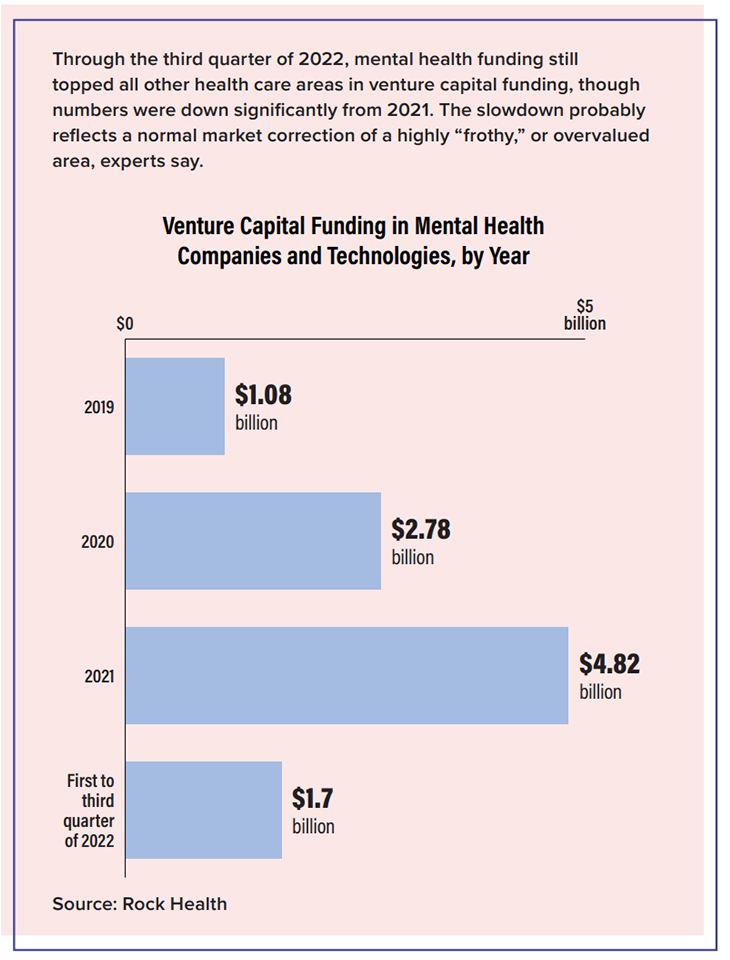 Today, that pace has slowed, but investment remains robust: “I don’t think funders’ excitement is necessarily cooling, but I think they’re getting a bit more realistic in their expectations and more thoughtful about the ‘value added’ of a given product,” said Stephen M. Schueller, PhD, associate professor of science and informatics at the University of California, Irvine, and executive director of One Mind PsyberGuideopens in new window, a nonprofit Consumer Reports–style website that evaluates the credibility, user experience, and transparency of digital mental health tools.
In general, this means investors want to see more data on how an entrepreneur’s app or other technology platform provides a return on investment (ROI)—how it reduces symptoms, health care claims, and costs, for example—while expanding access to care, said Paula Wilbourne, PhD, cofounder and chief science officer at Sibly, a behavior change and mental health coaching serviceopens in new window. “You didn’t necessarily need to have that data when things were so frothy [inflated, in venture capital speak] two years ago,” she said, “but if you’re going to survive, you have to have that data now.”
Although the area is still evolving, the trend toward greater discernment is good news for psychologists who want to get involved in this space, said psychologist Grin Lord, PsyD, ABPP, founder and chief executive officer of mpathic, a venture capital-backed startupopens in new window that uses a range of artificial intelligence (AI) technologies to improve communication so it is delivered with greater empathy. With psychologists’ expertise in evidence-based treatments, data analysis, and clinical knowledge, they’re in a perfect position to pitch solutions with a chance for success, she said.
“Psychologists are really adaptable; we are generalists,” she said. “So, it’s much easier to teach us the business side of these ventures than it is to take someone coming out of business school and teach them the clinical side.”
That said, venture capital and technology remain areas that some psychologists are reluctant to enter, noted Nicole Owings-Fonner, director of operations and innovation in APA’s Office of Health Care Innovation. But it’s in their and consumers’ interest to get involved, she said.
“If psychologists can take advantage of these technologies and use them to reach more patients—rather than seeing them as a replacement for or competition with traditional therapy—it will benefit the public and the field as a whole,” she said.
Growth areas and innovations
While funders are becoming choosier in their investments, there are new areas of growth and innovation that investors seem keen on supporting, Schueller noted.
One area is apps and platforms geared to specific subpopulations, including youth, people of color and Indigenous people, LGBTQI+ individuals, and people with serious mental illness. The venture capital firm Telosity, for example, has been funding a burgeoning number of youth-focused apps and technologies, recently releasing a report describing this booming landscapeopens in new window for those interested in developing or investing in these products. The report states that by 2027, technologies and startup companies in the youth mental health space will be worth $26 billion; in the past four years alone, investment has increased 15-fold. “Investors and startup founders…can meet the insatiable market demand and a massive opportunity for youth wellness and mental health technologies,” the report says.
From another angle, funders appear increasingly interested in technologies that cover a broad spectrum of mental health problems rather than specific ones, though there are exceptions to that rule, Schueller added. “The feeling is that there can be only so many niche products, because people are whole people,” he said. Because apps are seen as part of a continuum of care—part of a stepped process toward greater involvement in the care system if and as needed—funders are seeing greater value in well-designed apps that cover a wide range of problems, he said.
That’s the strategy Wilbourne is using at Sibly. The app allows members with any degree of emotional or psychological distress—whether a difficult breakup or clinical depression—to tap into a team of trained coaches 24/7, text them about their problem, and get an immediate response. If the person is in crisis or needs more help, Sibly coaches quickly refer them to a PhD-level expert on the team who can vet the problem and refer them to additional help.
So far, the model appears to be working: In a claims analysis of a Fortune 50 company contracted with Sibly, Sibly showed that using the intervention reduced health care claims by 14%.
As it becomes clearer which products best serve people’s mental health needs, there are likely to be more mergers and acquisitions, as well, Schueller added. For example, two giants in the space—Headspaceopens in new window, which trains people in mindfulness and meditation techniques, and Gingeropens in new window, which provides on-demand mental health care as an employment benefit—made a $3 billion deal to merge in 2021. (The company is now called Headspace Health.)
“I think some of this trend is an appreciation by funders that one-pointed solutions are not going to be profitable in the long term,” he said.
Coaches, AI, and other trends
Sibly’s design highlights two other trends that are currently shaping the market: partnering with employers and other payers and using paraprofessional coaches to deliver services.
For instance, Wilbourne and Sibly cofounders Moe AlKadi and Omar AlEisa began Sibly as a direct-to-consumer app when they launched the company in 2016. “But it soon became clear that most health care and mental health services are paid for by organizations,” Wilbourne said. They pivoted so that Sibly now contracts with a range of companies and organizations.
Hiring and training coaches has been another key to Sibly’s growing success, helping to cut costs, improve quality, and address the dearth of doctoral-level providers by training paraprofessionals to take on counseling roles. The company trains these well-vetted and consistently supervised mental health workers in evidence-based cognitive behavioral and motivational interviewing techniques and supports them with AI tools designed by psychologists to help them maintain high fidelity to the evidence-based techniques. This process enables Sibly to meet demand, at scale, with a quality intervention, Wilbourne said.
Other companies, too, are integrating AI, machine learning, and natural language processing—computer programming that can process and analyze large amounts of natural language data—into mental health platforms. Examples include chatbots or AI software that mimic the role of a therapist, AI that provides feedback to therapists about their clinical skills, and AI that helps clients with clinical homework.
Such technologies are central to Lord’s mpathic platform, which uses natural language processing to automatically analyze voice- and text-based conversations to identify common factors skills such as empathy, alliance, trust, and rapport, and to reduce employee and other forms of turnover by automatically correcting problems as they occur, Lord explained.
Mpathic is innovative in another way: It is taking these methodologies out of the therapy room and into the real world—for example, to help employers gain a better track record in recruiting and retaining employees and insurance adjusters to display more empathy toward customers (mpathic uses these same methods to give therapists feedback on therapy interactions).
The overarching goal, Lord added, is prevention: “The somewhat extreme stance I took with [mpathic] was to ask, How many people can we train in empathy skills to support each other where they work and live before they have to enter the funnel of the actual mental health care system?” she said.
Why should psychologists get involved?
If these innovations aren’t inspiration enough, consider the many other reasons to enter this space, said other psychologists working in tech, venture capital, and related areas.
The biggest reason remains need: Millions of people aren’t getting adequate mental health care, so becoming tech savvy is a vital way to expand the reach of quality services, said Candice Monson, PhD, professor of psychology at Toronto Metropolitan University and founder of the virtual startup company Nellie Healthopens in new window, which offers a community of expert therapists and a platform to facilitate science-backed practices for the range of stress- and trauma-related conditions.
Nellie, which also uses technology strategies such as AI to provide feedback to clinicians and gamification to increase engagement in services, is limited to North America, but Monson eventually wants to take a version of it overseas. “There’s a huge market of people outside of North America who have mental health problems and don’t have good access to care, and other places with hardly any mental health care at all,” she commented.
In addition, psychologists can ensure that these products are data driven, ethical for consumers, don’t oversell their value, and enhance rather than replace therapy. “These technologies tend to be most useful when they are thoughtfully integrated into clinical care pathways,” Schueller said. “We have to make sure that we’re involved so that someone else doesn’t take what we’re doing and use it in a way that reflects poorly on the field.”
Owings-Fonner added that there’s a huge opportunity for psychologists in research and academia to share their research-based tools and treatments in tech capacities, but that they need to partner with industry to make these tools engaging and marketable.
Getting involved in these areas can also be lucrative, said Lord, and even psychologists who aren’t super savvy in these skills can learn what they need to. In 2020, she founded a group called Therapists in Techopens in new window, devoted to helping mental health professionals get the knowledge and training they need to succeed in this arena. Some of its members who first transitioned from academia and clinical work into tech as late as 2020 “are now leaders in the field, with director-level roles at places like Modern Health and Amazon,” she said.
Finally, technology as a means of delivering mental health care is undoubtedly here to stay, said Schueller, so avoiding it means that psychologists are missing out on a huge, growing aspect of care delivery.
“The most innovative platforms,” he predicted, “will take the best of technology and the best of traditional psychology practices and bring those together.”
11 emerging trends for 2023











Resources and reading
Therapists in Techopens in new window
A digital community that promotes the development of ethical digital mental health leaders
Society for Digital Mental Healthopens in new window
Training the next generation of behavioral medicine scientists to accelerate digital healthopens in new window
Sweet, C. C., et al., Translational Behavioral Medicine, 2022
Accelerator programs
- WELLopens in new window (for female entrepreneurs)
- On Deckopens in new window
- Andreessen Horowitz’s a16z START programopens in new window
- Y Combinator’s Y Startup Schoolopens in new window