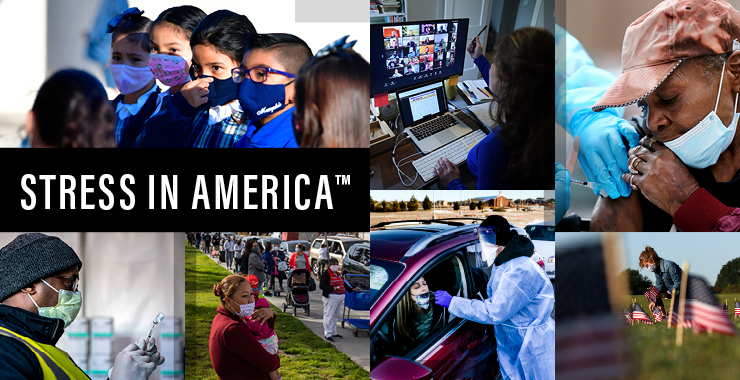
American Psychological Association. (2021, March 11). Coronavirus stress: Majority of Americans never imagined pandemic would last this long. https://www.apa.org/news/press/releases/stress/2021/one-year-pandemic-stress-conclusion
A majority of adults (82%) said they never imagined the COVID-19 pandemic would last this long. Nearly 7 in 10 Americans (67%) said that living through the coronavirus pandemic has been a rollercoaster of emotions.
Nearly 1 in 4 U.S. adults (24%) said they or a household member were laid off from a job during the coronavirus pandemic, while 22% started working from home, and 16% of all U.S. adults had a child or children age 18 or younger at home for remote learning. Among parents who had a child home for remote learning, the majority (85%) still had at least one child remote learning from home as of February 2021.
Additionally, 2 in 3 Americans (67%) reported less in-person social interaction since the start of the coronavirus pandemic, but a similar proportion (67%) have had online social interactions (e.g., social media, online chat rooms or video calls) during this time. The majority of those who have had online social interactions since the coronavirus pandemic started (84%) said these engagements have helped them cope with stress.
When asked how the level of stress in their life has changed compared with before the pandemic, nearly half of U.S. adults (47%) said the level of stress in their life has increased.
Regardless of vaccination status, Americans feel uneasy about in-person interactions in the future
Looking ahead, Americans are hesitant about the future regard- less of their vaccination status. Nearly half of Americans (49%) said they feel uneasy about adjusting to in-person interaction once the pandemic ends. Adults who received a COVID-19 vaccine were just as likely as those who have not received a vaccine to say this (48% vs. 49%, respectively).
Similarly, 46% of adults said they do not feel comfortable going back to living life like they used to before the pandemic. Here, too, similar proportions of Americans agreed with this statement regardless of whether they had received a COVID-19 vaccine (44% of those who received a vaccine vs. 46% of those who did not receive a vaccine).
APA provides guidance: Calls on policymakers to address severe health consequences
While the situation is critical, it is not hopeless. This report contains small steps Americans can take to stay active, positive and connected on a daily basis. But the U.S. response to this crisis also requires large, systemic changes by health leaders and policymakers.
We need to facilitate access to mental health services during and after the pandemic, including an expansion of congressional pandemic relief efforts that include substantial funding for mental health services and support. This also should include investing in prevention and treatment, continuing support for and expansion of telehealth services, and increasing funding to better support school mental health services.
Even before the COVID-19 pandemic turns the corner, we need to invest in helping Americans recover mentally and physically, making us stronger for the future.
A special thank you to our member psychologists specializing in child development, parenting, racial disparities, education, substance use, eating disorders and employment who contributed actionable advice to this report: Emma Adam, PhD; Mary Alvord, PhD; Leslie Hammer, PhD; Byron McClure, PhD; James Murphy, PhD; Tracy Sbrocco, PhD; Mia Smith-Bynum, PhD; and Erlanger “Earl” Turner, PhD. A special thanks also to our staff who provided insights on this report: Senior Director, Practice Transformation and Quality Lynn Bufka, PhD; APA Deputy CEO Jim Diaz- Granados, PhD; and Senior Director of Health Care Innovation Vaile Wright, PhD.