skip to main content

Overview

  • The lesbian, gay, bisexual and transgender (LGBT) community has been disproportionately affected by HIV. Many older LGBT adults lack family supports, and HIV affects caregiving needs.
  • Older gay and bisexual men remain disproportionately affected by HIV, and account for approximately 60 percent of those over age 50 and living with the virus.
  • LGBT adults, including those living with HIV, will increasingly require caregiving assistance from their family and friends as they grow older. However, the informal social networks of older LGBT adults may not be as robust social network resources that characterize older heterosexuals.
  • The social networks of older LGBT adults rely on the “family of choice” comprised of close friends and neighbors. In contrast, it is the biological family or “family of origin” that provides the bulk of caregiving support for most heterosexual older adults. There are important limits in the ability of these non-related significant others to provide care over the long-term, especially if decision-making is required.
  • The absence of blood ties between friends who comprise the family of choice and the older LGBT adult can result in negative interactions with the biological family.
  • The lack of legal recognition of same-sex partners in some jurisdictions excludes these individuals from making caregiving decisions concerning their significant others, although this may change in the near future.
  • Older LGBT adults living with HIV report greater comorbidity and worse mental health compared to their HIV-negative peers, which suggests HIV may exacerbate caregiving needs in this community.
APA Style leaf logo Cite this in APA Style
Brennan-Ing, M. (2015, May 19). Caregiving for aging LGBT adults living with HIV. American Psychological Association. https://www.apa.org/pi/aids/resources/aging/caregiving-lgbt

expand all
  • Older LGBT adults living with HIV may be more likely to indicate caregiving needs which may range from help with instrumental tasks of daily living (i.e., shopping, cooking and household chores), to personal care (i.e., help with mobility issues, post-hospital care).
  • Most care giving for those living with HIV is from paid helpers such as home health aides or visiting nurse, while a lesser percent is typically provided by friends, partners/spouses and family.
  • Older LGBT adults are not only recipients of caregiving, but they provide extensive caregiving assistance to both their families of origin and families of choice. Study participants were asked whether they had provided caregiving assistance to others within the past five years.
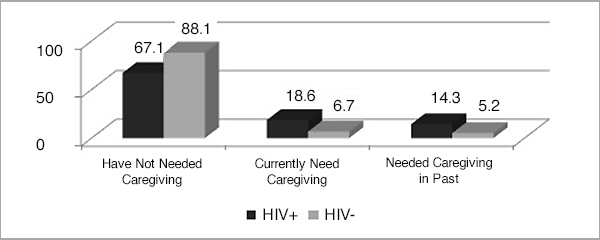
  • Almost 20 percent of older LGBT report they need caregiving assistance now, and 15 percent report needing it in the past.Caregiving needs chart
  • Given the limited social care resources older LGBT adults, including those living with HIV, there is a need to increasingly utilize formal community-based services to meet their needs for caregiving as they grow older.
  • LGBT older adults face barriers when accessing care including assumption of heterosexual identity, lack of recognition of same-sex partners and unequal treatment by providers manifested by discrimination springing from negative biases towards LGBT individuals.
  • These barriers can result in a lack increasing health disparities made more challenging when care providers lack of cultural awareness, are discriminatory or stigmatizing of their LGBT and patients living with HIV.
  • Many providers of mental health, substance use, aging and health services do not have enough information or training about LGBT issues to serve members of this population in a culturally competent manner.

Older LGBT adults find their support needs are exacerbated in the context of living with HIV. Health disparities in LGBT adults are magnified when they are diagnosed with HIV resulting in greater caregiving needs. Older LGBT adults tend to have friend-centered social networks resulting from rejection and discrimination from family members as well as the result of relocation to large urban areas that have viable gay communities. However, the friend-centered social networks of these older adults, many who also have friends living with HIV, will likely be unable to provide the instrumental and emotional support older LGBT adults living with HIV will need to live independently in their communities. It is imperative that government agencies and community-based organizations recognize the needs in this community and provide culturally competent caregiving support.

National Resource Center on LGBT Agingopens in new window
The National Resource Center on LGBT Aging is the country's first and only technical assistance resource center aimed at improving the quality of services and supports offered to LGBT older adults. Established in 2010 through a federal grant from the U.S. Department of Health and Human Services, the National Resource Center on LGBT Aging provides training, technical assistance and educational resources to aging providers, LGBT organizations and LGBT older adults. The center is led by Services and Advocacy for Gay, Lesbian, Bisexual and Transgender Elders in collaboration with 18 leading organizations from around the country.

Brennan-Ing, M., Seidel, L., Larson, B., & Karpiak, S. E. (2014). Social care networks and older LGBT adults: Challenges for the future. Journal of Homosexuality, 61(1), 21-52. DOI: 10.1080/00918369.2013.835235.

Centers for Disease Control and Prevention. Diagnoses of HIV infection among adults aged 50 years and older in the United States and dependent areas, 2007–2010. HIV Surveillance Supplemental Report 2013;18(No. 3). https://www.cdc.gov/hiv/topics/surveillance/resources/reports/#supplementaopens in new windowl. Published February 2013. Accessed October 1, 2014.de Vries, B., & Hoctel, P. (2007). The family friends of older gay men and lesbians. In N. Teunis and G. Herdt (Eds.), Sexual inequalities and social justice, (pp.213-232). Berkeley: University of California Press.

Dorfman, R., Walters, K., Burke, P., Hardin, L., & Karanik, T. (1995). Old, sad and alone: The myth of the aging homosexual. Journal of Gerontological Social Work, 24(1/2), 29-44.

Grossman, A.H., D’Augelli, A.R., & Hershberger, S.L. (2000). Social support networks of lesbian, gay and bisexual adults 60 years of age and older. Journal of Gerontology: Psychological Sciences, 55B(3), P171-P179.

Shippy, R. A., Cantor, M. H., & Brennan, M. (2004). Social networks of aging gay men. Journal of Men’s Studies, 13(1), 107-120.

Fredriksen-Goldsen, K. I., Kim, H. J., Emlet, C. A., Muraco, A., & Erosheva, E. (2011). The Aging and Health Report: Disparities and Resilience among Lesbian, Gay, Bisexual, and Transgender Older Adults. Seattle: Institutional for Multigenerational Health.   

Cantor, M. H., Brennan, M., & Shippy, R. A. (2004). Caregiving among older lesbian, gay, bisexual, and transgender New Yorkers. Final report. Washington, D.C.: National Gay and Lesbian Task Force Policy Institute.

Brennan-Ing, M., Karpiak, S. E., & Seidel, L. (2011). Health and psychosocial needs of LGBT older adults. Final Report to the Center on Halsted, Chicago. New York: AIDS Community Research of America, Center on HIV and Aging. Retrieved June 26, 2012 from: https://www.acria.org/files/COH percent20Study percent20Final percent20Report percent20091911.pdfopens in new window .

Brotman, S., Ryan, B., & Cormier, R. (2003). The health and service needs of gay and lesbian elders and their families in Canada. The Gerontologist, 43(2) 192-202. 

Cantor, M. H., Brennan, M., & Shippy, R. A. (2004). Caregiving among older lesbian, gay, bisexual, and transgender New Yorkers. Final report. Washington, D.C.: National Gay and Lesbian Task Force Policy Institute.

Hughes, M. (2007). Older lesbians and gays accessing health and aged-care services.  Australian Social Work, 60(2), 197-209.

Tan, P.P. (2005). The importance of spirituality among gay and lesbian individuals. Journal of Homosexuality, 49(2), 135-144.  

Tjepkema, M. (2008). Health care use among gay, lesbian and bisexual Canadians. Health Reports, 19(1), 53-64.

IOM (Institute of Medicine; 2011). The health of lesbian, gay, bisexual, and transgender people: Building a foundation for better understanding. Washington, D.C.: The National Academies Press.

Hughes, A. K.,Harold, R. D.,Boyer, J. M.  (2011). Awareness of LGBT aging issues among aging services network providers. Journal of Gerontological Social Work, 54(7),659-77.

Israel, T., Walther, W., Gortcheva, R., & Perry, J.S. (2011). Policies and practices for LGBT clients: Perspectives of Mental Health Services Administrators. Journal of Gay and Lesbian Mental Health Providers, 15(2), 152-168.

Knochel, K. A., Quam, J. K., & Croghan, C. F. (2011). Are old lesbian and gay people well served? Understanding the perceptions, preparation and experiences of aging services providers. Journal of Applied Gerontology, 30(3), 370-389.


Date created: 2015