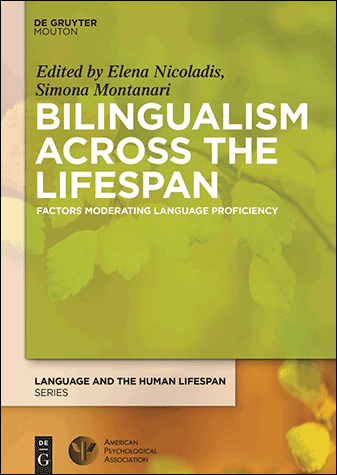
Bilingualism Across the Lifespan
The study of bilingualism unfolds against a varied backdrop of sociocultural and sociopolitical factors. While the nature of bilingualism and multilingualism has often been misunderstood, the bilingual community is a dynamic and ever-growing part of the global population.
This book pioneers the study of bilingualism across the lifespan and in all its diverse forms. In framing the newest research within a lifespan perspective, the editors highlight the importance of considering an individual's age — from infancy to late adulthood — when researching how bilingualism affects language acquisition and cognitive development.
Five major topics are explored:
- early bilingualism
- factors affecting bilingualism across the lifespan
- academic achievement and literacy in bilinguals
- cognitive effects of bilingualism
A key theme is the variability among bilinguals, which may be due to a host of individual and sociocultural factors, including the degree to which bilingualism is or is not valued in each country and context.
This book is a call for language researchers, psychologists, and educators to pursue and promote a better understanding of bilingualism in our increasingly multicultural society.
Contributors
Introduction
Simona Montanari and Elena Nicoladis
- Shifting Perspectives on Bilingualism
Fred Genesee
I. Early Bilingualism
- Early Bilingualism: From Differentiation to the Impact of Family Language Practices
Suzanne Quay and Simona Montanari - Speech Perception in Simultaneously Bilingual Infants
Christopher T. Fennell, Angeline Sin-Mei Tsui, and Tamara M. Hudon - Early Lexical Development in Bilingual Infants and Toddlers
Barbara T. Conboy and Simona Montanari - Code-Switching in Childhood
W. Quin Yow, Ferninda Patrycia, and Suzanne Flynn
II. Factors Affecting Bilingualism Across the Lifespan
- Quantity and Quality of Language Input in Bilingual Language Development
Sharon Unsworth - Factors Moderating Proficiency in Bilingual Speakers
Virginia C. Mueller Gathercole - Age of Onset of Bilingualism Effects and Availability of Input in First Language Attrition
Silvina Montrul - Age of Second-Language Acquisition: Critical Periods and Social Concerns
David Birdsong and Jan Vanhove - Code-Switching in Adulthood
Jeff MacSwan
III. Academic Achievement and Literacy in Bilinguals
- Bilingualism and Academic Achievement in Children in Dual Language Programs
Kathryn Lindholm-Leary - Literacy in Adulthood: Reading in Two Languages
Judith F. Kroll, Jason Gullifer, and Megan Zirnstein
IV. Cognitive Effects of Bilingualism
- Cognitive Effects of Bilingualism in Infancy
Ágnes Melinda Kovács - Bilingual Speakers' Cognitive Development in Childhood
Elena Nicoladis - Cognitive and Emotional Effects of Bilingualism in Adulthood
Max R. Freeman, Anthony Shook, and Viorica Marian - The Contribution of Bilingualism to Cognitive Reserve in Healthy Aging and Dementia
Hilary D. Duncan and Natalie A. Phillips
V. Conclusion
- Concluding Remarks and Future Directions
Simona Montanari and Elena Nicoladis
Index
About the Editors
Elena Nicoladis, PhD, is a professor in the psychology department at the University of Alberta in Edmonton, Alberta, Canada. She received her PhD in developmental psychology at McGill University. Her dissertation focused on the language choice of preschool French–English bilingual children.
Dr. Nicoladis's research focuses on several areas.
One area focuses on language acquisition in bilingual children, in particular, how bilinguals use their two languages. The bilinguals in her studies include not only French–English bilinguals but also bilinguals who speak other minority languages, like Hindi and Chinese, as well as English.
Another area focuses on the relationship between language and thought in development, including how language use and/or structure might affect children's thinking.
A third area raises questions about how manual gestures are related to language use and development on the one hand and cognitive development on the other.
Simona Montanari, PhD, is an associate professor in the Department of Child and Family Studies at California State University, Los Angeles. She received her PhD in linguistics from the University of Southern California, specializing on early trilingual development.
Her research, which has focused on the acquisition of phonology, lexicon, morphosyntax and communicative competence in two or three languages, has been published in the Journal of Child Language, in Bilingualism: Language and Cognition, and in the International Journal of Bilingualism, among others.
Dr. Montanari has also been involved in the creation and implementation of the first public Italian/English dual language program in the Glendale Unified School District (Los Angeles County), and has been studying its educational outcomes since its launch in 2009.
At California State University, Los Angeles, Dr. Montanari teaches graduate and undergraduate courses on language development and second-language acquisition in childhood, and she is currently involved in research on phonological development in Spanish–English dual language preschoolers. She also continues to work as a consultant for the Glendale Unified School District and has designed common-core-standards-aligned curricula for its Italian/English, French/English and German/English dual-language programs.
The time has come for language researchers to abandon the monolingual model in favor of more inclusive theories of language development and processing that are inclusive of the bilingual experience. Clearly, Bilingualism Across the Lifespan is an essential read for all psycholinguists and developmental psychologists.
—PsycCRITIQUES