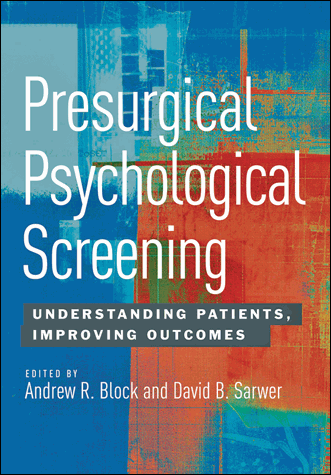
Presurgical Psychological Screening
The success of many surgical procedures depends not only on the skill of the surgeon and the use of state-of-the-art technology, but also on the actions and characteristics of the patient. Patients' emotional and psychosocial concerns, health-related behaviors, outcome expectations, and compliance with treatment regimen can all strongly influence the ultimate effectiveness of surgery.
Thus, mental health professionals are increasingly called upon to perform presurgical psychological screening (PPS) to ensure that patients are given the treatments most likely to be effective, while reducing the chances of worsening their conditions.
This book presents PPS procedures for a wide range of surgery types, such as spinal surgery, organ transplantation, bariatric surgery, and plastic surgery. Drawing on both research and clinical experience, the authors explain how to conduct PPS, communicate results to patients and surgeons, and identify possible pre- or postsurgery interventions to mitigate risk factors and maximize the likelihood of surgical success.
Case studies and a discussion of bioethics are included.
Contributors
Acknowledgments
Introduction
Andrew R. Block and David B. Sarwer
- Transplant Recipients and Organ Donors
Kristin K. Kuntz and Diane B. V. Bonfiglio - Spine Surgery
Andrew R. Block - Bariatric Surgery
David B. Sarwer, Kelly C. Allison, Brooke Bailer, Lucy F. Faulconbridge, and Thomas A. Wadden - Pain Control Procedures: Stimulators and Intrathecal Pumps
Robert N. Jamison and Robert R. Edwards - Bone Marrow and Stem Cell Transplant
Jane E. Austin and Chistine Rini - Deep Brain Stimulation for Parkinson's Disease
Sarah K. Lageman, Melody Mickens, Therese Verkerke, and Kathryn Holloway - Temporomandibular Disorder–Related Oral Surgery
Sarah E. Fraley, Eric Swanholm, Anna W. Stowell, and Robert J. Gatchel - Reconstructive Procedures
Canice E. Crerand and Leanne Magee - Breast Cancer Surgery
Sarah J. Miller, Julie B. Schnur, and Guy H. Montgomery - Gynecologic Surgery
Andrea Bradford - Carpal Tunnel Surgery
M. Scott DeBerard and Jason T. Goodson - Cosmetic Surgery
David B. Sarwer
Afterword
David B. Sarwer and Andrew R. Block
Index
About the Editors
Andrew R. Block, PhD, received his bachelor's degree from Haverford College and his doctorate from Dartmouth College. He is a board-certified clinical health psychologist and fellow of APA Division 38 (Health Psychology).
He has worked for more than 20 years with the Texas Back Institute in Plano, Texas, and, before that, with the Spine Institute in Carmel, Indiana. He specializes in presurgical psychological screening and perioperative treatment of candidates for spine surgery and pain control procedures (implantable stimulators and pumps), as well as candidates for bariatric surgery. He serves on the Conservative Care Committee and the Clinical Outcomes Committee of the North American Spine Society.
Dr. Block has many peer-reviewed research publications in the areas of chronic pain and presurgical psychological screening, beginning in the 1970s. He has written two books, most recently The Psychology of Spine Surgery, of which he was lead author. He was also the editor-in-chief of the Handbook of Pain Syndromes: Biopsychosocial Perspectives. This is his fourth book.
David B. Sarwer, PhD, is professor of psychology, Departments of Psychiatry and Surgery, Perelman School of Medicine, University of Pennsylvania, and director of clinical services, Center for Weight and Eating Disorders. He received his bachelor's degree in 1990 from Tulane University, his master's degree in 1992 from Loyola University Chicago, and his doctorate in clinical psychology in 1995 from Loyola University Chicago.
Dr. Sarwer's research interests focus on the assessment and treatment of obesity. He is principal or coprincipal investigator on several grants from the National Institutes of Health, investigating the psychological and behavioral aspects of obesity and, more specifically, bariatric surgery.
Dr. Sarwer is also a consultant to the Edwin and Fannie Gray Hall Center for Human Appearance, University of Pennsylvania Medical Center, where he conducts research on the psychological aspects of cosmetic and reconstructive surgery.
Clinically, Dr. Sarwer is the director of the Albert J. Stunkard Weight Management Program and is actively involved in the Bariatric Surgery Program, Perelman School of Medicine, University of Pennsylvania. He conducts behavioral and psychological evaluations of patients before surgery and treats individuals with eating or other psychological concerns after bariatric surgery.
Dr. Sarwer also provides psychotherapeutic treatment to people who have body dysmorphic disorder or other appearance concerns.