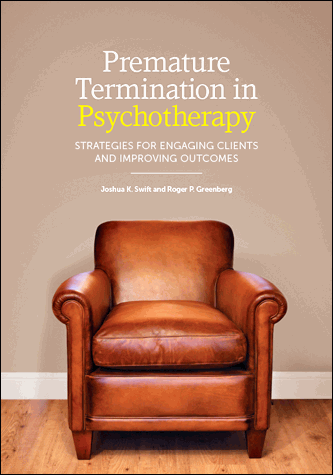
Premature Termination in Psychotherapy
Premature termination is a significant yet often neglected problem in psychotherapy with significant consequences for clients and therapists alike.
According to some estimates, as many as 20% of adult clients terminate psychotherapy prematurely. Even experienced practitioners using the best evidence-based techniques cannot successfully promote positive, long-term change in clients who do not complete the full course of treatment.
This book helps therapists and clinical researchers identify the common factors that lead to premature termination, and it presents eight strategies to address these factors and reduce client dropout rates. Such evidence-based techniques will help therapists establish proper roles and behaviors, work with client preferences, educate clients on patterns of change, and plan for appropriate termination within the first few sessions.
Additional strategies can be used throughout therapy to help strengthen and reinforce clients' feelings of hope, enhance their motivation to create change, develop and maintain the therapeutic alliance, and continually evaluate overall treatment progress.
Case examples demonstrate how these strategies can be employed in real-life scenarios.
Introduction
I. Understanding Premature Termination in Psychotherapy
- What Is Premature Termination, and Why Does It Occur?
- Predictors of Premature Termination in Psychotherapy
II. Strategies for Reducing Premature Termination
- Provide Role Induction
- Incorporate Preferences Into the Treatment Decision-Making Process
- Assist in Planning for Appropriate Termination
- Provide Education About Patterns of Change in Psychotherapy
- Strengthen Hope
- Enhance Motivation for Treatment
- Foster the Therapeutic Alliance
- Assess and Discuss Treatment Progress With Clients
III. Conclusion
- Conclusions and Future Directions
References
Index
About the Authors
Joshua K. Swift, PhD, is an associate professor in the Department of Psychology at the University of Alaska Anchorage and a core faculty member in the Joint University of Alaska Fairbanks/University of Alaska Anchorage PhD Program in clinical-community psychology, where he directs the Psychotherapy Process and Outcome Research Lab. He is also a licensed psychologist in the state of Alaska.
As an early career psychologist he has authored or coauthored more than 80 professional publications and presentations. He has also been recognized with a number of awards, including the APA Division 29 (Psychotherapy) Distinguished Publication of Psychotherapy Research Award, Division 29 President's Award for Psychotherapy Research, and University of Alaska Anchorage's Chancellor's Awards for Excellence in Teaching and Research.
Roger P. Greenberg, PhD, is Distinguished Professor and director of the Psychology Division at State University of New York (SUNY) Upstate Medical University in Syracuse. He is also the psychology internship training director at SUNY and a long-standing clinician in private practice.
He has authored or coauthored about 250 publications and presentations, including The Art and Science of Brief Psychotherapies: An Illustrated Guide (2012), From Placebo to Panacea: Putting Psychiatric Drugs to the Test (1997), and the award-winning The Scientific Credibility of Freud's Theories and Therapy (1985).
He has received the National Register of Health Service Psychologists' Alfred B. Wellner Lifetime Achievement Award, the New York State Psychological Association's Joanne Lifshin Mentorship Award, the Association of Psychology Postdoctoral and Internship Centers' Excellence in Training Award, and the SUNY President's Award for Excellence in Teaching.
Premature client termination is a problem for both beginning and experienced clinicians. The objective of this book is to offer an understanding of why it happens and when it happens most frequently, as well as provide strategies supported by empirical data that meaningfully reduce the incidence of premature termination. This objective is certainly attained in a clear, concise and empirically supported style that is for the most part accessible to any level of counselor.
—The Professional Counselor
One of the very best examples of the new generation of psychotherapy development. Based on rigorous research findings and a deep look into the preexisting literature, this book presents practical guidelines to understand premature termination and provides evidence-based strategies for how to engage patients in treatment. It will especially be a highlight for practitioners who are interested in a broad insight of the overall empirical literature. For graduate students in clinical and counseling psychology, this book might be an excellent prototype for how to bring rigorous quantitative research and convenient practice examples together.
—PsycCRITIQUES
Informed, informative, pragmatic and practical, Premature Termination in Psychotherapy should be considered mandatory reading for both aspiring and practicing psychotherapists and is an essential, core addition to academic library Psychology/Psychiatry reference collections and supplemental reading lists.
—Midwest Book Review