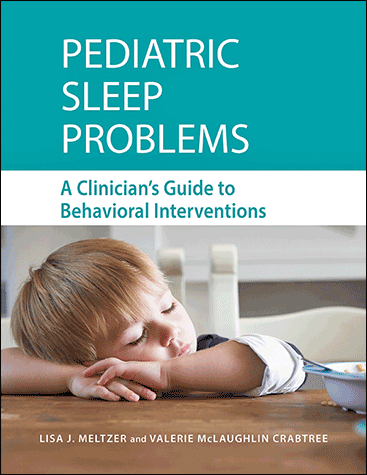
Pediatric Sleep Problems
Sleep problems are common in children. Between 25–40% of youth experience sleep difficulties such as sleep anxiety, insomnia, frequent waking, delayed circadian rhythm, night terrors, and nocturnal enuresis or encopresis at some point during childhood or adolescence. Yet, most healthcare providers receive little if any training in pediatric sleep problems — and most training that does exist tends to emphasize medical rather than behavioral interventions.
This book presents highly effective behavioral interventions for common pediatric sleep problems. Step-by-step instructions show readers how to clinically assess and treat children from toddlers to teenagers, and case examples apply the instructions to real-life scenarios.
The authors also provide more than 30 handouts and worksheets for parents and children, including sleep logs and directions for a series of creative, at-home interventions.
List of Handouts
Foreword
Jodi A. Mindell
Acknowledgments
Introduction
I. The Basics of Pediatric Behavioral Sleep Medicine
- Typical Sleep Across Development and Healthy Sleep Habits
- Common Pediatric Sleep Problems
- Behaviorism and Essential Concepts for Pediatric Behavioral Sleep Medicine
II. Clinical Basics for Pediatric Behavioral Sleep Medicine
- Clinical Assessment of Sleep
- Working With Families to Increase Treatment Success
III. Presenting Problems
- Sleep-Onset Associations and Night Wakings in Young Children
- Bedtime Stalling, Protests, and Curtain Calls
- Nighttime Fears, Anxiety, and Recurrent Nightmares
- Insomnia
- Delayed Sleep–Wake Phase
- Confusional Arousals, Sleep Terrors, and Sleepwalking
- Nocturnal Enuresis
- Nonadherence to Positive Airway Pressure Therapy
Appendix A: Resources for Clinicians and Families
Appendix B: Handouts
References
Index
About the Authors
Lisa J. Meltzer, PhD, CBSM, is an associate professor of pediatrics at National Jewish Health. She received her doctorate in clinical and health psychology from the University of Florida, and she completed her clinical internship and postdoctoral fellowship at the Children's Hospital of Philadelphia. She was selected as a Pickwick Postdoctoral Fellow in Sleep Research by the National Sleep Foundation, studying sleep patterns in parents of children with chronic illnesses.
Dr. Meltzer is board certified in behavioral sleep medicine by the American Board of Sleep Medicine, and she directs both the Pediatric Behavioral Sleep Clinic and the Actigraphy Program at National Jewish Health. She also has a funded program of research examining sleep in children with chronic illnesses and their parents, the impact of deficient sleep on health outcomes in adolescents with asthma, as well as the development and validation of objective and subjective measures of pediatric sleep.
Valerie McLaughlin Crabtree, PhD, CBSM, is an assistant faculty member in the Department of Psychology at St. Jude Children's Research Hospital. She received her doctorate in counseling psychology from the University of Southern Mississippi and completed her internship and postdoctoral fellowship at the University of Louisville School of Medicine.
Dr. Crabtree is board certified in behavioral sleep medicine by the American Board of Sleep Medicine and directs the psychology clinic and psychology training programs at St. Jude. Her clinical work and research are focused on sleep in children and adolescents with cancer.
This is a compelling book that offers clinicians the most complete behavioral intervention guidelines for pediatric sleep problems currently available. The authors were able to translate a vast amount of research into practical application without sacrificing treatment rigor and integrity. The arrangement of chapter by sleep problem also gives clinicians quick access to the most effective treatments.
—New England Psychologist
The text is well written, comprehensive, up-to-date, and absolutely practical for day-to-day clinical use. I applaud the authors on their attention to detail, accuracy, and lack of deficiencies. This book is appropriate for medical students, residents, fellows, mid-level providers, pediatric primary care providers (pediatricians, family practitioners), psychologists, and sleep medicine specialists. Even a veteran, experienced sleep specialist will learn something new within these chapters.
—Journal of Clinical Sleep Medicine
This well-written text represents a clinical practice niche in pediatric psychology that has come of age and is showing its clear relevance for a wide range of child and adolescent functioning.
—PsycCRITIQUES
This is an excellent book that is easy to read, very practical, and contains 33 useful handouts. It should be in the libraries of all clinicians who address sleep problems in children.
—Gary B. Kaniuk, PsyD, Cermak Health Services
Welcome to the clinician and practitioner resources resources for Pediatric Sleep Problems: A Clinician’s Guide to Behavioral Interventions. These resources contain downloadable handouts to give to parents and children/adolescents during a clinical visit. The handouts include step-by-step instructions for implementing many of the interventions described in the book, a brief rationale for the intervention, as well as reminders to help families be successful. These documents are offered for your personal use. If you reprint or adapt them for publication, permission is required from the copyright holder.
All handouts except for Handout 3 © 2015 by American Psychological Association.
Handout 3 © 2011 by Carney, Buysse, Ancoli-Israel, Edinger, Krystal, Lichstein, and Morin.
- 1. Healthy Sleep Habits (PDF, 28KB)opens in new window
- 2. Sleep Log With Instructions (PDF, 71KB)opens in new window
- 3. Sleep Diary With Instructions (PDF, 76KB)opens in new window
- 4. Nighttime Awakenings—Sleep Training (PDF, 33KB)opens in new window
- 5. Nighttime Awakenings—Checking Method (PDF, 34KB)opens in new window
- 6. Nighttime Awakenings—Parental Presence (PDF, 33KB)opens in new window
- 7. Dream Feed (PDF, 27KB)opens in new window
- 8. The Good Morning Light (PDF, 403KB)opens in new window
- 9. Bedtime Chart (PDF, 28KB)opens in new window
- 10. Bedtime Fading (PDF, 31KB)opens in new window
- 11. Moving Parents Out (PDF, 28KB)opens in new window
- 12. Take a Break (PDF, 28KB)opens in new window
- 13. The Second Goodnight (PDF, 28KB)opens in new window
- 14. The Sleep Fairy (PDF, 27KB)opens in new window
- 15. The Bedtime Pass (PDF, 28KB)opens in new window
- 16. Flashlight Treasure Hunts (PDF, 28KB)opens in new window
- 17A. Parents Helping Their Children Overcome Fear of the Dark (PDF, 112KB)opens in new window
- 17B. Getting Rid of Fears (PDF, 126KB)opens in new window
- 18. Worry Time (PDF, 28KB)opens in new window
- 19. Think Like a Detective (PDF, 95KB)opens in new window
- 20. Monster Spray (PDF, 28KB)opens in new window
- 21. Helping Your Child Have More Helpful Thoughts (PDF, 27KB)opens in new window
- 22. Helping Your Child Be the Boss of Her Dreams (PDF, 28KB)opens in new window
- 23. Stimulus Control (PDF, 29KB)opens in new window
- 24. Sleep Restriction (PDF, 29KB)opens in new window
- 25. Thought Record (PDF, 92KB)opens in new window
- 26. Bright Light Therapy (PDF, 28KB)opens in new window
- 27. Chronotherapy (PDF, 30KB)opens in new window
- 28. Confusional Arousals, Sleep Terrors, and Sleepwalking (PDF, 33KB)opens in new window
- 29. Scheduled Awakenings for Disorders of Arousal (Parasomnias) (PDF, 28KB)opens in new window
- 30. Dry Night Tracking Sheet (PDF, 1695KB)opens in new window
- 31. Urine Alarm Training (PDF, 28KB)opens in new window
- 32. Full-Spectrum Treatment for Bedwetting (PDF, 31KB)opens in new window
- 33. Task Analysis Chart (PDF, 67KB)opens in new window