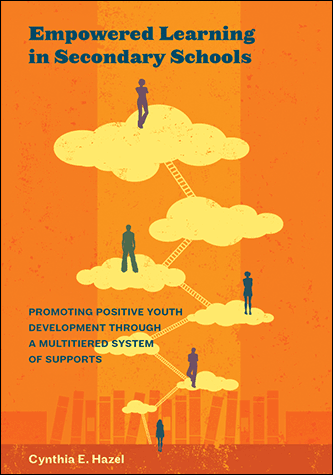
Empowered Learning in Secondary Schools
Positive youth development is a strengths-based, positive psychology approach to fostering adolescents' educational engagement and achievement. It focuses not just on students' academic development but also on their vocational, social, and emotional development. The positive youth development philosophy is at the heart of Cynthia Hazel's unique model of secondary school change, which uses a multi-tiered system of support to challenge the status quo of widespread achievement gaps.
In this thought-provoking book, Dr. Hazel presents her positive youth development–multi-tiered system of support model, including its theoretical foundations, practical instructions for implementing the model, and case examples illustrating application. Recognizing that students' own voices are critical to their empowerment and strong outcomes, the model calls for students to participate alongside parents, teachers, and administrators in designing and guiding the school's support structures.
The resulting paradigm shift — truly empowered learning — offers hope for all secondary schools, especially those in which many students currently do not achieve postsecondary success.
Series Forword
David Shriberg
- Introduction
I. Foundations for Positive Youth Development in Secondary Schools
- Challenging Educational Inequities Through Positive Youth Development
- Adolescence and Developmental Considerations
II. The PYD–MTSS Model
- Overview of the PYD–MTSS Processes
- PYD–MTSS Leadership Team Processes
- PYD–MTSS Student-Centered Team Processes
III. Making It Happen
- Student-Centered Data Collection and Analysis
- Student Leadership and Voice in Schools
- Important Considerations
- Case Studies and Concluding Thoughts
References
Index
About the Author
Cynthia Hazel, PhD, is chair of the Teaching and Learning Sciences Department and associate professor in the Child, Family, and School Psychology Program at the University of Denver.
Dr. Hazel has consulted extensively with secondary schools and districts interested in enhancing student outcomes and learning.
Besides multitiered system of supports (MTSS) and systems change, her research interests include consultation, student school engagement, on-time high school graduation, and the prevention of bullying. She has published two books and numerous articles and has presented internationally to promote equity and population-wide wellness for children, families, and school communities.
When not working to create equitable student outcomes and engaging learning communities, she kayaks, mountain bikes, and skis.