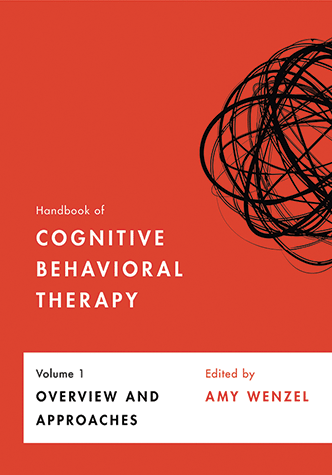
Handbook of Cognitive Behavioral Therapy, Volume 1
Available formats
Also available from
Volume 1 of this two-volume handbook of contemporary cognitive behavioral scholarship provides a historical and theoretical overview of cognitive behavioral therapy (CBT), summarizes the empirical support for the approach, describes the main strategies and techniques, and outlines an array of CBT treatment packages.
CBT is a psychological treatment that focuses on shifting unhelpful thinking or behavior patterns to more adaptive thinking or behavior patterns. An extensive body of empirical research confirms that CBT is highly efficacious in treating depression, anxiety disorders, alcohol and drug use problems, marital problems, eating disorders, and severe mental illness. Edited by renowned CBT scholar and practitioner Amy Wenzel, this handbook's in-depth coverage, up-to-date research, and rich clinical examples, make it an invaluable resource for all clinicians who offer CBT.
Volume 2 evaluates the application of CBT to specific clinical conditions, modalities and settings, and diverse populations.
Volume 1
About the Editor
Contributors
Introduction: The Evolution and Main Components of Cognitive Behavioral Therapy
Amy Wenzel
I. Context
- Philosophical and Historical Foundations
Robert L. Leahy and Christopher R. Martell - Theoretical Framework
Keith Dobson, Amanda Fernandez, and Stefan G. Hofmann - The Efficacy of Cognitive Behavioral Therapy for Emotional Disorders
Lorenzo Lorenzo-Luaces, Lotte H. J. M. Lemmens, John R. Keefe, Pim Cuijpers, and Claudi L. H. Bockting - Empirical Status of Mechanisms of Change
Janna N. Vrijsen, Rianne A. de Kleine, Eni S. Becker, Amy Wenzel, and Jasper A. J. Smits - Cognitive Case Formulation
Peter J. Bieling, Emanuele Blasioli, and Dara G. Friedman-Wheeler - Dissemination and Implementation
Bradley E. Karlin - The Therapeutic Relationship
Amy Wenzel
II. Strategies and Techniques
- Cognitive Restructuring
Christine Purdon - Behavioral Activation
Maria M. Santos, Ajeng J. Puspitasari, Gabriela A. Nagy, and Jonathan W. Kanter - Exposure Therapy
Lauryn Garner, Emily Steinberg, and Dean McKay - Motivational Interviewing
Deborah H. A. Van Horn, Amy Wenzel, and Peter C. Britton - Regulation of Physiological Arousal and Emotion
Holly Hazlett-Stevens and Alan E. Fruzzetti - Relapse Prevention
John Ludgate
III. Psychotherapy Packages
- Cognitive Therapy
Amanda Fernandez, Keith Dobson, and Nikolaos Kazantzis - Rational Emotive Behavior Therapy
Debbie Joffe Ellis - Emotion-Centered Problem-Solving Therapy
Arthur M. Nezu and Christine Maguth Nezu - Schema Therapy
Eva Fassbinder and Arnoud Arntz - Dialectical Behavior Therapy
Hollie F. Granato, Amy R. Sewart, Meghan Vinograd, and Lynn McFarr - Acceptance and Commitment Therapy
Eric B. Lee, Benjamin G. Pierce, Michael P. Twohig, and Michael E. Levin - Mindfulness Based Cognitive Therapy
Amanda Ferguson, Lê-Anh Dinh-Williams, and Zindel Segal - Metacognitive Therapy
Peter L. Fisher - Applied Behavior Analysis
Raymond G. Miltenberger, Diego Valbuena, and Sindy Sanchez - Cognitive Bias Modification
Emily E. E. Meissel, Jennie M. Kuckertz, and Nader Amir - The Unified Protocol: A Transdiagnostic Treatment for Emotional Disorders
Todd J. Farchione, Julianne Wilner Tirpak, and Olenka S. Olesnycky - Contemporary Cognitive Behavioral Therapy
Nikolaos Kazantzis, Hoang Kim Luong, Hayley M. McDonald, and Stefan G. Hofmann
Index
Amy Wenzel, PhD, ABPP, is a licensed clinical psychologist, owner and director of the Main Line Center for Evidence-Based Psychotherapy, faculty member at the Beck Institute for Cognitive Behavior Therapy, and certified trainer-consultant with the Academy of Cognitive Therapy.
She has authored or edited 25 books and treatment manuals, many on cognitive behavioral therapy. She lives in the Philadelphia, Pennsylvania, suburbs.
Visit her onlineopens in new window and follow her on Facebookopens in new window and Twitteropens in new window.