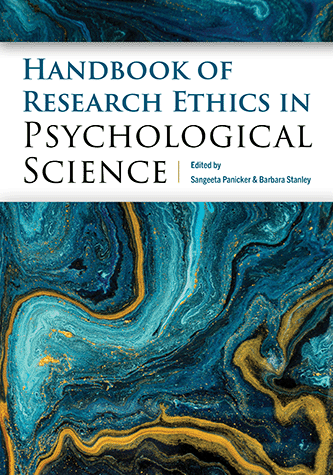
Handbook of Research Ethics in Psychological Science
ISBN: 978-1-4338-3636-7Available formats
Also available from
A rich guide for understanding the evolving research landscape in psychology, including changes to core research ethics concepts such as informed consent, privacy, and risk of harm.
This handbook offers a thorough and authoritative discussion of the ethical issues in conducting research with human participants. Each chapter poses an important ethical question, considers the relevant factors for addressing the question, and presents guidance for investigators.
Topics include:
- informed consent,
- deception,
- risk/benefit ratio,
- data security,
- authorship,
- conflicts of interest,
- fairness and equity when collaborating with researchers in resource-poor settings,
- and more.
While psychological research with humans still takes place in the investigator’s laboratory and field, there is an increasing trend toward multiple investigators and interdisciplinary research projects owing to the complexity of modern research questions.
Furthermore, technology has changed dramatically and affects all psychological researchers, whether they are working individually or in large teams. With its comprehensive scope and practical guidance, this book will serve as an invaluable aid to understanding and navigating the ethical challenges that confront new and seasoned researchers alike.
Preface
Sangeeta Panicker and Barbara Stanley
- Framework for the Ethical Conduct of Research: The Ethical Principles of the Belmont Report
Ivor A. Pritchard - Planning Research: Regulatory Compliance Considerations
Sangeeta Panicker - Risk-Benefit Assessment and Privacy
Camille Nebeker, Rebecca J. Bartlett Ellis, and Danielle Arigo - Informed Consent
Barton W. Palmer - Addressing Conflicts of Interests in Behavioral Science Research
Gerald P. Koocher and Konjit V. Page - Data Sharing
Rick O. Gilmore, Melody Xu, and Karen E. Adolph - Understanding Research Misconduct
Alison L. Antes and James M. DuBois - Ethics in Coercive Environments: Ensuring Voluntary Participation in Research
Michael D. Mumford, Cory Higgs, and Yash Gujar - Ethical Challenges in International and Global Research
B. R. Simon Rosser, Eleanor Maticka-Tyndale, and Michael W. Ross - The Ethics of Mental Health Intervention Research
Andrew W. Jones, Matthew V. Rudorfer, and Galia D. Siegel - Ethical Issues in Neurobiological Research
Young Cho and Barbara Stanley - Research Using the Internet and Mobile Technologies
Timothy J. Trull, Ashley C. Helle, and Sarah A. Griffin - Research in and With Communities
Mary Cwik - Legal and Ethical Requirements for Research With Minors
Mary Ann McCabe and Maryland Pao
Appendix A: The Belmont Report
Appendix B: Title 45 Code of Federal Regulations Part 46, Subparts A-E
Appendix C: Title 34 Code of Federal Regulations Part 98
Appendix D: Title 34 Code of Federal Regulations Part 99
Appendix E: Additional Resources
Sangeeta Panicker, PhD, is director of the Research Ethics Office in the Science Directorate of the American Psychological Association.
She received her doctorate in cognitive neuroscience from The Catholic University of America, in Washington, DC. She also has Masters' degrees in Psychopharmacology from the University of Cincinnati and in Clinical Psychology from the University of Bombay.
Dr. Panicker is a member of Public Responsibility in Medicine & Research (PRIM&R), and a Fellow of the APA.
Barbara H. Stanley, PhD, is professor of Medical Psychology in the Department of Psychiatry at Columbia University Vagelos College of Physicians & Surgeons. She is director of the Suicide Prevention Training, Implementation and Evaluation for the Center for Practice Innovation and Research Scientist in Molecular Imaging and Neuropathology at the New York State Psychiatric Institute.
She also is the Leader of the Conte Center for Suicide Prevention Project 5, "Stress, Inflammation, Aggression and Emotion Regulation in Suicidal Behavior," and she is a clinical psychologist who specializes in the treatment of individuals with borderline personality disorder, depression, and self-harm.