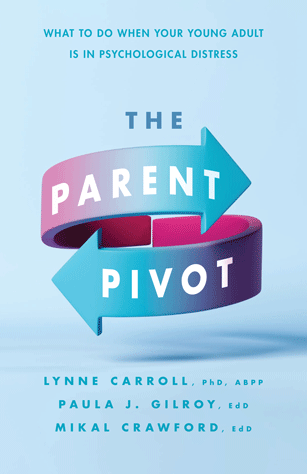
The Parent Pivot
For parents who feel overwhelmed, worried, or unsure how to help a young adult in psychological distress, this book offers compassionate, practical guidance.
Emerging adulthood (ages 18–29) is a vulnerable period often marked by anxiety, depression, substance misuse, internet misuse, and risky behaviors. As children enter adulthood, the parenting role must shift. Instead of being a full-time “caretaker,” parents must learn to “pivot” into roles such as “coach,” “wise counsel,” or “compeer”—and sometimes return to the “caretaker” role when distress intensifies.
The Parent Pivot provides clear guidance, support, and realistic hope for navigating this stage. Written by psychologists with decades of experience supporting emerging adults and their families, the book offers tools and language parents can begin using right away. Even when young adults resist help, readers will find strategies for staying connected without overstepping or disengaging.
You’ll learn how to:
- Distinguish between “normal” developmental stress and more serious mental health issues
- Communicate effectively, even during shutdown, conflict, or withdrawal
- Encourage professional help while respecting autonomy
- Determine when and how to seek treatment
- Set healthy boundaries and protect family well-being
- Manage your own stress, fear, and emotional exhaustion
Drawing on clinical research and real-world experience, The Parent Pivot addresses the complex emotional dynamics between parents and their young adults. It guides parents in practicing self-care, mourning lost expectations, and cultivating compassion—for themselves and their adult children.
Acknowledgments
Introduction: The Pivoting Wheel
Part I. OMG! I Thought I Was Done
- Chapter 1. A World in Chaos
- Chapter 2. The Pivots Begin
Part II. Upside Down and Inside Out
- Chapter 3. Riding the Dragons: Unhealthy Coping in Young Adults
- Chapter 4. Things Fall Apart: Serious Mental Health Issues in Young Adults
- Chapter 5. Advanced Skills for Serious Mental Health Issues
- Chapter 6. Help! I Need Somebody, Not Just Anybody
- Chapter 7. Becoming Wise Counsel
Part III. Right Side Up Again
- Chapter 8. Mourning Your Losses
- Chapter 9. Tending Your Own Garden
- Chapter 10. The Compeer State of Mind
References
Index
About the Authors
Lynne Carroll, PhD, ABPP, is a retired professor of psychology and former director of the master’s program at the University of North Florida. Throughout her 30+ years in academia, Dr. Carroll taught multiple undergraduate and graduate courses in psychology and mental health counseling in Maryland and Pennsylvania. Her research has been widely published in professional journals and presented at national and international conferences. Dr. Carroll is the author of a graduate textbook on psychotherapy published in 2010 by Pearson. A licensed and board-certified counseling psychologist, her clinical work focused on concerns of young adults in both university and community settings.
Paula J. Gilroy, EdD, is a licensed psychologist retired from 30+ years of clinical practice at a university counseling center. She worked with young adults who sought treatment for mood and anxiety disorders, trauma, family issues, grief, and loss. As the Assistant Director for Training, Dr. Gilroy provided individual and group supervision for graduate-level students. She offered consultation services to parents concerned about their young adults. Dr. Gilroy co-authored a wide range of scholarly articles and presented her research at national conferences. She lives in Iowa with her husband and menagerie of three dogs, five cats, and one rabbit.
Mikal Crawford, EdD, is a licensed psychologist in Maine retired from 30+ years of clinical work with young adults in a university counseling center in Maryland and as a graduate faculty member in counseling and psychology in both Maryland and Maine. She also worked with parents of young adults in psychological distress while they learned to pivot from the caretaker role as these adult children headed to college. Dr. Crawford has written and co-authored scholarly articles and presented at national and international conferences. She lives in Maine with her husband and makes monthly visits to senior living facilities with her therapy dog, Riley.
The Parent Pivot is an innovative and resourceful guide for parents of young adults in emotional distress. With real-world case examples and storytelling, The Parent Pivot provides parents with useful coping tools, informational resources, and a new relationship model for responding to the emotional distress of their young adult. More than anything, this marvelous book gives desperate parents some concrete measure of hope.
—Sherry Cormier, PhD, psychologist, bereavement trauma specialist, consultant, and author of Sweet Sorrow: Finding Enduring Wholeness After Loss and Grief
Reading every chapter, or even every page of this book, powerfully equips a parent, or an aunt, uncle, grandparent, or anyone who loves an emerging adult, with expert knowledge and evidence-based practice, enveloped in thoughtfulness and grace. The authors thoroughly understand the depths and intricacies of being a parent and offer a liberating yet intentional way of living for both the emerging adult and the self.
—Tes Tuason, PhD, Professor and Program Director, Clinical Mental Health Counseling, Brooks College of Health, University of North Florida, Jacksonville
This book serves as an amazing resource for parents whose children are on the cusp of emerging adulthood during these especially challenging times. The authors address concerns of young adults ranging from daily stressors to unhealthy coping behaviors to serious mental health disorders. This book provides help and support in understandable and relatable ways. Most important, this resource equips you with the knowledge and skills necessary to care for yourself as you navigate the demands associated with your evolving role.
—Cliff McKinney, PhD, Department of Psychology, Mississippi State University
This book is an exceptionally valuable resource for parents and caretakers who are trying to help their young adult children cope with emotional distress and more serious mental health disorders. The authors very clearly describe the challenges that can emerge during this critical developmental period and offer practical suggestions for how best to support their children. The authors have many years of experience and their expertise contributes to the credibility of the content of the book. The real-life case studies, the conversational writing style, and the focus of hope in the last chapter should appeal to parents who are struggling to help their children navigate a difficult period in their development.
—Ann Vernon, PhD, Professor Emerita, University of Northern Iowa, Cedar Falls