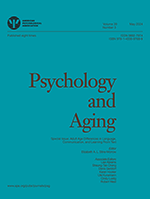

This special issue of Psychology and Aging on includes 16 contributions by leading researchers in the field.
These contributions provide new findings on different aspects of associative memory, including patterns of decline and sparing, heterogeneity in older adults' associative memory performance, and cognitive and noncognitive factors that may potentially improve older adults' associative memory performance.
Furthermore, some of the contributions provide interesting tests and discussion of several theoretical positions, mentioned below.
Finally, regardless of the preferred theoretical perspective, the different articles use a variety of measures, including behavioral, neuroimaging, and genetic analyses.
Special Issue Editors
Table of contents
View the table of contents with abstracts on APA PsycNETopens in new window
Introduction
- Age-Related Differences in Associative Memory: Empirical Evidence and Theoretical Perspectives
Moshe Naveh-Benjamin and Ulrich Mayr
Articles
- Effects of Time of Day on Age-Related Associative Deficits
Elizabeth A. Maylor and Stephen P. Badham - The Effects of Stereotype Threat on the Associative Memory Deficit of Older Adults
Matthew S. Brubaker and Moshe Naveh-Benjamin - Memory for Important Item-Location Associations in Younger and Older Adults
Alexander L. M. Siegel and Alan D. Castel - The Effects of Value on Context-Item Associative Memory in Younger and Older Adults
Joseph P. Hennessee, Barbara J. Knowlton, and Alan D. Castel - Effects of Changes in Schematic Support and of Item Repetition on Age-Related Associative Memory Deficits: Theoretically-Driven Empirical Attempts to Reduce Older Adults' High False Alarm Rate
Hope C. Fine, Yee Lee Shing, and Moshe Naveh-Benjamin - Age Differences in Memory for Meaningful and Arbitrary Associations: A Memory Retrieval Account
Tarek Amer, Kelly S. Giovanello, Cheryl L. Grady, and Lynn Hasher - Older Adults' Associative Memory Is Modified by Manner of Presentation at Encoding and Retrieval
Amy A. Overman, John M. McCormick-Huhn, Nancy A. Dennis, Joanna M. Salerno, and Alexandra P. Giglio - Repetition Lag Training Eliminates Age-Related Recollection Deficits (and Gains Are Maintained After Three Months) but Does Not Transfer: Implications for the Fractionation of Recollection
Nicole D. Anderson, Patricia L. Ebert, Cheryl L. Grady, and Janine M. Jennings - Association Between Subjective Memory Assessment and Associative Memory Performance: Role of AD Risk Factors
Marci M. Horn, Kristen M. Kennedy, and Karen M. Rodrigue - Age Differences in False Memory: The Importance of Retrieval Monitoring Processes and Their Modulation by Memory Quality
Yana Fandakova, Myriam C. Sander, Thomas H. Grandy, Roberto Cabeza, Markus Werkle-Bergner, and Yee Lee Shing - Flexible Retrieval Mechanisms Supporting Successful Inference Produce False Memories in Younger but Not Older Adults
Alexis C. Carpenter and Daniel L. Schacter - Age Differences in Episodic Associative Learning
Rachel Clark, Eliot Hazeltine, Michael Freedberg, and Michelle W. Voss - Leveraging Older Adults' Susceptibility to Distraction to Improve Memory for Face-Name Associations
Renée K. Biss, Gillian Rowe, Jennifer C. Weeks, Lynn Hasher, and Kelly J. Murphy - Using Attribute Amnesia to Test the Limits of Hyper-Binding and Associative Deficits in Working Memory
John M. McCormick-Huhn, Hui Chen, Bradley P. Wyble, and Nancy A. Dennis - Hyper-Binding Only Apparent Under Fully Implicit Test Conditions
Karen L. Campbell and Lynn Hasher - Modeling Age Differences in Effects of Pair Repetition and Proactive Interference Using a Single Parameter
Joseph D. W. Stephens and Amy A. Overman