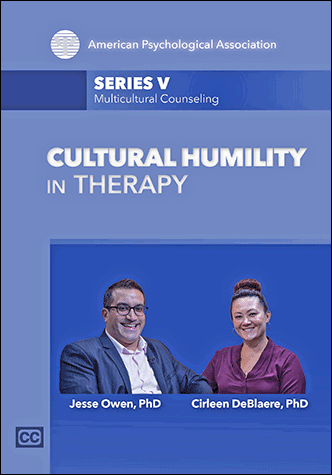
Cultural Humility in Therapy
ISBN: 978-1-4338-3134-8Available formats
Streaming options
Therapists working with clients whose culture differs from their own may worry about offending clients with awkward questions or making a misstep in discussion of therapeutic content that may have cultural elements. Cultural humility is an other-oriented interpersonal stance that can assist in such situations, as it allows the therapist to explore the client's cultural identities while being mindful of the therapist's culture and any limitations of knowledge.
This stance, which may be used in conjunction with any therapy approach, allows the therapist to address difference comfortably and maintain the therapeutic alliance, all while acknowledging meaningful content.
In this video, Dr. Cirleen DeBlaere demonstrates cultural humility working with a client who has experienced tragic loss in her life. In a lively discussion, Dr. Jesse Owen talks with Dr. DeBlaere about the demonstration and the usefulness of fostering cultural humility in therapy.
The approach illustrated in the video is the multicultural orientation framework (MCO; Owen, 2013). The MCO approach refers to how a therapist conceptualizes and values diversity, which necessarily affects the therapist's work with diverse clients; it focuses on "ways of being" with diverse clients (Owen, 2013).
There are three main pillars of the MCO framework: cultural humility, cultural opportunities, and cultural comfort (Owen, 2013).
The first pillar, cultural humility, is considered the foundation of MCO. It involves an interpersonal stance that is other-oriented, and open to the exploration of the client's salient cultural identities.
The second pillar, cultural opportunities, occur when a client introduces cultural content in the therapy session (Owen, 2013; Owen et al., 2016). These moments provide opportunities for the counselor to engage the client's cultural identities (e.g., values, beliefs, content related to cultural heritage). Alternatively, counselors may also initiate cultural opportunities when appropriate (e.g., inquiring about a client's values around marriage or discussing cultural practices related to life transitions).
Finally, the third pillar, cultural comfort, describes the therapist's sense of ease in addressing cultural subjects and engaging the client in cultural dialogue.
Cirleen DeBlaere, PhD, received her doctorate in counseling psychology from the University of Florida and is currently an assistant professor of counseling psychology at Georgia State University. Her professional interests include the identity and experiences of individuals with marginalized identities, particularly people with multiple marginalized identities (e.g., LGBTQ people of color, women of color), resilience, cultural humility, and multicultural counseling and supervision. She teaches graduate courses in multicultural issues, personality theory, and clinical supervision.
Jesse Owen, PhD, received his doctorate in counseling psychology from the University of Denver (DU) in 2005. He is currently an associate professor and chair of the counseling psychology department at DU. He worked at Gannon University and the University of Louisville prior to joining the faculty at DU. He is a licensed psychologist and has had a private practice at times over the past decade. His research focuses on psychotherapy processes and outcomes as well as romantic relationships. More specifically, his work in psychotherapy focuses on therapists' multicultural orientation and expertise.
- Mosher, D. K., Hook, J. N., Captari, L. E., Davis, D. E., DeBlaere, C., & Owen, J. (2017). Cultural humility: A therapeutic framework for engaging diverse clients. Practice Innovations, 2(4), 221–233.
- Owen, J. (2013). Early career perspectives on psychotherapy research and practice: Psychotherapist effects, multicultural orientation, and couple intervention. Psychotherapy, 50(4), 496–502. doi:10.1037/a0034617
- Owen, J., Tao, K., Drinane, J., Hook, J., Davis, D., & Foo Kune, N. (2016). Client perceptions of therapists' multicultural orientation: Cultural (missed) opportunities and cultural humility. Professional Psychology: Research and Practice, 47, 30–37.
APA Videos
- Culturally Informed Psychoanalytic Psychotherapy
Pratyusha Tummala-Narra - Culturally Responsive Cognitive Behavioral Therapy Over Time
Pamela A. Hays - Culturally Responsive Cognitive–Behavioral Therapy in Practice
Pamela A. Hays - The Dynamics of Power and Privilege in Psychotherapy
Malin Fors - Multicultural Care in Practice
Lillian Comas-Diaz - Multicultural Therapy Over Time
Melba J. T. Vasquez - Working With Issues of Social Class in Psychotherapy
William Ming Liu
APA Books
- Cultural Adaptations: Tools for Evidence-Based Practice With Diverse Populations
Edited by Guillermo Bernal and Melanie M. Domenech Rodríguez - Cultural Humility: Engaging Diverse Identities in Therapy
Joshua N. Hook, Don Davis, Jesse Owen, and Cirleen DeBlaere - Culturally Responsive Cognitive–Behavioral Therapy, Second Edition: Assessment, Practice, and Supervision
Pamela A. Hays and Gayle Y. Iwamasa - A Grammar of Power in Psychotherapy: Exploring the dynamics of privilege
Malin Fors - Mindfulness-Based Practices in Therapy: A Cultural Humility Approach
Don Davis, Cirleen DeBlaere, Joshua Hook, and Jesse Owen - Multicultural Care: A Clinician's Guide to Cultural Competence
Lillian Comas-Díaz