Autism Spectrum Disorders
ISBN: 978-1-59147-438-8Available formats
Streaming options
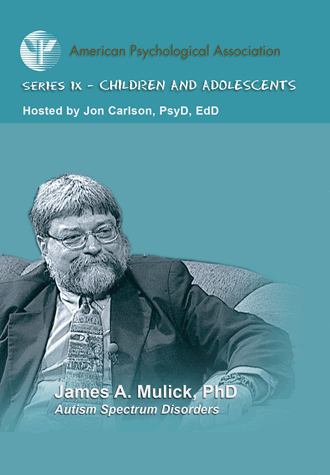
In Autism Spectrum Disorders, Dr. James A. Mulick shows his approach to counseling children with autism and their parents. Autism spectrum disorder, which includes autism and Asperger syndrome, is characterized by impairment in communication skills, social interactions, and repetitive patterns of behavior. Dr. Mulick works with families with autistic children to help them handle this disorder.
In this session, Dr. Mulick works with a mother of a 10-year-old boy who has been diagnosed with autism. Dr. Mulick uses his behavioral–educational approach to assess the present situation and makes several intervention suggestions, including exposure, distraction, and reinforcement.
Dr. Mulick's approach to working with parents emphasizes both family advocacy and alliance building and behavioral intervention. During most characteristically brief family encounters in pediatric psychology settings, parents are looking for an indication that they can be helped to solve behavior and learning problems that they may be having with their children; and they are seeking reassurance that the therapist understands their love and very special relationship with their children.
Because child learning and behavior problems occur and consequently must be solved in the natural environment, rather than in the therapist's office during 50-minute sessions, they must ultimately be solved by the people in the child's natural environment. They also must be solved in real time. Dr. Mulick tries to convey these messages as he gathers information about parent motivation and functional relations affecting the child's behavior for development of an initial treatment plan. Further observation of the child in home and community settings and focused parent training in behavior change procedures constitute the next steps following the initial parental clinical interview.
James A. Mulick, PhD, is a full professor at the Ohio State University in Columbus, jointly in the Department of Pediatrics and Department of Psychology. He has been practicing Pediatric Psychology there for the past 22 years, focusing on developmental disabilities, and founded the Postdoctoral Training program there in his specialty, in 1986. He was director of Psychology at Rhode Island Hospital's Child Development Center, having previously taught in the Brown University Program in Medicine.
He studied learning and behavioral development with Harold Leitenberg, PhD, and Justin Joffe, PhD, at the University of Vermont, where he earned his PhD in 1975; and was mentored in his applied specialty by Stephen R. Schroeder, PhD, and Carolyn S. Schroeder, PhD, during his postdoctoral training at the University of North Carolina in Chapel Hill. His research has emphasized behavioral approaches in developmental disabilities and more recently has focused on autism and autism early intervention.
He has published widely in scientific journals and contributed chapters to many textbooks in his area of expertise. He has been president of Division 33 (Mental Retardation and Developmental Disabilities) of the American Psychological Association (APA), and has served two terms representing Division 33 on the APA Council of Representatives.
- Jacobson, J. W., Foxx, R. M., & Mulick, J. A. (Eds.). (2005). Controversial therapies for developmental disabilities: Fad, fashion, and science in professional practice. Hillsdale, NJ: Lawrence Erlbaum Associates.
- Jacobson, J. W., & Mulick, J. A. (Eds.). (1996). Manual of diagnosis and professional practice in mental retardation. Washington, DC: American Psychological Association.
- Kanoy, K. W., & Schroeder, C. S. (1985). Suggestions to parents about common behavior problems in a pediatric primary care office: Five years of follow-up. Journal of Pediatric Psychology, 10, 15–30.
- Mulick, J. A., & Butter, E. M. (2002). Educational advocacy for children with autism. Behavioral Interventions, 17, 57–74.
- Mulick, J. A., & Hale, J. B. (1996). Communicating assessment results in mental retardation. In J. W. Jacobson & J. A. Mulick (Eds.), Manual of diagnosis and professional practice in mental retardation (pp. 257–263). Washington, DC: American Psychological Association.
- Mulick, J. A., & Meinhold, P.M. (1994). Developmental disorders and broad effects of the environment on learning and treatment effectiveness. In E. Schopler & G. R. Mesibov (Eds.), Behavioral issues in autism (pp. 97–126). New York: Plenum.
- Mulick, J. A., & Pueschel, S. M. (Eds.). (1983). Parent–professional partnerships in developmental disability services. Cambridge, MA: Academic Guild Publishers.
- Salvy, S. J., Mulick, J. A., Butter, E., Kahng, R., & Linscheid, T. R. (2004). Contingent electric shock (SIBIS) and a conditioned punisher eliminate severe head banging in a preschool child. Behavioural Interventions, 19, 1–14.
- Schroeder, C. S., & Gordon, B. N. (2002). Assessment and treatment of childhood problems: A clinician's guide (2nd ed.). New York: Guilford Press.
- Schroeder, S. R., Schroeder, C. S., & Landesman, S. (1987). Psychological services in educational settings to persons with mental retardation. American Psychologist, 42, 805–808.
APA Videos
- Caregiving
Tim Elliott - Consulting With Teachers
Jon Carlson and William Glasser - Family Therapy With Patients Having Physical Health Problems
Susan H. McDaniel - Individual Therapy From a Family Systems Perspective
Florence W. Kaslow - Parenting Young Children
Edward R. Christophersen
APA Books
- Empirically Based Play Interventions for Children, Second Edition
Edited by Linda A. Reddy, Tara M. Files-Hall, and Charles E. Schaefer - Intervening in Children's Lives: An Ecological, Family-Centered Approach to Mental Health Care
Thomas J. Dishion and Elizabeth A. Stormshak
Magination Press Books
- Feeling Better: A Kid's Book About Therapy
Rachel Rashkin; Illustrated by Bonnie Adamson - Oh Brother! Growing up With a Special Needs Sibling
Natalie Hale; Illustrated by Kate Sternberg