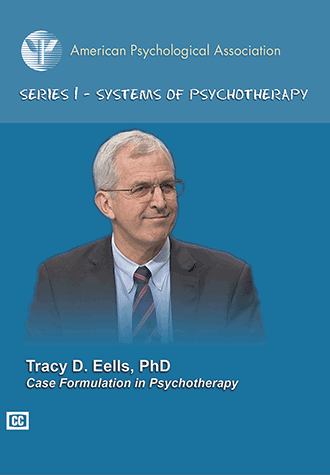
Case Formulation in Psychotherapy
ISBN: 978-1-4338-2007-6Available formats
Streaming options
How does a therapist know what to do next during a session? One key method for determining what to do in therapy is case formulation, a systematic process for developing hypotheses about and plans to address the causes and precipitants of a client's presenting problems.
Dr. Tracy Eells presents an evidence-based, integrative method of psychotherapy case formulation that can be adapted to single-theory approaches to therapy, any specific treatment manual, or any component of a theory or manual. This pragmatic case formulation model works for simple and straightforward cases as well as those involving many problems in many spheres of life.
In this video, Dr. Eells explains his case formulation model, works with a client in a therapy demonstration, then uses examples from the demonstration to illustrate how to apply his case formulation model.
This DVD presents an evidence-based, integrative method of psychotherapy case formulation. The method facilitates the integration of evidence-based theories and models of psychotherapy. It also adapts to single-theory approaches to therapy, any specific treatment manual, or any component of a theory or manual. The case formulation model is pragmatic and works for simple and straightforward cases, as well as those involving many problems in many spheres of life and multiple diagnostic co-morbidities.
The model is evidence-based in three ways:
- by emphasizing explanations of client problems based on empirically supported theory;
- by incorporating expert knowledge regarding formulation and steps to enhance sound reasoning in case formulation;
- and by drawing from evidence in psychological science beyond theories of psychotherapy.
This evidence includes findings from developmental psychology, psychopathology research, epidemiology, and cognitive science. Each of these domains has something to offer in explaining a client's presenting problems and in guiding treatment. The approach is consistent with the perspective on evidence-based practice in psychology as adopted by APA1. That perspective emphasizes integrating the best available research with clinical expertise, while also accounting for patient characteristics and preferences, as well as cultural factors.
The method emphasizes collaboratively identifying problems and working toward solutions. Toward this end, a set of empirically grounded, culturally informed explanatory templates are posited that the therapist may choose from and consider with the client. A diathesis-stress conceptualization is presented as an overarching and quintessentially integrative initial template to consider. Other templates are drawn from relational-psychodynamic psychotherapy, behavior therapy, cognitive therapy, and humanistic/experiential therapy.
These templates facilitate consideration of a client's problems from the perspective of wishes, fears, and compromises; representations of self, others, and relationships; functional analysis; cognitive appraisals; and deficits of emotional awareness.
A three-step approach to treatment planning is presented:
- assessing the client's set point for treatment
- identifying treatment objectives
- selecting interventions to achieve those objectives
Regular progress monitoring is considered essential to assess whether the selected interventions are helping. When considering the next intervention in psychotherapy, the method encourages the therapist to seek the answer in the case formulation and the mutually agreed upon treatment plan.
In summary, the case formulation method presented in this DVD facilitates a systematic process for developing hypotheses about and plans to address the causes, precipitants and maintaining influences of a client's psychological, interpersonal, and behavioral problems in the context of that individual's culture and environment. While comprehensive, the method is not daunting to use. Above all, it emphasizes a systematic case formulation frame of mind as a guide to treatment.
References
- APA Presidential Task Force on Evidence-Based Practice. (2006). Evidence-based practice in psychology. American Psychologist, 61(4), 271–285.
Tracy D. Eells, PhD, is a clinical psychologist, a professor in the department of psychiatry and behavioral sciences, and vice provost for faculty affairs at the University of Louisville. He maintains an individual psychotherapy practice, working with adults presenting with a wide variety of relationship, mood, anxiety, and life problems. He regularly supervises clinical psychology graduate students and psychiatry residents. Psychological assessment is also a major part of his practice.
He has taught and conducted research on psychotherapy case formulation for more than 20 years and more recently has researched the role of computer assisted cognitive behavior therapy for treatment of depression. He is a fellow of APA Division 29 (Society for the Advancement of Psychotherapy).
Dr. Eells obtained his PhD in clinical psychology at the University of North Carolina, Chapel Hill in 1989 and completed a postdoctoral fellowship at the John D. and Catherine T. MacArthur Foundation Program on Conscious and Unconscious Mental Processes of the University of California, San Francisco.
In addition to many journal articles and book chapters, he is author of Psychotherapy Case Formulation, and editor of the Handbook of Psychotherapy Case Formulation, now in its second edition.
How to use the Theories of Psychotherapy Series® in combination with APA Videos
- Eells, T. D. (Ed.) (2007). Handbook of psychotherapy case formulation (2nd Edition.) New York, NY: Guilford Press.
- Eells, T. D. (2015) Psychotherapy case formulation. Washington, DC: American Psychological Association.
- Eells, T. D., Lombart, K. G., Kendjelic, E. M., Turner, L. C., & Lucas, C. (2005). The quality of psychotherapy case formulations: A comparison of expert, experienced, and novice cognitive behavioral and psychodynamic therapists. Journal of Clinical and Consulting Psychology, 73, 579–589.
- Eells, T. D., Lombart, K. G., Salsman, N., Kendjelic, E. M., Schneiderman, C. T. & Lucas, C. (2011). Expert reasoning in psychotherapy case formulation. Psychotherapy Research, 21, 385–399.
- Eells, T. D. (2013). The case formulation approach to psychotherapy research revisited. Pragmatic Case Studies in Psychotherapy, 9, 426–447.
APA Videos
- Case Formulation in Emotion-Focused Therapy: Addressing Unfinished Business
Rhonda N. Goldman - Individualized Case Formulation and Treatment Planning
Jacqueline B. Persons, Michael A. Tompkins, and Joan Davidson - Integrative Therapy
John C. Norcross - Psychological Assessment and Case Conceptualization
Keith S. Dobson, Pamela A. Hays, and Amy Wenzel - Three Approaches to Psychotherapy With a Female Client: The Next Generation
Judith S. Beck, Leslie S. Greenberg, and Nancy McWilliams - Three Approaches to Psychotherapy With a Male Client: The Next Generation
Judith S. Beck, Leslie S. Greenberg, and Nancy McWilliams
APA Books
- Behavioral Interventions in Cognitive Behavior Therapy: Practical Guidance for Putting Theory Into Action, Second Edition
Richard F. Farmer and Alexander L. Chapman - Case Formulation in Emotion-Focused Therapy: Co-Creating Clinical Maps of Change
Rhonda N. Goldman and Leslie S. Greenberg - Psychotherapy Case Formulation
Tracy D. Eells
- Psychotherapy Case Formulation
This concise and engaging primer helps beginning therapists systematically organize their thoughts and ideas about a client, using an evidence-based approach to case formulation