Intimate Partner Violence
ISBN: 978-1-4338-2245-2Available formats
Streaming options
Exposure to trauma due to abuse or violence can increase risk for aggressive behavior in relationships. Intimate partner violence is more likely when an individual is suffering with trauma-related problems such as PTSD, as is sometimes the case in families with members who served in military combat positions.
Empirically validated, trauma-informed therapeutic interventions are essential to addressing such violence. These interventions help clients recognize a need to take responsibility for their abusive behavior and to develop effective conflict resolution skills.
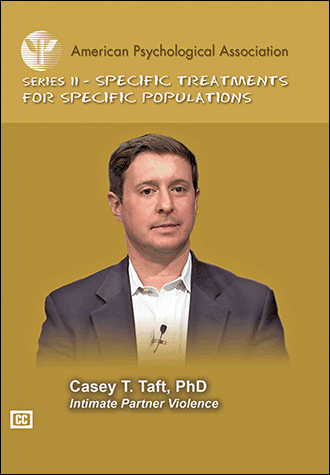
In this video, Dr. Casey Taft demonstrates this approach by helping a group of four men acknowledge intimate partner violence in their lives and take necessary steps towards remaining nonviolent.
The Strength at Home program is a trauma-informed intervention intended to end intimate partner violence in current relationships and prevent intimate partner violence in future relationships by helping participants to develop effective conflict resolution skills, enhance intimacy and closeness in their relationships, and reduce the negative effects of stress on their relationships. The program is intended for those who have engaged in recent physical intimate partner violence and/or other coercive, controlling, or abusive relationship behaviors.
The intervention is based on social information processing models of intimate partner violence and includes components from empirically validated interventions for intimate relationship difficulties and PTSD. The basic elements of the intervention include self-monitoring exercises, anger and conflict management techniques, and communication skills training. These components are used to combat the social information processing difficulties.
Through the improvement of social information processing, veterans should experience reductions in and/or cessation of relationship conflict and use of intimate partner violence.
Casey T. Taft, PhD, is a staff psychologist at the National Center for PTSD in the VA Boston Healthcare System, and professor of psychiatry at Boston University School of Medicine.
Dr. Taft was the 2006 Young Professional Award winner from the International Society for Traumatic Stress Studies, and the 2009 Linda Saltzman Memorial Intimate Partner Violence Researcher Award winner.
Dr. Taft has served as principal investigator on several funded grants focusing on understanding and preventing partner violence through the National Institute of Mental Health, the Department of Veterans Affairs, the Centers for Disease Control, the Department of Defense, and the Blue Shield Foundation of California.
Dr. Taft is former associate editor of the journal Psychological Trauma and is currently on the editorial boards of five other journals in the areas of clinical psychology, trauma, and the family.
Dr. Taft has also chaired an APA task force on trauma in the military and has consulted with the United Nations on preventing violence and abuse globally.
APA Videos
- Case Formulation in Emotion-Focused Therapy: Addressing Unfinished Business
Rhonda N. Goldman - Cognitive Behavioral Therapy for Social Anxiety
Amy Wenzel - Emotion-Focused Therapy for Trauma
Sandra C. Paivio - Emotionally Focused Couple Therapy for Clients Dealing With Infidelity
Sue Johnson - Forgiveness
Robert D. Enright and Richard P. Fitzgibbons - Mindfulness for Anxiety
Ronald D. Siegel - Working With Anger
Lorne Korman - Working With Men Survivors of Trauma and Abuse
Laura S. Brown - Working With Women Survivors of Trauma and Abuse
Laura S. Brown
APA Books
- A Practical Guide to PTSD Treatment: Pharmacological and Psychotherapeutic Approaches
Edited by Nancy C. Bernardy, and Matthew J. Friedman - Road Rage: Assessment and Treatment of the Angry, Aggressive Driver
Tara E. Galovski, Loretta S. Malta, and Edward B. Blanchard - Spiritually Oriented Psychotherapy for Trauma
Edited by Donald F. Walker, Christine A. Courtois, and Jamie D. Aten - Treating PTSD With Cognitive Behavioral Therapies: Interventions That Work
Candice M. Monson and Philippe Shnaider