Parent–Child Interaction Therapy Conducted Online
ISBN: 978-1-4338-4061-6Available formats
Streaming options
One of the most common reasons young children are referred for mental health services is because of challenging behaviors such as oppositionality, noncompliance, and aggression. These behaviors often lead to or are a sign of parent–child conflict. Parent–child interaction therapy (PCIT) is a powerful approach based on behavioral principles and attachment theory that seeks to repair the parent–child relationship, build strong positive parenting skills, and decrease children’s disruptive behaviors.
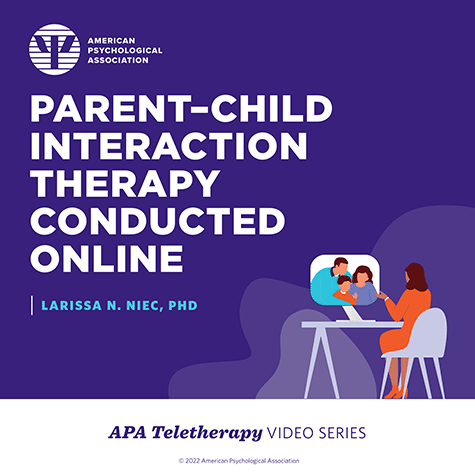
In this video, Dr. Larissa N. Niec demonstrates the delivery of PCIT online with a single father who feels ineffective in managing the challenging behaviors of his 3-year-old daughter. Watch as Dr. Niec conducts a session from the first phase of PCIT, child-directed interaction. Dr. Niec demonstrates how to manage the telehealth format of a PCIT session while providing the parent with in vivo coaching to promote his ability to relate effectively to his daughter. Before and after the demonstration, Dr. Niec discusses her approach to the case with Dr. Elizabeth Brestan Knight.
This video features actors portraying a father–daughter dyad based on a composite of PCIT cases.
The quality of caregiving and the caregiver–child relationship is core to child development. When children experience responsive and effective caregiving, they demonstrate better functioning across affective, behavioral, and cognitive domains. In this video, I use parent–child interaction therapy, a strength-based, robustly effective intervention for families with young children, to help the parent enhance his relationship with his daughter. Based on attachment theory, PCIT increases caregivers’ child-centered interactions so that they can respond sensitively to their children’s emotional needs, and increases caregivers’ effective interactions so that they can provide developmentally appropriate limits. This combination of warmth, nurturance, and safe limits promotes children’s positive behaviors and reduces conduct problems.
Although attachment theory drives the rationale for the PCIT approach (i.e., caregiver–child relationship building), behavioral theory drives the primary mechanism of change in PCIT (i.e., in vivo therapeutic coaching). As an active PCIT coach, the therapist uses behavioral strategies to build positive caregiving skills. In this video, she demonstrates the use of strategies such as modeling, reinforcement, and differential attention, which increase the parent’s positive interactions and decrease his negative interactions with his child.
A number of aspects embedded in the PCIT model allow it to be a culturally responsive intervention: First, PCIT welcomes all caregivers who are important in a child’s life (e.g., parents, foster parents, grandparents, adult siblings). Second, PCIT empowers caregivers to be the primary agent of change for their children, providing them with the skills to support their children’s healthy development. Relatedly, PCIT respects the role of the caregiver and keeps the focus on the caregiver–child relationship rather than the therapist–child relationship. Finally, PCIT uses in vivo coaching, which allows the therapist to focus on the targets that both therapist and caregiver agree are consistent with the family’s beliefs and culture.
Dr. Larissa N. Niec is a professor of psychology and the director of the Center for Children, Families, and Communities at Central Michigan University. As a clinician, educator, and researcher, Dr. Niec’s overarching goal is to promote health equity for families by increasing access to effective parent–child interventions.
Dr. Niec has been a parent–child interaction therapy (PCIT) therapist and trainer for nearly 30 years. She is involved in national and international efforts to disseminate PCIT to community therapists and has trained therapists in Australia, Mexico, South America, and across Europe.
Dr. Niec has developed and evaluated multiple adaptations of PCIT, including group PCIT, brief PCIT for the selective prevention of conduct problems (PCIT-SP), and PCIT to help parents manage children’s screen time and reduce obesity risk (PCIT-Health). She has written extensively on the parent–child relationship, the evidence-based use of play in clinical practice, and parent–child interaction therapy. Some of her books include Play in Clinical Practice: Evidence-Based Approaches (with Sandra Russ, Guilford Press), Handbook of Parent–Child Interaction Therapy: Innovations and Applications for Research and Practice (Springer Nature), and Strengthening the Parent–Child Relationship in Therapy: Laying the Foundation for Healthy Development (APA).
Her work has been highlighted in outlets such as the NBC Today Show.
Find more details about Dr. Niec’s work on her websiteopens in new window.
Niec, L. N. (Forthcoming, 2022). Strengthening the parent-child relationship in therapy: Laying the foundation for healthy development. American Psychological Association Press.
Niec, L. N., (Ed.). (2018). Handbook of Parent-Child Interaction Therapy: Innovations and applications for research and practice. Springer Nature.
Niec, L. N., Acevedo-Polakovich, I., Abbenante, E., Christian, A., Barnett, M., Peer, S. & Aguilar, G. (2014). Working together to solve disparities: Latina/o parents’ contributions to the adaptation of a preventive intervention for childhood conduct problems. Psychological Services, 11, 410-420. doi: 10.1037/a0036200
Niec, L. N., Barnett, M. L., Gering, C . L., Triemstra, K., & Solomon, D. T. (2015). Differences in mothers’ and fathers’ readiness for change in parent training. Child and Family Behavior Therapy, 37, 224-235.
Niec., L. N., Barnett, M. L., Prewett, M., Shanley, J. (2016). Group parent-child interaction therapy: A randomized control trial for the treatment of conduct problems in young children. Journal of Consulting and Clinical Psychology, 84(8), 682-698.
Videos
Mentalization-Based Therapy for Adolescents Delivered Online
Carla Sharp and Trudie Rossouw
Mentalization-Based Treatment With a 10-Year-Old Boy
Norka T. Malberg and Karin Ensink
Conducting Clinical Interviews With Parents and Other Caregivers Online
Jon Lasser
Functional Family Therapy Online
Thomas L. Sexton
Prescriptive Integrative Play Therapy
Athena A. Drewes
Treating Mood Disorders in Children
Mary A. Fristad
Building a Therapeutic Alliance With Adolescent Boys
Andrew P. Smiler
Books
Strengthening the Parent–Child Relationship in Therapy: Laying the Foundation for Healthy Development
Larissa N. Niec
Empirically Based Play Interventions for Children, Second Edition
Linda A. Reddy, Tara M. Files-Hall, and Charles E. Schaefer
Group Play Interventions for Children: Strategies for Teaching Prosocial Skills
Linda A. Reddy
Play Therapy for Preschool Children
Charles E. Schaefer
Psychosocial Treatments for Child and Adolescent Disorders: Empirically Based Strategies for Clinical Practice, Second Edition
Euthymia D. Hibbs and Peter S. Jensen
Intervening in Children's Lives: An Ecological, Family-Centered Approach to Mental Health Care
Thomas J. Dishion and Elizabeth A. Stormshak