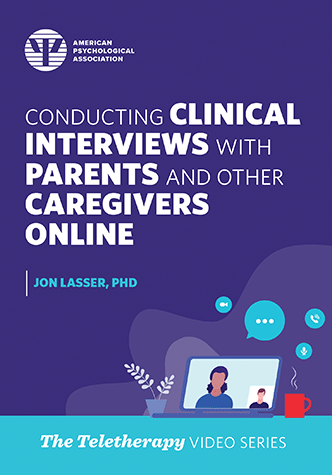
Conducting Clinical Interviews With Parents and Other Caregivers Online
ISBN: 978-1-4338-3826-2Available formats
Streaming options
In this video, Dr. Jon Lasser demonstrates consulting with a parent whose child exhibits behavioral and learning issues in school. Consulting with parents and caregivers is an effective approach to building rapport while also performing a psychological evaluation of the students’ home life and how it affects behavioral issues at school.
Consulting with parents and caregivers has also been proven to help reduce the student’s performance problems.
Watch as Dr. Lasser navigates the various issues presented during the structured clinical interview, which includes an exploration of the child’s developmental history from birth to present as well as a focus on the parent’s cultural background and how it may impact the child’s presentation.
During the demonstration, Dr. Lasser evaluates and makes recommendations to the parent for adjustments at home to help improve the student’s learning and behavioral outcomes at school. Dr. Lasser also discusses with the parent the effects of technology on child development. During the interview, Dr. Lasser discusses research efficacy, ethics, social justice, and child development with host, Dr. Janine Jones.
This session features a client portrayed by an actor on the basis of a composite of different cases.
High quality psychoeducational assessment integrates multiple sources of data using multiple methods of data collection. School psychologists and other mental health professionals who assess children and adolescents frequently use objective, standardized, norm-referenced measures such as tests of cognitive ability as a part of a comprehensive assessment, along with other observations, review of existing records, and interviews.
One of the most valuable sources of information about a child or adolescent’s history and current functioning is the parent or caregiver. In order to effectively consider the wide range of variables that potentially influence development and learning, school psychologists must have access to information about a child’s past, including pregnancy and birth, early development, medical history, social–emotional development, significant life events and transitions, family relationships, and educational history.
Although some psychologists collect such information via a form completed by a parent or caregiver, a face-to-face interview has many advantages. This approach uses face-to-face interviews as a part of a comprehensive assessment and reviews the essential content areas covered by such interviews.
Jon Lasser, PhD, is a psychologist, school psychologist, professor, and program director of the school psychology program at Texas State University. At Texas State he has developed and taught graduate courses for the school psychology program and has also taught the freshman first-year experience course.
He has coauthored two books (School Psychologist as Counselor and Professional Ethics in Midwifery Practice) as well as journal articles and chapters on a variety of subjects including autism, parenting, ethics, sexuality, and graduate preparation.
Jon holds a bachelor’s degree in Plan II liberal arts from the University of Texas at Austin, a master’s degree in human sexuality education from the University of Pennsylvania, and a doctorate in school psychology from the University of Texas at Austin.
APA Videos
- Consulting With Teachers Working With Diverse School Populations
Jon Lasser - Treating Mood Disorders in Children
Mary A. Fristad - Bullying Prevention
Arthur M. Horne - Building a Therapeutic Alliance With Adolescent Boys
Andrew P. Smiler - Consulting With Teachers
Jon Carlson and William Glasser - Harm Reduction With High School Students
Mary E. Larimer - Cognitive Behavior Therapy for Adolescent Depression
John F. Cury
APA Books
- Building a Career Outside Academia: A Guide for Doctoral Students in the Behavioral and Social Sciences
Edited by Jennifer Brown Urban and Miriam R. Linver - Evidence-Based Psychological Practice With Ethnic Minorities: Culturally Informed Research and Clinical Strategies
Edited by Nolan Zane, Guillermo Bernal, and Frederick T. L. Leong - An Introduction to Consulting Psychology: Working With Individuals, Groups, and Organizations
Rodney Lowman - Microaggressions and Traumatic Stress: Theory, Research, and Clinical Treatment
Kevin L. Nadal - Transcultural Competence: Navigating Cultural Differences in the Global Community
Jerry Glover and Harris L. Friedman
Magination Press Books
- Grow Grateful
Sage Foster-Lasser and Jon Lasser - Grow Happy
Jon Lasser and Sage Foster-Lasser - Grow Kind
Jon Lasser and Sage Foster-Lasser