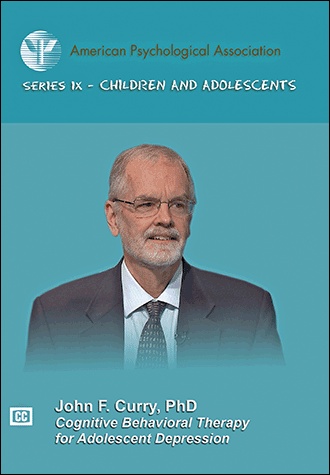
Cognitive Behavior Therapy for Adolescent Depression
ISBN: 978-1-4338-2908-6Streaming options
Although peer pressure, stress and self-esteem issues are not new, and have been generally accepted as normal growing pains for adolescents, an increasing issue among today's adolescents is depression.
Fortunately, adolescent depression is a treatable condition: Evidence-based approaches are available and, by sharpening the skills needed to establish an effective working alliance with adolescents and applying these approaches, clinicians can provide excellent treatment.
The cognitive-behavioral approach demonstrated in this program by Dr. John F. Curry is based in developmental psychopathology and social cognitive learning theory, and typically includes behavioral activation, problem-solving, and cognitive restructuring. In the therapy demonstration, Dr. Curry applies his approach to behavioral activation and works with an adolescent teen who is suffering from depression.
From the developmental psychopathology perspective, we know that depression can result from a wide variety of contributing factors and can affect adolescents with widely varying personality characteristics and family circumstances. Depression can also be viewed within multiple levels of analysis, ranging from the genetic level through the psychological level to the family and broader social contextual levels.
Psychotherapeutic treatment of depression addresses the psychological and to some extent the family levels of analysis. It is often accompanied by medication treatment which addresses biological factors maintaining the depression.
Cognitive behavioral therapy for depression is based on social cognitive learning and aims to help the adolescent to cope with stressful life events in effective ways so as to prevent or alleviate depression. Social cognitive learning theory helps the therapist to focus on the ways in which the adolescent has learned to respond to specific situations.
Dr. John F. Curry received his bachelor's degree in philosophy from Villanova University and his doctoral degree in clinical psychology from Catholic University of America, after completing a clinical internship at Duke University Medical Center.
He joined the Duke faculty in 1978 in the Department of Psychiatry where he conducted research and clinical practice. Since 1991 he has had a joint appointment in Psychology & Neuroscience, where he teaches, and directed the APA-accredited doctoral program in clinical psychology from 1997 to 2001. His research and clinical work has focused on adolescent disorders, especially depression and substance abuse.
Dr. Curry has conducted this work in outpatient and inpatient clinical settings, in consultations with the juvenile court and school systems, and in major National Institute of Mental Health-funded clinical trials. He was lead author of the cognitive behavior therapy (CBT) manual, and leader of the CBT team for the multi-site Treatment for Adolescents with Depression Study (TADS), and a contributing author and supervisor in the Treatment for Suicidal Adolescents (TASA) study.
His research has investigated efficacy and effectiveness of CBT, alone or with medication, in treating adolescent major depression. Currently, he leads a National Institute on Alcohol Abuse and Alcoholism-funded adaptive treatment study for adolescents with substance abuse and depression.
In the clinical psychology program, Dr. Curry mentors graduate students and teaches courses in child and adolescent psychotherapy, developmental psychopathology, and personality assessment.
- Becker, S. J. & Curry, J. F. (2008). Outpatient interventions for adolescent substance abuse: A quality of evidence review. Journal of Consulting & Clinical Psychology, 76, 531–543.
- Curry, J., Silva, S. Rohde, P., Ginsburg, G., Kratochvil, C., Simons, A., Kirchner, J., May, D., Ke1mard, B., Mayes, T., Feeny, N., Albano, A., Lavanier, S., Reinecke, M., Jacobs, R., Becker-Weidman, E., Weller, E., Emslie, G., Walkup, J., Kastelic, E. Burns, B., Wells, K., & March, J (2011). Recovery and recurrence following treatment for adolescent major depression. Archives of General Psychiatry, 68, 263–270.
- Curry, J., Silva, S., Rohde, P., Ginsburg, G., Kratochvil, C., Simons, A., Kirchner, J., May, D., Kennard, B., Mayes, T., Feeny, N., Albano, A., Lavanier, S., Reinecke, M., Jacobs, R., Becker-Weidman, E., Weller, E., Emslie, G., Walkup, J., Kastelic, E., Burns, B., Wells, K., & March, J. (2012). Onset of alcohol or substance use disorders following treatment for adolescent depression. Journal of Consulting and Clinical Psychology, 80, 299–312.
- Curry, J. F. (2014). Future directions in research on psychotherapy for adolescent depression. Journal of Clinical Child and Adolescent Psychology, 43, 510–526.
- Curry, J. F., & Meyer, A. E. (in press). Cognitive behavioral treatment of youth depression In P.C. Kendall (Ed.). Cognitive therapy with children and adolescents: A casebook for clinical practice. New York: Guilford Press.
- Curry, J. F., Rohde, P., Simons, A., Silva, S. G., Vitiello, B., Kratochvil, C. J., Reinecke, M. A., Feeny, N., Wells, K. C., Pathak, S., Weller, E., Rosenberg, D., Kennard, B. D., Robins, M., Ginsburg, G. S., March, J. S., and the Treatment for Adolescents with Depression Study (TADS) Team. (2006). Predictors and moderators of acute outcome in the Treatment for Adolescents with Depression Study (TADS). Journal of the American Academy of Child and Adolescent Psychiatry, 45, 1427–1439.
- Hersh, J, Curry, J. F., & Kaminer, Y. (2014). What is the impact of comorbid depression on adolescent substance abuse treatment? Substance Abuse, 35, 364–375.
- Treatment for Adolescents with Depression Study (TADS) Team (2007). The Treatment for Adolescents with Depression Study (TADS): Long-term effectiveness and safety outcomes. Archives of General Psychiatry, 64, 1132–1144.
- Treatment for Adolescents with Depression Study (TADS) Team. (2004). Fluoxetine, cognitive-behavioral therapy, and their combination for adolescents with depression. Journal of the American Medical Association, 292, 807–820.
APA Videos
- Attachment-Based Family Therapy
Guy S. Diamond - Cognitive-Behavioral Group Play Interventions
Linda A. Reddy - Functional Family Therapy for High-Risk Adolescents
James F. Alexander - Mentalization-Based Treatment With a 10-Year-Old Boy
Norka T. Malberg and Karin Ensink - Parents of Children With Autism Spectrum Disorder
V. Mark Durand - Prescriptive Integrative Play Therapy
Athena A. Drewes
APA Books
- Empirically Based Play Interventions for Children, Second Edition
Linda A. Reddy, Tara M. Files-Hall and Charles E. Schaefer - Group Play Interventions for Children: Strategies for Teaching Prosocial Skills
Linda A. Reddy - How to Find Mental Health Care for Your Child
Ellen B. Braaten - Intervening in Children's Lives: An Ecological, Family-Centered Approach to Mental Health Care
Thomas J. Dishion and Elizabeth A. Stormshak - Play Therapy for Preschool Children
Charles E. Schaefer - Psychosocial Treatments for Child and Adolescent Disorders: Empirically Based Strategies for Clinical Practice, Second Edition
Euthymia D. Hibbs and Peter S. Jensen