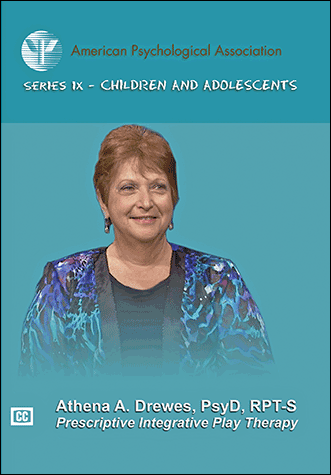
Prescriptive Integrative Play Therapy
ISBN: 978-1-4338-2843-0Available formats
During the period of middle childhood, which occurs between the ages of 6–12, children will experience social, emotional, and cognitive developmental changes. Such changes can be challenging for therapists treating children within this age group who may have behavioral and psychological disorders.
Because behavioral and psychological disorders for children and adolescents are multi-layered and complex, often with several overlapping problems, a multifaceted treatment approach is needed.
Dr. Athena A. Drewes' approach to middle childhood play therapy consists of a prescriptive, integrative method. In this video program, Dr. Drewes demonstrates her therapeutic approach with an eight-year-old child who is a victim of bullying in school, has low self-esteem and anger management problems.
In the session, Dr. Drewes checks in with the client, demonstrates a directive approach using play-based techniques that address the presenting problem issues, and then conducts a nondirective, child-led period of time to facilitate relaxation and self-regulation.
Dr. Athena A. Drewes' approach to play therapy with children is a prescriptive, integrative method.
Possible reasons for the rapid increase in integrative psychotherapies may be due to
- a large increase in therapies
- the lack of a single theory or treatment that is adequate
- a rise in short-term, problem-focused treatment
- the rise in evidence-based treatments resulting from the identification of specific therapy effects
- the recognition that there are therapeutic commonalities that heavily contribute to outcome (Norcross, 2005)
Consequently, integration of theory as well as integration of treatment approach may happen within sessions, across sessions, or both.
In addition, the use of an integrative, play-based approach allows for a developmentally appropriate treatment using the healing powers of play. Children, especially younger children, do not respond to verbal psychotherapies and resist school-like work, so play-based interventions and techniques are necessary for engagement and use of right brain, nonverbal abilities. The integration of expressive arts, movement, music, and similar activities may also be necessary to help with emotional regulation before being able to move into verbal interactions.
Depending on the symptoms, presenting problems and needs of the client, the best treatment approach is selected and tailored to the client (prescriptive approach), integrating and using play as therapy (a nondirective, child-led approach) or play in therapy (a directive, play based technique approach).
The clinician needs to be well versed in different theories, as well as in techniques and treatment approaches. It is not an arbitrary selection of play-based techniques, but rather a careful thinking through and selection and integrative process.
Dr. Athena A. Drewes is a licensed child psychologist, certified school psychologist, and registered play therapist and supervisor. She was director of clinical training and APA-accredited doctoral internship at Astor Services for Children and Families, a large multiservice nonprofit mental health agency in New York.
She has more than 30 years clinical experience in working with sexually abused and traumatized children and adolescents in school, outpatient, inpatient and foster care settings. Her treatment specialization is working with complex trauma, sexual abuse, and attachment issues utilizing an integrative play therapy approach.
Her theoretical approach is based on psychodynamic, cognitive–behavioral, attachment and systemic theories that inform her work.
- Drewes, A. A., & Schaefer, C. E. (2015). Play therapy in middle childhood. Washington, D.C.: American Psychological Association.
- Drewes, A. A., & Schaefer, C. E. (2013). The therapeutic powers of play: 20 core agents of change, 2nd Edition. New York: Wiley & Sons.
- Drewes, A. A., Bratton, S. C., & Schaefer, C. E. (2011). Integrative play therapy. New York: Wiley & Sons.
- Drewes, A. A. (2009). Blending play therapy with cognitive behavioral therapy: Evidence-based and other effective treatments and techniques. New York: Wiley & Sons.
- Perry, B. D. (2009). Examining child maltreatment through a neurodevelopmental lens: Clinical applications of the neurosequential model a/therapeutics. Journal of Loss and Trauma, 14, 240–255.
APA Videos
- Cognitive-Behavioral Group Play Interventions
Linda A. Reddy - Filial Play Therapy
Risë VanFleet - Integrative Family Therapy
Jay Lebow - Parenting Young Children
Edward R. Christophersen - Psychotherapy of Children With Conduct Disorders Using Games and Stories
Richard A. Gardner - Treating Adolescents With ADHD
Robert J. Resnick - Working With Children With ADHD
Vincent J. Monastra
APA Books
- Empirically Based Play Interventions for Children, Second Edition
Edited by Linda A. Reddy, Tara M. Files-Hall, and Charles E. Schaefer - Group Play Interventions for Children: Strategies for Teaching Prosocial Skills
Linda A. Reddy - Play Therapy for Preschool Children
Charles E. Schaefer - Play Therapy in Middle Childhood
Edited by Athena A. Drewes and Charles E. Schaefer - Psychosocial Treatments for Child and Adolescent Disorders: Empirically Based Strategies for Clinical Practice, Second Edition
Edited by Euthymia D. Hibbs and Peter S. Jensen