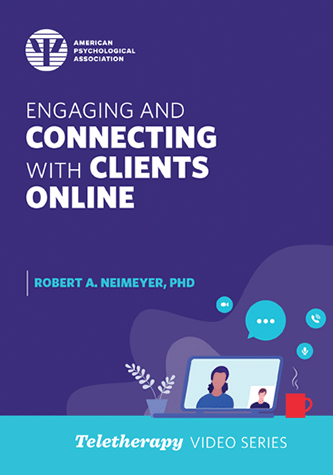
Engaging and Connecting With Clients Online
ISBN: 978-1-4338-4022-7Available formats
Streaming options
Connecting and engaging with clients in a virtual setting can be challenging, whether it is due to technical issues, background ambient noise, or a general sense of disconnection due to the absence of an in-person presence. In this video, Dr. Robert A. Neimeyer effectively demonstrates his approach to establishing therapeutic presence and alliance-building with the client while simultaneously working with the client’s experience of grief using a constructivist approach that centers on meaning making.
Watch as Dr. Neimeyer demonstrates how grief therapy as meaning reconstruction helps clients review and revise their self-narratives in light of their losses. During the demonstration, Dr. Neimeyer fully maintains engagement by helping the client identify implicit needs to address points of fixation and blockage that hinder the integration of the meaning of the loss in adaptive terms.
During the interview, Dr. Neimeyer discusses with host, Dr. Darcy Harris, the elements of restorative retelling of the event of the death or loss, the restorative realignment of the back story of the relationship to the deceased, as well as the restorative revision story of the mourner’s identity, all while seamlessly maintaining a compassionate, yet affirming presence with the client online.
This session features clients portrayed by actors on the basis of a composite of different cases.
Constructivist therapists “lead from one step behind,” helping clients identify their implicit need and readiness to address one or more of the points of fixation, blockage, or impasse that impede them from integrating the meaning of the loss in adaptive terms. Typically this involves attending to one or more obstacles to (a) restorative retelling of the event story of the death or loss, which calls for a trauma-informed approach to therapy; (b) restorative realignment in the back story of the relationship to the deceased, which calls for an attachment-informed approach to therapy; or (c) restorative revision of the personal story of the mourner’s identity, which calls for a development-informed approach to therapy.
Each of these points of “stuckness” in the meaning-making process is signaled by characteristic symptoms or struggles (e.g., traumatic arousal and ruminative preoccupation in the first instance, separation distress and unfinished business in the second, and pervasive meaninglessness and identity confusion in the third). Therapeutic procedures are correspondingly creative and variegated, but also carefully matched with the client’s evolving needs, and collaboratively co-constructed by clients and therapists rather than directed by a standard protocol based on generic diagnoses.
Specific techniques can be as diverse as metaphoric analogical listening to the felt sense of grief in the client’s body, emotionally modulated restorative retelling of the narrative of a violent death, performed imaginal dialogues with the deceased to address unresolved relational issues, personal or collective legacy projects that honor the continued relevance of the dead in the lives of the living, and a plenitude of expressive arts practices that stretch or supplement the power of language to give voice and form to the significance of the loss and life in its aftermath.
Robert A. Neimeyer, PhD, is professor emeritus of the Department of Psychology, University of Memphis, and maintains an active consulting and coaching practice. He also directs the Portland Institute for Loss and Transition, which provides online training internationally in grief therapy.
Neimeyer has published 33 books, including New Techniques of Grief Therapy: Bereavement and Beyond, and serves as editor of the journal Death Studies. The author of over 500 articles and book chapters and a frequent workshop presenter, he is currently working to advance a more adequate theory of grieving as a meaning-making process.
Neimeyer served as president of the Association for Death Education and Counseling (ADEC) and Chair of the International Work Group for Death, Dying, & Bereavement. In recognition of his scholarly contributions, he has been granted the Eminent Faculty Award by the University of Memphis, made a Fellow of the Clinical Psychology Division of APA, and given Lifetime Achievement Awards by both the ADEC and the International Network on Personal Meaning.
Suggested reading
Harris, D. (Ed.). (2020). Non-death loss and grief: Context and clinical implications. Routledge.
Klass, D. & E. Steffen (Eds.). (2017). Continuing bonds in bereavement: New directions for research and practice. Routledge.
Neimeyer, R. A. (Ed.). (2022).New techniques of grief therapy: Bereavement and beyond. Routledge.
Neimeyer, R. A. (Ed.). (2016). Techniques of grief therapy: Assessment and intervention. Routledge.
Neimeyer, R. A. (Ed.). (2012). Techniques of grief therapy: Creative practices for counseling the bereaved. Routledge.
Neimeyer, R. A. (2009). Constructivist psychotherapy. Routledge.
Videos
The Core Conflictual Relationship Theme Method
Hadas Wiseman and Orya Tishby
Conducting Clinical Interviews With Parents and Other Caregivers Online
Jon Lasser
Functional Family Therapy Online
Thomas L. Sexton
Providing Emotion-Focused Therapy Online
Rhonda Goldman
Reflections on Race and Ethnicity in the Therapeutic Setting
Rita Chi-Ying Chung, Frederic P. Bemak, Thema S. Bryant-Davis, and Joseph M. Cervantes
Mentalization-Based Therapy for Adolescents Delivered Online
Carla Sharp and Trudie Rossouw
Working With Couples in the Correctional System
Corinne C. Datchi
Cognitive Therapy for Depression Online
Steve Hollon
Culturally Informed Psychodynamic Psychotherapy Online
Pratyusha Tummala-Narra
Books
Handbook of Bereavement Research: Consequences, Coping, and Care
Edited by Margaret S. Stroebe, Robert O. Hansson, Wolfgang Stroebe, and Henk Schut
Identity and Story: Creating Self in Narrative
Edited by Dan P. McAdams, Ruthellen Josselson, and Amia Lieblich
Meaning Reconstruction and the Experience of Loss
Edited by Robert A. Neimeyer