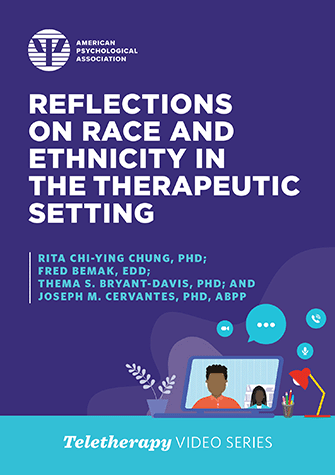
Reflections on Race and Ethnicity in the Therapeutic Setting
ISBN: 978-1-4338-3882-8Available formats
Streaming options
In Reflections on Race and Ethnicity in the Therapeutic Setting, four therapists known for their culturally adaptive work discuss ways to honor differences in identity and address the effects of prejudice in psychotherapy. The therapists—who have different racial and ethnic backgrounds and represent two different genders—each worked with a client of either a different or a similar identity to the therapist. The clients each experienced a recent incident of prejudice against them.
These therapy demonstrations provide rich material for the four guest therapists to explore issues such as learning to discuss race and ethnicity with clients nondefensively, finding relief for “racial battle fatigue,” and shifting focus from individual psychology to the societal and historical dynamics that are just as relevant to clients.
This powerful discussion among four deeply experienced therapists provides a centerpiece for advancing examination of the effects of client and therapist identity on the process and content of therapy.
The sessions feature clients portrayed by actors on the basis of composites of different cases.
This video focuses on race and ethnicity in the therapeutic setting. The making of this video corresponds with a long-standing history of racism, xenophobia, discrimination, hate crimes, racial injustice, and widening socioeconomic divides in the United States and globally, and the critical need for psychologists and mental health professionals to effectively address these issues in practice and training.
The video is unique in examining how four clinicians, from diverse racial and ethnic backgrounds, provide psychotherapeutic interventions and address issues of diversity, race, ethnicity, racism, culture, sociopolitical and historical issues, and racial injustice within the therapeutic setting.
This video provides important information about how the APA Multicultural Guidelines: An Ecological Approach to Context, Identity, and Intersectionality (2017) works in actual practice.
Rita Chi-Ying Chung, PhD, is an emerita professor at George Mason University (GMU). Her research focuses on cross-cultural psychology, social justice, racial justice, racial dialogues, immigrant and refugee psychosocial adjustment and adaptation, the trafficking of Asian children, and post-disaster counseling. She has presented and published extensively in these areas.
Dr. Chung has lived in five different countries and has worked in the Asia, Pacific Rim region, Europe, Africa, and the Americas. Prior to being at GMU, Dr. Chung was a consultant for the World Bank, an adjunct professor at Johns Hopkins University and George Washington University, and an assistant professor at the Ohio State University. She arrived in the United States in 1990 as a postdoctoral fellow at the National Research Center for Asian American Mental Health at the University of California Los Angeles (UCLA). At UCLA Dr. Chung was the project director of the NIMH-funded Chinese American Psychiatric Epidemiological Study and also conducted the first NIMH-funded U.S. conference on Southeast Asian Refugee Re-Education Camp Detainees and Vietnamese Amerasians.
As a result of her work on Asian immigrants, she was invited by Save the Children, UK, to be a consultant on their human trafficking program in Myanmar (Burma) and later invited as a featured speaker to the United Nations in New York to present on cultural factors in sex trafficking of Asian women/girls. Dr. Chung has consulted for the U.S. Armed Forces on a high-profile military court-martial regarding cultural perspectives on sexual abuse and rape.
She was awarded the Commonwealth of Virginia Commendation Award for her social justice and human rights work, and was a recipient of the Commonwealth of Virginia’s highest award in academia, the State Council for Higher Education of Virginia Outstanding Faculty Award. She also received the GMU Spirit of the King (Martin Luther King) faculty award for her work on race dialogues, and the GMU Presidential Medal of Honor for Diversity and Inclusion. She is an APA Fellow (Divisions 45 and 52).
Fred Bemak, EdD, is a professor emeritus at George Mason University (GMU) and founder and executive director of Counselors Without Borders. His career has involved training, consulting, presenting, and teaching focused on cross-cultural psychology, race relations, racism, refugee and immigrant mental health, and human rights and social justice.
He began his career as an Upward Bound summer counselor and years later, at the age of 26, became one of the youngest directors of an Upward Bound Program in the United States.
Dr. Bemak has received four Fulbright awards (Brazil, Scotland, Turkey, and Malta); has held faculty appointments in Australia, Brazil, Malta, Mexico, Turkey, and Taiwan; was the recipient of a Kellogg Foundation Fellowship in International Leadership and Development (Latin America and the Caribbean) and a World Rehabilitation Fund International Exchange of Experts Fellowship to undertake research at the National Institute of Mental Health and Neuro Sciences in India. He has given keynote addresses in the United States as well as Australia, Azerbaijan, Cyprus, India, Korea, Singapore, Turkey, and the United Kingdom and holds an Honorary Distinguished Professorship from Amity University, India.
Dr. Bemak has won multiple awards including the Commonwealth of Virginia State Council for Higher Education Outstanding Faculty Award and the GMU Presidential Diversity and Inclusion Award. He is a Fellow of the American Psychological Association Divisions 17 and 52.
Thema Bryant-Davis, PhD, is a licensed psychologist, ordained minister, and sacred artist who has worked nationally and globally to provide relief and empowerment to marginalized persons.
Dr. Thema, a professor at Pepperdine University, is a past president of the Society for the Psychology of Women. Her contributions to psychological research, policy, and practice have been honored by national and regional psychological associations. Dr. Thema earned her doctorate from Duke University, completed her post-doctoral training at Harvard Medical Center, and is a past American Psychological Association representative to the United Nations.
She has served as a mental health media consultant for numerous print, radio, and television media outlets, including but not limited to the Huffington Post, NPR, CBS, Oxygen, CNN, BET, TV One, Lifetime, and We TV. Dr. Thema has edited and coedited books on recovery from sexual violence, spirituality, and religion in women’s lives, and womanist and mujerista psychologies.
She is the author of the critically acclaimed books Tweets for the Soul: When Life Falls Apart,Thriving in the Wake of Trauma: A Multicultural Guide,Mangos and Manna, and The Birthing of a Lioness; and she is the recording artist on the CD, Sky: An upbeat black girl’s song. Her work is based in an interdisciplinary understanding of spirituality, gender, culture, and psychology.
Joseph M. Cervantes, PhD, ABPP, received his PhD in community-clinical psychology from the University of Nebraska, Lincoln (1977). He is a professor in the department of counseling, College of Health and Human Development, California State University, Fullerton, and maintains an independent forensic practice in child, adolescent, and family psychology.
He holds diplomas in both clinical and couple and family psychology from the American Board of Professional Psychology and is licensed in the states of California and Hawaii. In addition, he has taught the leadership course to undergraduate students at the Foreign Trade University, School of Business, Ha Noi, Vietnam, for the last several years.
Dr. Cervantes' research interests are in the realm of cultural diversity and indigenous spirituality, as well as immigration issues.
Dr. Cervantes has served as the ethics chair for the Orange County Psychological Association, is the past president for the National Latinx Psychological Association (2007-2009), and is a past chair of the Committee on Ethnic Minority Affairs (CEMA), American Psychological Association. He holds Fellow status with Divisions 12 (Society of Clinical Psychology), 43 (Society for Couple and Family Psychology), and 45 (Society of Ethnic Minority Psychology), American Psychological Association.
Dr. Cervantes recently published a coedited book entitled Latinx Healing Practices: Psychospiritual Counseling Interventions (2021).
Amri, S., & Bemak, F. (2012). The impact of social stigma and cultural mistrust on the mental health help-seeking behaviors of Muslim immigrants in the United States. Journal of Muslim Mental Health,7, 43–63
Bemak, F., & Chung, R. C-Y. (2021). A culturally responsive intervention model for modern day refugee: A multiphase model of psychotherapy, social justice, and human rights. In J. D. Aten & J. Hwang (Eds.), Refugee mental health (pp.103–136). American Psychological Association.
Bemak, F., & Chung, R. C-Y. (2021). Contemporary refugees: Challenges and a culturally responsive intervention model for effective practice. The Counseling Psychologist, (Special Issue), 49(2), 305–324. https://doi.org/10.1177/0011000020972182opens in new window
Bemak, F., & Chung, R. C-Y. (2021). Race, culture and group psychotherapy. In R. Moodley & E. Lee (Eds.), Handbook on race, culture and mental health (pp. 103–114). Routledge International.
Bemak, F., & Chung, R. C-Y. (2018). Race dialogues in group psychotherapy: Key issues in training and practice. International Journal of Group Psychotherapy, 69(2), 172–191. https://doi.org/10.1080/00207284.2018.1498743opens in new window
Bemak, F., & Chung, R. C-Y. (2013). Immigrants and refugees. In Leong, F. T. L., Comas-Diaz, L., Nagayama Hall, G., McLloyd, V. C., & Trimble, J. (Eds.), APA handbook of multicultural psychology, vol. 1, 503–517. American Psychological Association.
Cervantes, J. M. (2010) Mestizo spirituality: Toward an integrated approach to psychotherapy for Latina/os. Psychotherapy: Theory, Research, Practice, Training, 47, 527–539.
Cervantes, J.M. & McNeill, B.W. (Eds.) (2021). Latinx Healing Practices: Psychospiritual Counseling Interventions. Cognella Academic Publishing.
Chung, R. C-Y. (2014). Group counseling with Asians. In J.L. DeLucia-Waack, D. Gerrity, C. Kalodner & M. Riva (Eds.), Handbook for group counseling and psychotherapy (pp. 231–241, 2nd ed.). Sage Publications.
Chung, R. C-Y., & Bemak, F. (2012). Social justice counseling: The next steps beyond multiculturalism. Sage Publications.
Chung, R. C-Y., Bemak, F., Talleyrand, R. M. & Williams, J. (2018). Challenges in promoting race dialogues in psychology training: Race and gender perspectives. The Counseling Psychologist, 1–28. https://doi.org/10.1177/0011000018758262opens in new window
Chung, R., C-Y, Bemak, F., & Talleyrand, R. (2007). Mentoring within the field of counseling: A preliminary study of multicultural perspectives. International Journal for the Advancement of Counselling, 29, 21–32.
Comas-Diaz, Lillian. (2006). Latino healing: The integration of ethnic psychology into psychotherapy. Psychotherapy: Theory, Research, Practice, Training, 43, 436–453.
Duran, E. (2006). Healing the soul wound: Counseling with American Indians and other native peoples. Columbia University.
Hill, D. (2009). Traditional medicine and restoration of wellness strategies. Journal of Aboriginal Health, 5, 26–42.
Medina, L., & Gonzalez, M. R. (2019). Voices from the ancestors: Xixanx and Latinx spiritual expressions and healing practices. The University of Arizona Press.
APA Videos
Cultural Humility in Therapy
Cirleen DeBlaere and Jesse Owen
Counseling Latina/Latino Clients Using a Family Systems Perspective
Joseph M. Cervantes
Working With Immigrants
Rita Chi-Ying Chung
The Core Conflictual Relationship Theme Method
Hadas Wiseman and Orya Tishby
Conducting Clinical Interviews With Parents And Other Caregivers Online
Jon Lasser
Functional Family Therapy Online
Thomas L. Sexton
Providing Emotion-Focused Therapy Online
Rhonda N. Goldman
APA Books
Applying Multiculturalism: An Ecological Approach to the APA Guidelines
Caroline S. Clauss-Ehlers, Scott J. Hunter, Gayle Skawennio Morse, and Pratyusha Tummala-Narra
Counseling Psychology
Charles J. Gelso and Elizabeth Nutt Williams
Cultural Humility: Engaging Diverse Identities in Therapy
Joshua N. Hook, Don Davis, Jesse Owen, and Cirleen Deblaere
Culturally Responsive Cognitive Behavior Therapy: Practice and Supervision, Second Edition
Edited by Gayle Y. Iwamasa and Pamela A. Hays
Integrating Multiculturalism and Intersectionality Into the Psychology Curriculum: Strategies for Instructors
Edited by Jasmine A. Mena and Kathryn Quina
The Responsive Psychotherapist: Attuning to Clients in the Moment
Edited by Jeanne C. Watson and Hadas Wiseman
Trauma and Racial Minority Immigrants: Turmoil, Uncertainty, and Resistance
Edited by Pratyusha Tummala-Narra