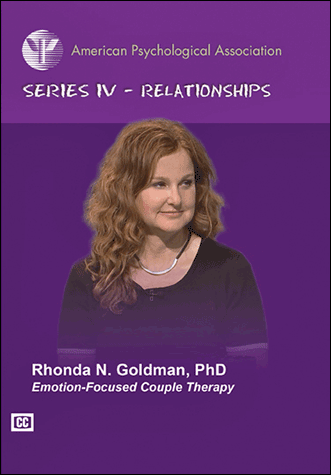
Emotion-Focused Couple Therapy
ISBN: 978-1-4338-2918-5Available formats
Streaming options
For couples undergoing marital distress, common interactional cycles between partners, such as criticizing and withdrawing, can obstruct the emotional engagement needed for secure bonding and partner validation.
An important key in couple therapy is recognizing these patterns as they are occurring and from within a highly validating therapeutic relationship, exploring the underlying, negative emotional and interactional states, and then transforming them into more adaptive cycles that support healthier mutual understanding and bonding.
In this video program, Dr. Rhonda N. Goldman demonstrates her approach to therapy in two sessions, each with a different couple experiencing a conflict marked by a pursuing and distancing cycle and covering deeper emotional wounds. By forming a strong emotional connection with the partners and applying the emotion-focused therapy method that integrates strategies from client-centered, Gestalt, and systemic therapies, Dr. Goldman seeks to help the couples with their unresolved emotional patterns and encourage them toward healthy, positive relational changes.
Emotion-focused therapy (EFT) for couples is an evidence-based approach that is based on understanding the role of emotion in marital distress. EFT views marital distress as maintained by absorbing states of negative affect and constricted patterns of interaction. Therapy focuses on accessing and exploring the negative emotional and interactional states to transform them into more adaptive patterns that support healthier relating and bonding.
The goals of the therapy are to expand and reorganize key emotional response, create a shift in partner's interactional positions, initiate new cycles of interaction, and foster the creation of a secure bond and identity validation between partners. Therapists encourage both self- and other-soothing between partners to help heal wounds and create change.
The approach is integrative, synthesizing elements of client-centered Gestalt, systems, cognitive behavioral, and dynamic practice within an emotion theory framework.
Many approaches to date have focused on changing cognition or conscious understanding. EFT focuses on changing emotion and using adaptive emotion as a guide to living.
Rhonda N. Goldman, PhD, is a professor of clinical psychology at the Illinois School of Professional Psychology at Argosy University, Schaumburg and an affiliate therapist at the Family Institute at Northwestern University in Evanston, Illinois where she works with both individuals and couples.
She has co-authored four texts on emotion-focused therapy including Learning Emotion-Focused Therapy: The Process-Experiential Approach to Change; Case Studies in Emotion-Focused Treatment of Depression: A Comparison of Good and Poor Outcome; Emotion-Focused Couples Therapy: The Dynamics of Emotion, Love, and Power; and Case Formulation in Emotion-Focused Therapy: Co-Creating Clinical Maps for Change. She is currently coediting the Clinical Handbook of Emotion-Focused Therapy.
Dr. Goldman conducts workshops on emotion-focused therapy for both couples and individuals in countries throughout North America, Europe, and Asia. In addition, she practices, teaches, and conducts research on emotional processes and outcomes in couples and individual therapy and has written on an array of other topics such as empathy, vulnerability, depression, and case formulation.
She is the recipient of the 2011 Carmi Harari Early Career Award from APA Division 32 (Society for Humanistic Psychology).
- Elliott, R., Watson, J. C., Goldman, R. N., & Greenberg, L. S. (2004). Learning emotion-focused therapy: The process-experiential approach to change. Washington, DC, US: American Psychological Association.
- Goldman, R. N., & Greenberg, L. (2013). Working with identity and self‐soothing in Emotion‐Focused Therapy for Couples. Family Process, 52(1), 62–82.
- Goldman, R. N., Greenberg, L. S., & Angus, L. (2006). The effects of adding emotion-focused interventions to the client-centered relationship conditions in the treatment of depression. Psychotherapy Research, 16(5), 536–546.
- Goldman, Rhonda N.; Greenberg, Leslie S. (2015). Case formulation in emotion-focused therapy: Co-creating clinical maps for change. Washington, DC, US: American Psychological Association.
- Greenberg, L. S., & Goldman, R. N. (2008). Emotion-focused couples therapy: The dynamics of emotion, love, and power. Washington, DC, US: American Psychological Association.
- Greenberg, L.S. & Goldman, R. N. (Eds.). (in press). The clinical handbook of emotion-focused therapy, Washington: American Psychological Association.
- Watson, J. C., Goldman, R. N., & Greenberg, L. S. (2007). Case studies in emotion-focused treatment of depression: A comparison of good and poor outcome. Washington, DC, US: American Psychological Association.
- Watson, J.C, Goldman, R.N., & Warner, M.S. (Eds.). (2002) Client-centered and experiential psychotherapy: Advances in theory, research and practice, United Kingdom: PCCS Books.
APA Videos
- Couples at an Impasse
Jon Carlson - Couples Experiencing Commitment Uncertainty
Jesse Owen and Johanna Strokoff - Emotionally Focused Therapy With Couples
Leslie S. Greenberg - Integrative Behavioral Couple Therapy
Andrew Christensen - Integrative Couple Therapy
Ellen F. Wachtel and Paul L. Wachtel - Integrative Systemic Therapy With Couples
William M. Pinsof - Older Couples
Paula Hartman-Stein
APA Books
- Couple and Family Therapy: An Integrative Map of the Territory
Jay L. Lebow - Couple Power Therapy: Building Commitment, Cooperation, Communication, and Community in Relationships
Peter L. Sheras and Phyllis R. Koch-Sheras - Emotion-Focused Couples Therapy: The Dynamics of Emotion, Love, and Power
Leslie S. Greenberg and Rhonda N. Goldman - Enhanced Cognitive–Behavioral Therapy for Couples: A Contextual Approach
Norman B. Epstein and Donald H. Baucom - The Marriage Checkup Practitioner's Guide: Promoting Lifelong Relationship Health
James V. Cordova