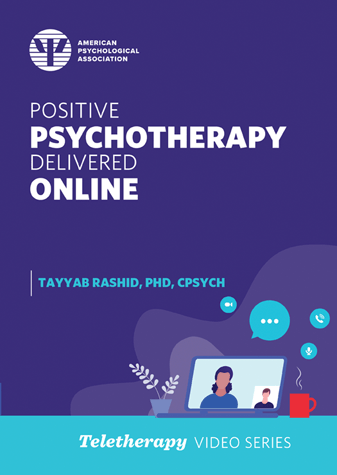
Positive Psychotherapy Delivered Online
ISBN: 978-1-4338-4127-9Available formats
Streaming options
Grounded in evidence-based interventions, positive psychology is designed to help clients build resiliency by helping to tap into internal sources of strength—such as positive emotions, character strengths, and meaning development. Positive psychology aims to mitigate risks and enhance character strengths and the well-being of clients.
In this video, Dr. Tayyab Rashid discusses his work with host, Dr. Katherine Helm, and gives an overview of the theoretical and empirical foundations of positive psychology. During the therapy demonstration, watch as Dr. Rashid works with an African American female client.
This video features an actor portraying a client based on a composite of case material.
Broadly informed by notions of Positive Psychology, the primary focus of Positive Psychotherapy is to integrate symptoms with strengths, risks with resources, and weaknesses with values to understand client holistically.
Without dismissing or minimizing their concerns, I strive to understand their clinical complexities in a balanced way and equip them with strengths-based skills which can help them to use their own resources to manage their challenges. I believe that all clients have the inherent capacity for growth and resilience.
As a therapist, I see my role as a conduit or facilitator who activates this capacity or paves the way towards growth and fulfilment. Therefore, I do not view psychotherapy therapy as a reparative process. I see it as a restorative process. A process that needs careful, compassionate, handhold of clients towards learning practical strategies of identifying and using strengths and whenever necessary learning ways of managing symptoms.
Finally, I believe that COVID-19 has simultaneously exposed and amplified the deep-grained inequities of health, and mental health. Clients from culturally diverse, marginalized, racialized, gender and sexually diverse backgrounds do not readily subscribe to Eurocentric, deficit-oriented medical model of psychotherapy. By equally focusing on strengths, without dismissing symptoms, we can offer clients flexible, inclusive, and empowering paths of healing, in a post-pandemic world.
Dr. Tayyab Rashid is a senior lecturer at the Wellbeing Science Centre, University of Melbourne, Australia. He is also a faculty associate with the Human Flourishing Program, Harvard University. Dr. Rashid’s expertise includes strength-based clinical psychotherapy with complex mental health challenges, resilience, wellbeing, and posttraumatic growth. Dr. Rashid has also worked with individuals experiencing severe trauma, including survivors of the Asian Tsunami of 2004, with refugee families and journalists who have worked in high-conflict zones and with survivors of mass shootings.
Dr. Rashid has delivered more than fifty invited talks and keynotes and trained mental health professionals and educators internationally. His work has been published in academic journals, included in textbooks of psychiatry and psychotherapy and been featured media. His book Positive Psychotherapy (2018), co-written with Martin Seligman, is considered one of the most comprehensive clinical resources in the field and has been translated into several languages so far. Dr. Rashid won the Outstanding Practitioner Award (2017) from the International Positive Psychology Association (IPPA) and Chancellor Award (2018) from the University of Toronto.
APA Videos of related interest
Engaging and Connecting With Clients Online
Robert A. Neimeyer
Cognitive Restructuring of Automatic Thoughts
Keith S. Dobson, Pamela A. Hays, and Amy Wenzel
Adlerian Therapy
Jon Carlson
Problem Solving Therapy
Arthur M. Nezu and Christine Maguth Nezu
Performance Psychology
Charles H. Brown, Jr.
Positive and Transpersonal Approaches to Therapy
Roger Walsh
Positive Psychology With Male Clients
Mark S. Kiselica
APA Books of related interest
Therapist Performance Under Pressure: Negotiating Emotion, Difference, and Rupture
J. Christopher Muran and Catherine F. Eubanks
The Psychology of High Performance: Developing Human Potential Into Domain-Specific Talent
Rena F. Subotnik, Paula Olszewski-Kubilius, and Frank C. Worrell
Train Your Mind for Peak Performance: A Science-Based Approach for Achieving Your Goals
Lyle E. Bourne, Jr. and Alice F. Healy
Positive Psychology in Racial and Ethnic Groups: Theory, Research, and Practice
Edited by Edward C. Chang, Christina A. Downey, Jameson K. Kirsch, and Natalie J. Lin
Positive Psychological Assessment: A Handbook of Models and Measures, Second Edition
Edited by Matthew W. Gallagher and Shane J. Lopez
Solving Modern Problems With a Stone-Age Brain: Human Evolution and the Seven Fundamental Motives
Douglas T. Kenrick and David E. Lundberg-Kenrick