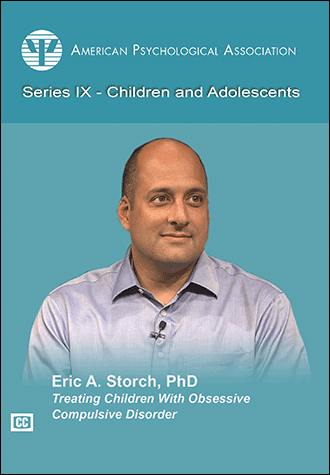
Treating Children With Obsessive Compulsive Disorder
ISBN: 978-1-4338-3262-8Available formats
Streaming options
Obsessive–compulsive disorder, or OCD, affects 1 in 200 children, and is characterized by unwanted, distressing and repeated thoughts that lead to compulsive actions. Children and adults suffering from OCD usually hold the false notion that rituals reduce anxiety and distressing thoughts, and this belief inevitably results in a pattern of repetitive negative reinforcement.
The most effective interventions often focus on breaking this pattern, and in this video, Dr. Eric A. Storch illustrates this aspect of the approach with a vivid application of exposure and response prevention. The therapy demonstration in this program shows Dr. Storch working for the fifth session with a nine-year-old girl and her mother, helping the child confront her fear that she will physically harm those she loves.
This demonstration features actors portraying clients on the basis of a composite of actual cases.
Dr. Eric Storch’s approach to treating pediatric OCD focuses primarily on exposure and response prevention from a family-based perspective. This involves having the person with OCD face their fear or the possibility of the feared outcome taking place while refraining from engaging in repetitive, time-consuming compulsions.
This is based on the notion that rituals serve to reduce anxiety and distress and are thus reinforcing. Triggers are approached gradually with easier stimuli targeted initially. The person remains in the distress provoking situation until anxiety and distress habituates naturally (i.e., in the absence of rituals or other behaviors to reduce anxiety such as relaxation).
Family members are engaged to provide appropriate support.
Dr. Eric Storch is professor and McIngvale Presidential Endowed Chair in the Menninger Department of Psychiatry and Behavioral Sciences at Baylor College of Medicine (BCM). He serves as vice chair and head of psychology, and oversees the CBT for OCD program at BCM.
Dr. Storch has received multiple grants from federal agencies for his research (i.e., NIH, CDC), is a Fulbright Scholar, and has published more than 14 books and more than 550 articles and chapters.
He specializes in the nature and treatment of childhood and adult obsessive–compulsive disorder and related conditions, anxiety disorders, and anxiety among youth with autism.
Abramowitz, J. S., McKay, D., & Storch, E. A. (2017). Handbook of obsessive–compulsive disorder Across the lifespan. Wiley: Chichester, West Sussex.
Storch, E. A., Abramowitz, J. S., & McKay, D. (2017). Handbook of obsessive–compulsive related disorders. Wiley: Chichester, West Sussex.
Storch, E. A., McGuire, J. F., & McKay, D. (2017). Clinicians’ guide to cognitive-behavioral therapy for childhood obsessive–compulsive disorder. Elsevier: Waltham, MA.
APA Videos
- Children Experiencing Fear and Anxiety
Bonnie Zucker - Cognitive–Behavioral Psychoeducation for Clinical Anxiety
Jonathan S. Abramowitz - Cognitive Behavioral Therapy for Obsessive–Compulsive Disorder
Eric A. Storch - Obsessive–Compulsive Behavior
Martin M. Antony - Obsessive–Compulsive Disorder
R. Reid Wilson - Treating Mood Disorders in Children
Mary A. Fristad
APA Books
- Clinical Handbook of Fear and Anxiety: Maintenance Processes and Treatment Mechanisms
Edited by Jonathan S. Abramowitz and Shannon M. Blakey - Cognitive Behavior Therapy for OCD in Youth: A Step-by-Step Guide
Michael A. Tompkins, Daniela J. Owen, Nicole H. Shiloff, and Litsa R. Tanner - Strategic Decision Making in Cognitive Behavioral Therapy
Amy Wenzel