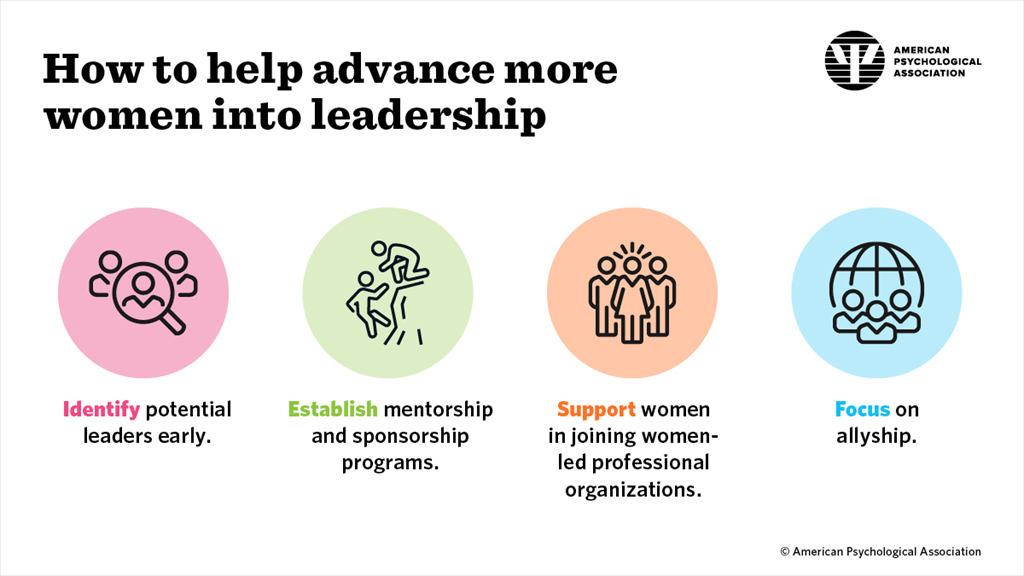
Science points to a series of steps organizations and individuals can take to help close the leadership gender gap.
Identify potential leaders early. One promising approach is the earlier identification of leadership potentialopens in new window, says Anna Marie Valerio, PhD, an executive coach and adjunct professor of psychology at New York University. This includes enabling potential leadership candidates to obtain a wealth of feedback at an early point in their careers, through assignments, mentoring, and coaching, all of which may allow them to develop their networks and demonstrate their ability to take on greater responsibilities.
“Giving women key experiences early in their careers helps give them the runway to be able to develop themselves and excel and go as far as their skills and abilities and motivation will take them,” said Valerio, author of the 2009 book Developing Women Leaders: A Guide for Men and Women in Organizationsopens in new window.
Establish mentorship programs that also focus on sponsorship. A host of studies tout the benefits of successful mentoring programsopens in new window, including greater career success for individuals and higher levels of employee engagement, retention, and knowledge-sharing for organizations.
When it comes to mentors, however, it’s important that women seek out both mentors, who can provide career guidance, support, feedback, and knowledge, as well as sponsors, who go beyond the role of mentor and use their position and influence to proactively advocate for a junior employee’s advancement, says I/O psychologist Victoria Mattingly, PhD, founder and CEO of Mattingly Solutions, a workplace inclusion consulting firm.
“Research shows that sponsorship is more effective at helping advance into leadership positions than mentorshipopens in new window,” Mattingly said. “Mentors are great as a sounding board and to provide guidance, but when the rubber hits the road, you need someone who will speak up for you when you’re not in the room.”
Support women in joining women-led professional organizations. Women also boost their leadership capabilities through joining women’s professional organizationsopens in new window, according to a 2023 study. Researchers surveyed members of a women-led professional organization in the southeastern United States and found that experiences within these women-led associations allow members to hone their leadership abilities, network with other women, work directly with and observe women leaders, and receive support from others to take on leadership roles.
“In turn, these members had increased leadership aspirations, more confidence in their leadership capabilities, and a more expansive view of leadership within their careers,” study authors wrote.
Organizations can encourage this by including professional development funds in their budgets to increase the ability of employees to take part in these groups.
Focus on allyship. Women aren’t the only ones who can help boost the number of female leaders, Mattingly said. Male executives who are trained on how to be alliesopens in new window are far more likely to speak up about incidents of gender inequality than men who are not trained in this approach, according to a 2018 study. “This happens because they are already in a position of power and they are not going to be penalized for speaking out the way a woman would,” said Mattingly, the study’s author.
Allies use their privilege and in-group status to support and advocate for those from a different, historically disadvantaged identity group, Mattingly said. Allyship should be examined through an intersectional lens as well, she added, with White women serving as allies for women of color, able-bodied allies for those with disabilities, or heterosexual allies for those within the LGBTQ+ community.
“It’s a matter of recognizing our privileges, working through biases that we all have as humans, and then leveraging that privilege to either step up or step back or step in and help those who have historically been left behind when it comes to advancing into leadership roles,” Mattingly said.
Thanks to these and other efforts around the globe empowering women to lead, the future of female leaders shows promise, Valerio said.
“We know so much more about this issue than we did 10 years ago, and we have the perspective of seeing what happens when you give people key experiences and the forums to learn from those experiences, and you give them mentors and coaches,” she said. “They are able to really make the strides they need to make, coupled with an attitude toward inclusion. I’m hopeful this may not even be an issue 10 years from now, though it will still require persistent effort for us to get there.”