skip to main content

This page has been archived and is no longer being updated regularly.

Eduardo Salas, PhD

Organizational Psychologist
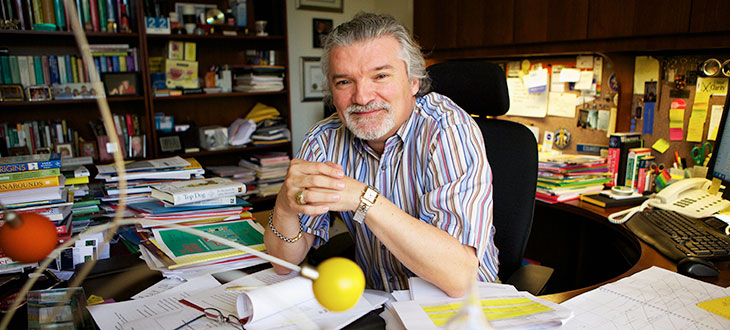
A profile photo of Dr. Salas

“My job is to study and solve. In nearly 30 years, I’ve never been bored.”

Early Vision

Growing up in Peru, Salas knew that he wanted to be a scientist. But that goal seemed too broad and too small at the same time. He also knew that he wanted to make the world a better place. Today, he is blending his passions by studying people and processes at work — what individuals do, what groups do and what organizations do to motivate and even guide employees so that they will be more satisfied and productive.

Salas focuses on understanding and facilitating teamwork, optimizing environments for learning and development, and performing simulation-based training. Leaders in high-stakes industries — like the military, aviation and health care — have given him the task of finding solutions to their organization’s challenges.

When asked to describe what an industrial and organizational (I/O) psychologist does, Eduardo Salas, PhD, says, “We change the minds of engineers, pilots, sailors, instructors and team leaders… about how to train, diagnose competencies, develop teams, be leaders and build simulators for learning. That is our legacy.”
Dr. Salas in Action

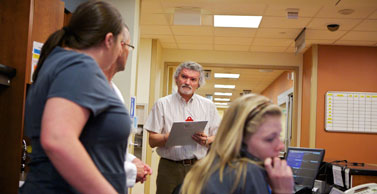
Dr. Salas observes nurses working in an emergency room.

Observing Interaction

Dr. Salas observes the emergency registration desk at Florida Hospital in Orlando to learn more about the ways nurses interact as a team, especially when they are under pressure.
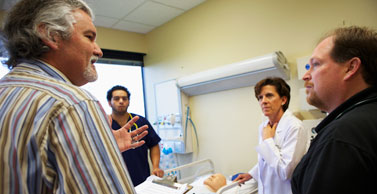
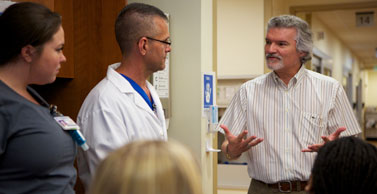
Dr. Salas talks with emergency room nurses.

Team Dynamics

Dr. Salas talks with Florida Hospital’s emergency room nurses to help him better understand their team dynamic. He asks questions that will help him test his theories about team performance.
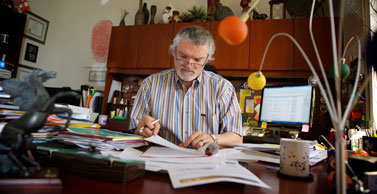
Dr. Salas reviews data

Deciphering Challenges

Dr. Salas reviews the data he has gathered to help him understand the challenges facing teams that work in high-stakes environments and help them improve their team dynamics and communications.
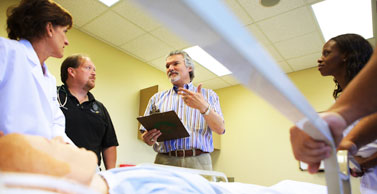
Dr. Salas talks with nursing students

Training Teams

Dr. Salas trains people to help them work better as teams. After observing nursing students perform tasks in a simulated patient environment, he shares ideas to help them communicate better.
Dr. Salas interacts with nursing students.

Simulated Environments

Dr. Salas works with health care providers in simulated patient environments to identify science-based solutions that will help them perform better and improve patient outcomes.
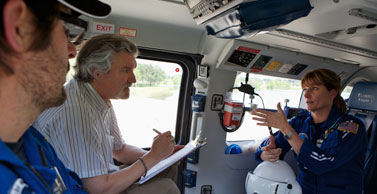
Dr. Salas sits in a helicopter with pilots.

High-Stakes Industries

Dr. Salas partners with people working in high-stakes industries, like helicopter pilots, to understand the types of scenarios they face and how teamwork can help them during stressful situations.

Digging In

After getting his degree in I/O psychology from the University of Nebraska, Salas landed at Old Dominion University (ODU) by way of the U.S. Navy. He credits these experiences for igniting his passion for theory, measurement and applications of research about human behavior into programs that impact the workplace.

“It was at ODU where the opportunities arose to study work teams and training and development,” Salas says. “My journey and passion for these topics began there.”

Today, at the Institute for Simulation & Training at the University of Central Floridaopens in new window, Salas and his team replicate decision-making scenarios in order to learn how and why people make certain choices. His research uncovers why mistakes happen, especially in high-stakes environments where seconds count. In their research, the team first immerses itself in the environment it is studying by observing as closely as possible all of the decision-making points. Then, they bring their understanding of the problem to the lab and apply theories that could result in a different outcome. This trial-and-error process allows them to understand whether introducing different processes or variables will create stronger teams and better results.

I/O Psychology at Work

Solving Problems Through Team Training

By replicating decision-making scenarios in high-stakes environments, I/O psychologist Eduardo Salas, PhD, is learning how and why mistakes happen. He uses real-world simulations to identify how teams make decisions under stress, and then uses research-based methods to improve team coordination.

The Sky is the Limit

To Salas, what’s most significant about the future of I/O psychology is that the nature of the work is changing. With recent rapid changes in technology, new types of teams are emerging. For example, NASA hopes to send five to seven astronauts to Mars around the year 2030. The agency is concerned about the physiological impacts of this 24- to 30-month mission on the astronauts, and how they will perform in this environment.

That’s where Salas comes in. By studying team dynamics and the variables inherent in an isolated and extremely dangerous environment, he’s hoping to provide insights that will keep the astronauts safe and productive.

“I truly believe that we have a wealth of knowledge about how to manage work teams,” says Salas. “This knowledge is not perfect, but what we know is useful, practical and it works.”

I/O Psychology

Industrial and organizational psychologists study and assess individual, group and organizational dynamics in the workplace. They apply that research to identify solutions to problems that improve the well-being and performance of organizations and their employees.

Date created: 2013
The content I just read: