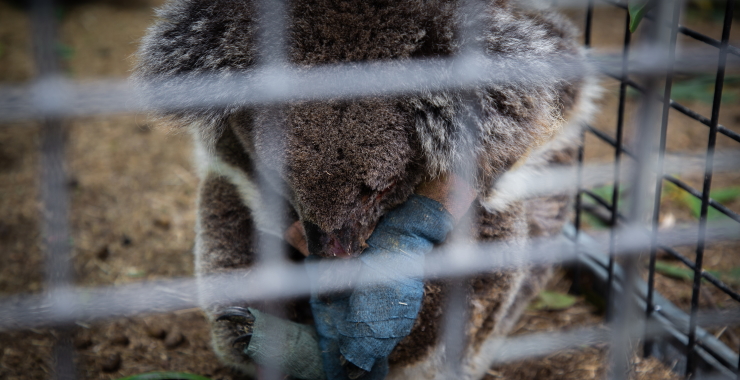
A combination of climate factors are impacting Australia’s iconic koala. Intense wildfires, habitat loss and CO2 changes to their food supply have reduced their numbers. The koala in this photo is suffering from extreme brushfire injury.
Allen, S. (2020, February 19). Is climate grief something new? American Psychological Association. https://www.apa.org/members/content/climate-grief
Andrew Bryantopens in new window, MSW, LICSW, a clinical social worker and therapist based in Seattle, Washington, says he is contacted by people struggling with climate change about once a week.
He says climate change sometimes manifests as relationship conflicts — partners who have difficulty deciding whether to have children or struggle with different opinions about consumption choices. It can also exacerbate symptoms of depression and anxiety.
“Fear combined with uncertainty leads to anxiety, and I see that cropping up for people a lot,” he says.
And then there's climate grief.
People experience climate grief when they notice or anticipate the loss of “species, ecosystems and meaningful landscapes due to acute or chronic environmental change,” writesopens in new window Ashlee Cunsolo, PhD, director of the Labrador Institute, and Neville Ellis, PhD, research fellow at the University of Western Australia.
In many ways climate grief is like other forms of grief.
“Grief is a normal human reaction to loss or anticipated loss,” says Bryant. “The loss of stability or a predictable future — or anticipating exposure to other people's loss—is naturally going to trigger grief.”
But in other ways, climate grief may be unique.
For starters, climate change, at least in some circles, is still controversial, which can make people wary about discussing their feelings with others.
Plus climate change is relentless. “When you're grieving for something else, a person or a place, it's gone already, but climate change is an ongoing process,” says Susan Claytonopens in new window, PhD, a professor of psychology and environmental studies at the College of Wooster in Ohio. “It's not over yet so you can't come to terms with it, and you don't know exactly what's going to happen.”
Related to this is the existential nature of climate change. “It's so all-encompassing. People might be having that feeling that the entire ecosystem of which they are a part is changing,” says Clayton. “That's different than losing a dog or losing a person; the whole fundamental structure has changed.”
Furthermore, a person may grieve for the anticipated losses of other people, which, in the case of climate change, is potentially everyone.
A form of disenfranchised grief
Conceptualizing the losses — and anticipated losses — associated with climate change is a relatively new proposition, which means we don't have cultural practices in place to help us process this type of grief.
When someone dies, there are culturally specific and even family-specific rituals such as funerals, wakes, or sitting shiva that help people process their grief and work through it in a group.
None of this exists for climate change.
“This is a type of disenfranchised grief, which is a type of grief that doesn't have a core cultural support or social acknowledgement in the general public,” says Bryant. He notes that many of his clients feel that their friends and family don't understand their feelings.
“A lot of people are feeling lonely, and that's the context in which I think it's different from other kinds of grief,” he says.
Who's most at risk?
Not much is known about climate grief so we don't know who is most vulnerable to experiencing it. But a few groups of people may be especially predisposed, such as children and teens.
“Younger people seem to be more worried than older people,” says Clayton. “That doesn't surprise me either; they have more at stake. I think also, especially among adolescents and very young adults, there's a sense of betrayal like, ‘the adults in the room were supposed to be taking care of us but they fell down on the job.'”
Along similar lines, parents and teachers are looking for ways to help children process their feelings about the issue. “A common question that comes up is how do we work with kids around this? How do we work with teenagers around this? And meanwhile, how do we, as adults, manage our own feelings and emotions so that we can work with kids in a way that's clear and not mixed up with our own fears and thoughts?” asks Bryant. “That's where I would really love to see research.”
Climate scientists and activists may be another group particularly prone to climate grief. “In terms of where it seems most common, it's in people who are engaged with climate science or climate activism in some way,” says Bryant. Clayton also found some anecdotal evidence that climate scientists may be at risk for climate-related mental health issues in her 2018 reviewopens in new window of the research.
Indigenous communities and people who make their living off the land are particularly vulnerable to climate change — and to climate grief. When Cunsolo and Ellis studiedopens in new window climate grief in Inuit from Nunatsiavut, Canada and family farmers form the rural Australian Wheatbelt, they found that members of both groups reported experiencing climate grief.
A recent studyopens in new window found that people with less psychological distance from climate change — people who feel that climate change is an imminent threat — had stronger feelings of anger, fear, sadness, and guilt. This finding could help explain why climate scientists and indigenous communities may be more likely to experience climate grief; they have more intimate knowledge of the ways climate change is already altering the environment.
Responding to climate grief
There haven't been any clinical studies of interventions specifically targeting climate-related mental health concerns.
“Even therapists who are interested in this topic are still trying figure out how to deal with these kinds of feelings when they come into the therapy room,” says Bryant. “In certain ways they resemble issues we're familiar with like anxiety and grief and depression, but they're also quite different in other respects.”
He also notes that therapists may have their own feelings that can make it difficult to help a client work through climate issues.
“It might be denial, it might be their own anxiety or depression or worry that makes it hard to sit with someone who's really struggling with these feelings,” he says. “I think those of us who are looking at this topic are also trying to grapple with the best ways of helping people.”
However, there are some strategies that may help people cope.
Clayton says that some people might benefit from becoming more informed about the specifics of how climate change is likely to impact their area in the near term.
She also recommends that people spend time in nature.
“We have more and more evidence that that is good for your mental health,” she says. “And I think it probably is helpful to remind people that nature is a source of strength as well as a source of anxiety.”
Feeling, talking, uniting, acting
Bryant has a workflow that he's developed for helping clients process their climate grief. “A really simple schematic I came up with is feeling, talking, uniting, and acting,” says Bryant. “And in that order.”
According to Bryant, creating a space for people to discuss their feelings — while therapy 101 — is especially important for people struggling with climate change who may feel wary of discussing their feelings with others.
“In this context, it's really important because a lot of the times people feel alone, isolated, even from their own close family who don't seem to understand,” he says. “They don't want to be a drag or a downer.”
Talking about feelings also includes identifying areas where a client may have a lot of guilt or shame or self-judgment about their environmental footprint, capacity to engage in activism, or consumption choices. He says therapists can help clients understand how these thoughts and feelings might not be helpful and may actually hinder taking action.
Uniting — getting together with like-minded people — can also help people work through climate grief.
“It could be a support group, it could be a trail maintenance group in the woods, it could be an activist group, it could be a meet-up group,” he says. “Finding other people who have similar concerns and feelings and joining in with them helps with the isolation and the loneliness. It also helps with that disenfranchisement.”
And, finally, taking action to address climate change and build climate resilience may be the best way to channel feelings of climate grief.
“Whatever type of involvement feels comfortable for a person will have two advantages: it will empower them so they don't feel quite so helpless and probably it will help them connect with others,” says Clayton. “Social connections are a very strong source of resilience, so working together to address a problem could be quite a happy experience.”
As an added bonus, the 2017 APA report "Mental Health and Our Changing Climate: Impacts, Implications and Guidance" (PDF, 3.3MB)opens in new window (Clayton was one of the authors of this report) notes that climate solutions such as increasing the adoption of active commuting, public transportation, green spaces, and clean energy will also help support psychological health.
A new focus for the field
Bryant and Clayton are hopeful that more psychologists — both researchers and practitioners — will take on the issue of climate grief.
“I'm really hopeful about bringing this topic into discussion in the mainstream community of therapists, and I think it's important now to integrate it into our graduate school curriculums,” says Bryant. He notes that young graduate students have expressed experiencing “a vacuum of knowledge” about ecological and environmental psychology in their training. “Now is the time for that to be addressed.”
APA Climate Change Coverage
- APA reaffirms psychologists' role in combating climate change
- Survey: Majority of U.S. adults believe climate change is most important Issue today
- From APA's CEO: A global effort on climate change
From the Monitor on Psychology
- Psychologists are working with the UN, policymakers, corporations and community groups to combat climate change
- Psychologists are working to address the defining issue of our era
- Researchers are taking stock of the emotional toll of climate change in threatened communities
- Psychologists helping cities and corporations embrace more eco-friendly behaviors