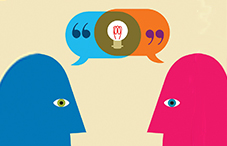

Turn on any cable news network. It's a safe bet the news story unfolding on the screen touches on some aspect of human behavior. But what are the odds that a trained psychologist will appear on the screen to put that behavior in context? Not good enough, says APA President Nadine J. Kaslow, PhD.
That problem illustrates a paradox in psychology: Although the subject is hugely popular among high school and college students and most people are inherently interested in what makes people tick, the field is frequently misunderstood. Recent APA surveys have found, for example, that a mere 30 percent of the public identifies psychology as a science.
"The public believes in the importance and efficacy of science, but doesn't necessarily believe that psychology is a science. That's a challenge for us," says Rhea K. Farberman, executive director of APA's public and member communications. "So many of the world's problems are grounded in behavior or social issues, but if the public doesn't perceive psychology as a science, we won't be thought of as a discipline that should be at the table" in the search for solutions.
That's something that Kaslow is confronting head-on during her term. She identified "Translating Psychological Science for the Public" as one of her 2014 APA presidential initiatives, and appointed a task force to develop new strategies to communicate psychology to the public.
Of course, one task force can't do it all. Instead, many psychologists say everyone in the field shares responsibility for disseminating psychological knowledge to the world.
"We need to be explaining what we do, why it matters and how the public is benefiting from this knowledge," says Northwestern University psychologist Eli J. Finkel, PhD, who presents psychology through TED Talks, television and radio appearances, and newspaper op-eds. "We absolutely must share our findings."
The public's poor understanding of psychology should be a wake-up call, points out task force co-chair Roxane Cohen Silver, PhD, a psychologist at the University of California, Irvine. "There have been many instances when psychological science has been misused or misinterpreted," she says. "At a time when psychological science is being targeted for decreased federal funding, it's our responsibility as scientists to communicate the value of our work to the public."
Talking to many publics
Kaslow, a psychologist at Emory University School of Medicine, first became interested in improving communication channels as a psychology journal editor. "Psychologists do an amazing amount of incredibly interesting research," she says. But while that research is frequently shared in professional venues among colleagues in the field, she says there's a disconnect when it comes to communicating those findings — and their implications — to the public.
Kaslow defines "public" broadly. The general public is just one audience that could benefit from a better understanding of psychological science, she says, along with lawmakers, scientists in other STEM fields, and students and their families. She envisions a world where CNN features psychology correspondents alongside health reporters and psychological concepts are displayed alongside the fossils and the solar-system models at science museums (see related article).
In June, the task force recommended several short- and long-term proposals to improve psychology's reputation (see sidebar). The group, which will remain in place during Kaslow's presidential term, plans to finalize its report by fall. Among the ideas: increasing APA's podcast offerings, offering an award for the best student journalism reporting on psychological science and issuing more press releases to promote science published in the organization's journals.
One proposal that the task force is particularly excited about is a recommendation that authors send in a layperson-friendly significance statement with every article they submit to APA's journals. The statement would help the media understand the importance of the research, says Silver. But even more important, she says, the statements would help researchers think more critically about the relevance of their work.
"It helps the author step back and think through how and why their research is useful for a broader audience," Silver says. "If you address the value of the work upfront, you're not on the defensive in highlighting its value after the fact."
Another task force proposal calls for creating Web-based training materials to help psychologists improve their communication skills. After all, being interviewed by journalists, writing blog posts and giving TED Talks aren't typically skills psychologists learn in grad school.
"When I first started [publicizing my research], I was thrown into the fire, and I had some negative experiences," says task force member Michael K. Scullin, PhD, a postdoctoral fellow at Emory University School of Medicine. "If I had had someone there to help me along, had a little training, I think it would have been very valuable."
Unrealized potential
Beyond the efforts of the task force, many psychologists argue that their colleagues have an obligation to speak out. It's critical for the public to understand psychology, they say, since research funding hinges upon the public's understanding of how the science can improve lives.
"Until the last decade or so, the public appreciated there were things they didn't understand that needed to be invested in. That's changed. Dollars have become more competitive," says Steven Breckler, PhD, executive director of APA's Science Directorate. "If we don't do a good job in communicating the value and merit of that work to the public, we lose the main rationale for supporting it."
There's also an ethical side to the justification for promoting psychology, says Laurie Santos, PhD, a cognitive psychologist at Yale University. "It's part of our social contract to the public. … I see our role as not just generating findings but sharing them with the people who pay for science."
Santos, who regularly communicates through venues such as Twitter, TED Talks and appearances on PBS, finds the public receptive to psychology's findings. "The public is naturally very interested in how their minds work. People care way more about how they make decisions and form habits than they do about how proteins fold," she says. "And this means that psychologists should have an even bigger obligation to share what we learn."
Scott O. Lilienfeld, PhD, a professor of clinical psychology at Emory University, who writes regularly for popular magazines and websites, argues that psychologists also play a critical role in confronting bad science. Knocking down pseudoscience is more unpleasant than writing about new developments in the field, he says, "but it's just as important because there's a lot of unrealized potential for psychology to help people."
As just one example, consider the huge number of self-help books published each year, he says, most of which have never been subjected to independent scientific scrutiny. "Some are good, some are bad and some are potentially harmful. We don't do a good enough job teaching the public to distill the wheat from the chaff."
Debunking bad science should be done with some delicacy, he warns. "If you're talking to parents of someone with autism, for example, they need to know the latest fad doesn't work — but they also need to know what does work," he says. "We have to realize the public needs hope."
Getting it right
Of course, one reason psychologists aren't speaking out more about their work is because many scientists remain leery of talking to the media. "There's a widespread complaint that journalists get it wrong," says Finkel. "But I've found they generally get it right."
He attributes his positive experiences with the media to the fact that he has realistic expectations. "I don't expect them to get every nuance," he says. It's easy for academics to get hung up on the fine details, he says. But Finkel argues it's more important to put the science out there, even if a news story misses some of the subtleties.
"We as a field are obligated to communicate the best we can to get our findings out into the marketplace of ideas," he says. "We can stay silent, or we can actually talk with expertise about these things, knowing that [media reports] may only be 90 percent accurate."
That said, you don't have to wait for reporters to come knocking on your door. Social media have put the tools for communication in everyone's hands, and a tweet or blog post can gain surprising traction.
Earlier this year, Silver and her colleagues published an article in PNAS on how the media contributed to people's acute stress response after the 2013 Boston Marathon bombing. The journal highlighted her paper on Twitter and Facebook, as well as on its own website. That high-interest current-events topic, combined with the social media promotion strategy, resulted in intense media interest worldwide. "I've never been so bombarded" by requests from news outlets, she says. But she welcomed the flurry of interest. "It meant psychology was in the news."
Not everyone is so eager for that kind of attention, however. "There is some amount of stigmatizing people who talk to the media as being publicity-seekers," says Finkel. "We as a field need to stop doing that. If you don't talk to the media, that's your right, but let's appreciate the need for others to do it."
Even those who don't feel stigmatized for popularizing their science may not feel particularly rewarded for doing so. Unfortunately, says Lilienfeld, colleges and universities tend not to value public outreach activities such as blogging and tweeting. "I think most academic departments would roll their eyes at that kind of thing," he says. He believes writing books for the public, giving public talks or sharing research findings on social media should be regarded as highly valued and perhaps even expected service activities, just as research faculty are expected to review publications and sit on grant review panels.
That kind of culture change will take time. But Kaslow is optimistic that public knowledge of psychology can one day resemble the public's knowledge of — and demand for — medical information. "Every morning, medical findings make their way into the news. We need to do a better job of that with psychological findings when things happen in the world, both negative and positive" she says — whether that's discussing conflict in the Middle East, or the psychology of the World Cup.
"I'm not talking about sacrificing scientific integrity," Kaslow stresses. "Let's take what we know is interesting and exciting and tell the world about it."
Kirsten Weir is a journalist in Minneapolis.