As artificial intelligence (AI) and automation revolutionize work, employers worldwide are striving to keep pace with the latest developments, maintain productivity, and reduce employee stress.
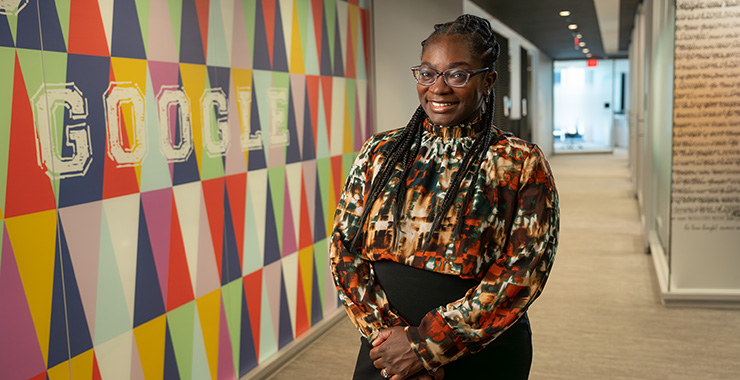
Applied cognitive psychologist Melissa Smith, PhD, is studying the best ways to help companies and organizations do that as a senior user experience (UX) researcher at Google Workspace, based in Raleigh, North Carolina. The group designs and integrates Google’s vast suite of productivity tools, including Gmail, Google Docs, and Google Meet, into a cohesive service. Using the latest cognitive science, Smith and her team are building more intuitive, user-friendly programs, such as the mobile versions of popular applications like Google Drive and Calendar. Their goal is to boost both employee performance and well-being.
Smith underscores the need for workplaces to adapt to AI and other emerging technologies. She sees these advances not as threats to replace people but as tools to aid in mundane or risky tasks, enabling people to prioritize what truly defines human work: collaboration and creativity. “The beauty of user experience research is discovering what makes someone care deeply about a product, then developing that technology to support their learning and growth,” said Smith.
The Monitor talked with Smith about how she came to UX research and its implications for the future workforce.
How do your team’s strategies and goals stand out from those of other companies developing tools to improve how people work?
Google Workspace products have always been known for their collaborative nature. When I was in early college and Google first introduced Docs, it was revolutionary to be able to have multiple people working on one document at the same time. Today, those collaborative features are an industry norm, and our team is still pushing the cutting-edge boundaries of collaborative work. We are currently incorporating generative AI features across Gmail and Workspace to simplify organization tasks. Soon, you will be able to use Gmail’s side panel to summarize emails and highlight the most important action items. Also, the “Help me write” feature in Gmail and Docs, which uses AI to draft messages based on your prompts, will support Spanish and Portuguese.
Our team also prioritizes tech accessibility as we build new features, making sure that we don’t inadvertently exclude people who, for instance, rely on screen readers or high-contrast screens to interact with our services. Accessibility considerations can be easily overlooked if you don’t actively engage with the many types of consumers who use your services. There are always opportunities for us to improve in creating technology that caters to people with diverse needs or disabilities.
How is your research at Google enhancing employee well-being and shaping how the next generation will work?
User experience research is vital in product development because we are actively incorporating the voices of customers and users. My work focuses on talking with people who use our products to accomplish the diverse tasks relevant to their roles. For example, the needs of a general consumer using our products to complete schoolwork or organize family events differ from those of a small business owner who uses Google Workspace to manage a team.
By making productivity tools more user-friendly, our services streamline workflows and reduce employee stress. Overly complex software and information overload can cause mental fatigue. If we can simplify these processes and present information more clearly, we can help workers focus on essential tasks. This is especially important as workplaces increasingly adopt hybrid work models and communication among workers is fragmented. Our research helps us develop products that better support remote work, such as improved virtual collaboration and scheduling tools that help employees maintain work-life balance.
For example, my team has gained valuable information from users about the importance of seamless connection across multiple platforms and devices which has inspired us to improve the mobile interface for Google Workspace products. Just 5 years ago, I would have never opened a Google Doc on my phone. Now, mobile Docs is far more accessible and offers expanded features for collaboration among employees working from many different locations and platforms.
What led you to user experience research?
During middle school and high school, I was involved with a nonprofit organization called FIRST, which fosters excitement for science and technology among K–12 students through annual robotics competitions. It’s been more than 20 years since I first participated in the program, but that excitement hasn’t stopped. I serve on the FIRST Robotics board and help connect FIRST students with alumni at Google.
One of my goals is to show students the diverse STEM (science, technology, engineering, and mathematics)-related careers available to them, beyond the already well-known roles like engineer, lab scientist, or doctor. This is partly influenced by my own experiences. I spent my undergraduate years as a mechanical engineering major because I wanted to work in robotics. But when I discovered human-robot interactions, I found that exploring how people engage with and trust artificial agents, and how robots can improve human lives, interested me far more. So, I changed my major and pursued a PhD in applied cognitive psychology and eventually realized that my research interests aligned with the user experience field.
Your dissertation looked at people’s trust in automation and robotics. How do you bring that knowledge into your current work?
No matter what the technology is—you could insert whichever technology buzzword you want, whether it’s AI, machine learning, or big data—people’s fundamental approaches to adopting new systems follow a similar pattern. There will be the early adopters, who embrace the new technology and trust it even if it’s still being workshopped. Then, there is a larger chunk of intermediary users, who prefer to test the waters and wait for the technology to take off before they immerse themselves in it. Finally, there are the people who resist change altogether—the “if it’s not broken, why fix it?” users, who probably wouldn’t mind using an old-school flip phone.
That research taught me that you need to adapt to each set of users. I emphasize that perspective in every product my team creates because most of us on the development team belong to that first group, who generally trust and understand technology. But we aren’t representative of most consumers, so it’s essential to reach out to our end users, not to convince them to trust our product but to hear their concerns so we can build a product worth trusting.
How will AI continue to influence UX research?
AI is unique in that it doesn’t just offer incremental improvements over existing technologies; it represents a whole new paradigm in how people think about and interact with technology. Consequently, we need to exercise much greater caution when building new products and proactively anticipate how users will interact with these systems. At the same time, AI opens many more opportunities to create magical moments—to push productivity, problem-solving, and collaboration forward. That kind of entirely new technology hasn’t emerged in many years, so it is an incredibly interesting time to be a user experience researcher.