Key points
- Unionization is at a high, and employers and employees are facing off over where-to-work mandates.
- There’s an urgent need to build psychologically healthy workplaces that respect differences in how different generations view work.
- Psychologists see a disconnect between how people think they should feel about their jobs (passionate and fulfilled) and how they actually feel (bored or disillusioned).
Five years after the start of the Covid-19 pandemic, working life in America remains fractured. Psychologists who focus on the workplace say employers and employees in traditionally office-based jobs are facing off over where-to-work mandates, colleagues are clashing over generational norms, and workers are battling internally to find work that aligns with their values but doesn’t consume their identities. Nowhere is this workplace tension more evident than in the resurgence of union organizing, which has hit levels not seen since the 1960s, especially among younger workers.
“We are reaching a boiling point,” said Jessica Kriegel, EdDopens in new window, chief strategy officer at Culture Partners, a business management consulting firm.
But psychologists are also helping to cool the temperature by parsing out the nuances and similarities—not just stereotypes and differences—in diverse workers’ desires, studying how to maximize the benefits of new technologies and shifting work environments, and redefining best practices so that businesses and their people can thrive.
And there’s more work to be done, said Zhiqing (Albert) Zhou, PhD, an associate professor at the Johns Hopkins Bloomberg School of Public Health. “We need more interdisciplinary efforts to not only understand how work might contribute to impaired or better mental health but also to potentially design and implement changes in the workplace,” he said. “This will take efforts and contributions from researchers, practitioners, and policymakers all together.”
“We need to break this us-versus-them narrative,” added Megan Gerhardt, PhD, a professor of management and leadership at the Farmer School of Business at Miami University in Ohio. “We’re not on different sides. We’re all in organizations pursuing shared goals and visions. We [just] might have different ideas about how to get there or the priority we put on certain ways of working.”
Employees and employers clash
Look no further than unionization efforts—and successes—for real-world proof of the disconnect between employees’ and employers’ work-life expectations. From Trader Joe’s and Barnes & Noble to news organizations and the auto industry, employees are organizing in record numbers to demonstrate their mistrust of management and demand more.
One Gallup poll, for instance, found that 67% of Americans now approve of unionsopens in new window, and another showed that 88% of those under 30 see unions in a positive lightopens in new window. “We’re renegotiating that view of what we think is reasonable to expect, and I think workplaces are trying to figure out how to respond to that,” Gerhardt said.
Some of that renegotiation is around where to work. When Amazon, for one, announced its return-to-office mandate, which requires that all employees must work full-time in the office beginning January 2025, many employees were outraged. One survey conducted days after the announcement found that 73% said they were considering finding another job to avoid complyingopens in new window with the policy.
Not that the company, or the many others expected to follow suit, really care, said Kriegel, whose doctoral research focused on human resources development, educational leadership, and management. “These big companies are not worried about losing workers—they welcome it; they’re overstaffed,” she said. “They are all going to be downsizing from here on out.”
Psychologists are redirecting the debate by gathering data and pointing to evidence showing what really works for office-type jobs that can be done remotely.
In one 2024 study in the journal Nature, for instance, researchers randomly assigned 1,612 employees of a Chinese technology company to work from the office either 5 days a week or 3 days a week. After 6 months, the study authors found that the hybrid model improved job satisfaction and reduced quit rates by one third, with no effect on performance or promotions (Bloom, N., et al. Nature, Vol. 630, 2024opens in new window).
That’s not to say hybrid or remote work is flawless. Elizabeth Marsh, PhDopens in new window, a researcher in England’s University of Nottingham’s School of Psychology, has studied some of the “dark side effects” of a digital workplace. She found that workers can struggle to manage both “information overload” from technology (think nonstop Slack messages and Zoom meetings) and the “fear of missing out” on information if they don’t stay technologically engaged. (Marsh, E., et al. Sage Open, Vol. 14, No. 3, 2024opens in new window).
“Technology has really eroded our boundaries—that was true prepandemic and that’s really gotten true since the pandemic,” says Jason Wang, PhD, a therapist and owner of Inflection Points Therapyopens in new window in Washington, DC, who specializes in working with patients with career issues. “We proliferated the number of tech tools needed to communicate with each other during the pandemic, and a lot of those haven’t been pulled back.”
One related outcome: micromanagement. In one study conducted during Covid, for instance, Zhou and colleagues found that remote workers reported higher self-regulation at work and better work outcomes when supervisors were equally supportive and offered a sense of control. If supervisors’ behaviors weren’t balanced, though, workers did better if their bosses offered more support than control (Gan, J., et al. The International Journal of Human Resource Management, Vol. 34, No. 15, 2023opens in new window).
At the same time, many workers are lacking direction in the place they need it: the use of artificial intelligence (AI). In APA’s 2024 Work in America survey, 35% of workers said they’re using the technology at least monthly to assist on the job, but only 18% reported knowing that their employer has an official policy on how to use AI appropriately.
Instead of simply waiting for a consensus about the best use of digital tools, some strategies can help remote workers take their workplace well-being into their own hands. In another 2024 study, Marsh and colleagues found that both digital mindfulness (like consciously taking screen breaks and being aware of how technology is affecting you emotionally and physically) and digital confidence (feeling capable of using said technology) protected digital workers against stress, anxiety, and overload (PLOS ONE, Vol. 19, No. 2, 2024opens in new window).
“That process of reflection on our digital practices is one of the strongest things [we can do]—not ‘we should or shouldn’t’ do certain things,” Marsh said.
An intergenerational workforce
There are also rifts between workers themselves who are operating in a five-generation workforce, Gerhardt said.
In APA’s 2024 Work in America survey, 32% of U.S. workers said they felt that colleagues of different ages didn’t see the value in their ideas. That was especially the case for 18- to 25-year-old employees, nearly half of whom felt that older coworkers didn’t appreciate their insights. Still, 92% of all workers said they appreciated the opportunity to work with people of different ages.
Generations differ in their workplace behaviors and expectations, too. Tessa West, PhD, a professor of psychology at New York University and author of Jerks at Work: Toxic Coworkers and What to Do About Them and Job Therapy: Finding Work That Works for You.
“Young people who embrace the ‘slow life’ strategy care less about being unemployed—even the ones that have no money,” she said. “They will quit out of unhappiness in a way that other generations never would have fathomed doing.”
Gen Z also expects their mental health to be a priority for their superiors, not relegated to something you leave at home, finds Gerhardt, coauthor of Gentelligence: The Revolutionary Approach to Leading an Intergenerational Workforceopens in new window and founder of a company by the same name. One survey by the Society for Human Resource Management, for instance, found that 61% of Gen Z respondents said they’d strongly consider leaving their job for one with significantly better mental health benefits.
Gerhardt said their mentality is understandable. Young people who started their first jobs remotely during Covid may not have realized that a supervisor’s frequent mental health check-ins were situational, not standard. They may also struggle to comprehend “returning” to an office they’ve never seen. “The anchor is always interesting—what lens are you using? And then it’s not right or wrong, it’s just different,” Gerhardt said.
And while companies can’t and shouldn’t necessarily bend to every new generation’s demands, they can recognize that often what’s good for young workers is good for middle-aged and older workers too. For example, APA’s Work in America data show psychological safety at work—or feeling comfortable expressing yourself without fear of negative consequences—is linked to feelings of belonging in the workplace. That cuts across generational lines.
“Research shows across generations we have very similar intrinsic needs: We need to feel respected; we need to feel connected. Where we’re getting hung up is how one fills those needs,” Gerhardt said. “We need to break that toxic ‘we’re hesitant to hire Gen Zopens in new window’ narrative and say, ‘How do we build psychologically healthy workplaces that respect the fact that there’s going to be some differences in the ways people have viewed work or the ways that they want to integrate work into their life?’”
A job, career, or calling?
Even individuals face sometimes seemingly paradoxical desires when it comes to designing their work lives. One of Wang’s patients, for example, struggles to reckon his need to make a living with his socially conscious nature.
“He wants to be able to live a good life, but at the same time, he feels really uncomfortable working within a system that demands productivity and all of these capitalistic ideas that he doesn’t subscribe to in terms of an ideology,” Wang said.
Similarly, psychologists also often see a disconnect between how people think they should feel about their jobs (passionate and fulfilled) and how they actually feel (burned out or disillusioned). One survey found that nearly 90% of millennials and Gen Z respondents, for instance, say that finding work they feel passionate about is their top career priority. At the same time, APA’s 2024 Work in America survey found 67% of workers experienced a lack of interest, low energy, or feeling isolated at work in the past month.
“Society has really pushed the idea, at least recently, that our work should be a calling—it should be more than a job or a career—and I challenge that notion,” Wang said.
But social media continues to drive this often-unrealistic expectation. One 2024 study of 1,204 Chinese college graduates found that social media use, and particularly upward social comparison, predicted employment anxiety (Jin T., et al. Frontiers in Psychology, Vol. 15, 2024opens in new window).
“We’re finding people in this kind of danger zone when they’re chasing this passion-driven narrative,” West said. “Then when it’s not going well, it absolutely crushes them. And because they don’t have a healthy psychological distance from their career, they don’t know what to do, and so they panic, and they start job hunting.”
One key to creating that psychological distance could be to truly understand what the day-to-day details of many office-based jobs look like: emails, meetings, and spreadsheets—not making world-altering decisions, West said.
“You can be highly engaged with your job, and you can find passion for it [when] you’ve actually created some more psychological distance from it,” she said. “I’m starting to come around to this idea that psychological distance from your career is a necessary condition to finding love in places that you’re not necessarily looking.”
Reducing burnout
A new guide for reimagining workplace resilience
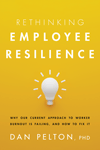 Coming in May, the new APA book Rethinking Employee Resilience: Why Our Current Approach to Worker Burnout is Failing, and How to Fix It by psychologist Dan Pelton, PhD, offers a set of practical guidelines that organizations can adopt to foster workplace resilience. “In modern workplaces, adversity is a constant,” said Pelton. “Overwork, cognitive overload, emotional exhaustion, and a lack of transparency are just some of the stressors that can either break us or make us stronger. But one thing is clear: Adversity changes us. So, why not harness it to build a resilient culture?” Read more about Pelton’s work.
Further reading
Job therapy: Finding work that works for youopens in new window
West, T., Portfolio, 2024
Violence and aggression against educators and school personnel, retention, stress, and training needs: National survey resultsopens in new window
McMahon, S., et al. American Psychologist, 2024
Gentelligence: The revolutionary approach to leading an intergenerational workforceopens in new window
Gerhardt, M., et al. Rowman & Littlefield Publishers, 2021
The digital renaissance of work: Delivering digital workplaces fit for the futureopens in new window
Miller, P., & Marsh, E., Digital Workplace Group, 2017